

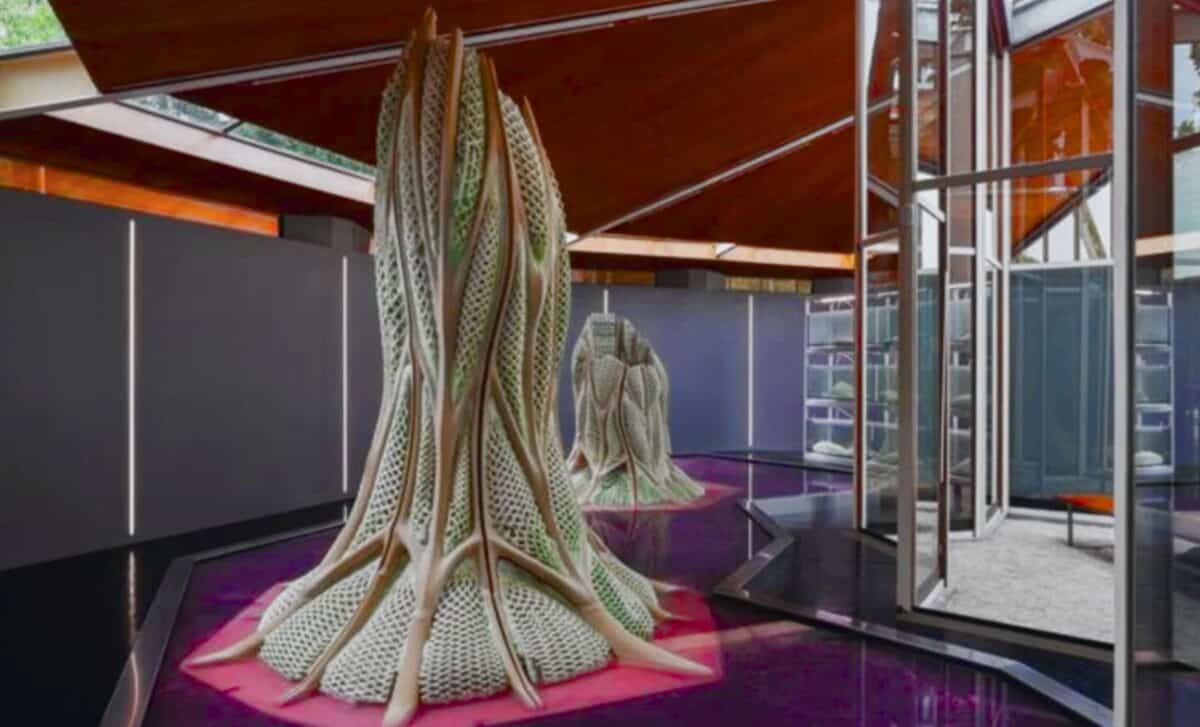
For the next nine months, caretakers inside the Canada Pavilion at the 2025 Venice Architecture Biennale will tend to something unusual: the walls themselves. The installation, called Picoplanktonics, consists of 3D printed architectural structures embedded with living cyanobacteria that require calibrated light, humidity, and temperature to survive. If the organisms die, the installation fails.
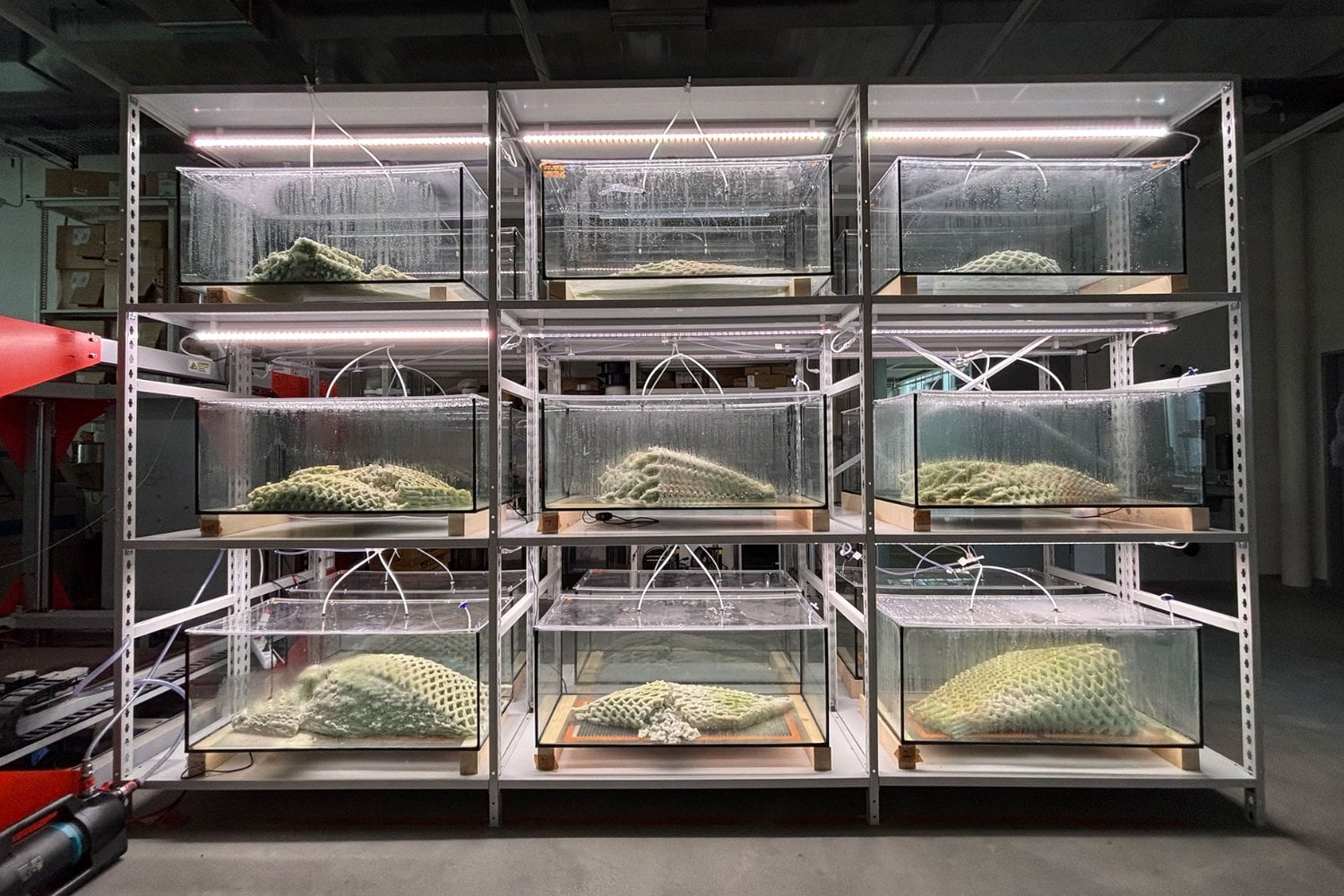
Several kilometers away, in a laboratory setting that operates on vastly different timescales, researchers have been tracking similar cyanobacteria embedded in hydrogel for more than 400 days. A study published in Nature Communications detailing the dual carbon sequestration process shows these encapsulated organisms continued capturing carbon dioxide throughout that period without active intervention beyond nutrient replacement.
The organisms were not merely surviving. They were slowly transforming their surroundings, precipitating calcium carbonate that accumulated within the material and potentially strengthened it over time.
Carbon Capture Through Dual Biological Pathways
The Nature Communications study, led by researchers engineering photosynthetic living materials, quantified two distinct carbon sequestration mechanisms operating simultaneously within cyanobacteria laden hydrogels. The first is biimass accumulation: as the Synechococcus sp. strain PCC 7002 cells multiply, they fix atmospheric CO₂ into organic compounds through photosynthesis. The second involves microbially induced carbonate precipitation, a process in which the organisms create alkaline conditions that cause dissolved calcium and magnesium ions to precipitate as insoluble carbonates.
Data from the study shows the living materials sequestered 2.2 ± 0.9 milligrams of CO₂ per gram of hydrogel over the first 30 days of incubation. Extended observation over 400 days yielded cumulative sequestration of 26 ± 7 milligrams per gram. The researchers designed the hydrogel matrix using Pluronic F-127 modified with urethane methacrylate groups, which permitted both extrusion based 3D printing and subsequent photo crosslinking for structural stability. Optical transmission measurements indicated the hydrogel transmitted 76 ± 3 percent of visible light, declining to approximately 30 percent after bacterial encapsulation.
Calcium staining of samples over the incubation period showed progressive accumulation of precipitates throughout the hydrogel volume. Control samples without cyanobacteria showed no such accumulation. The report notes that the mineral phase mechanically reinforces the living materials and stores sequestered carbon in a more stable form than biomass alone.
Architectural Demonstration Tests Material Limits
The Picoplanktonics installation at the Venice Biennale, documented by ArchDaily in May 2025, represents the largest known architectural structure composed of living materials, according to the Canada Council for the Arts, which presents the pavilion. Developed over four years by the Living Room Collective, a group comprising architects, scientists, and educators, the installation uses a biofabrication platform developed at ETH Zürich capable of printing living materials at architectural scale.
The exhibition space has been modified to accommodate the biological requirements of the cyanobacteria. Officials said caretakers will remain on site for the duration of the exhibition, underscoring the role of long term stewardship. The installation runs until November 23, 2025.
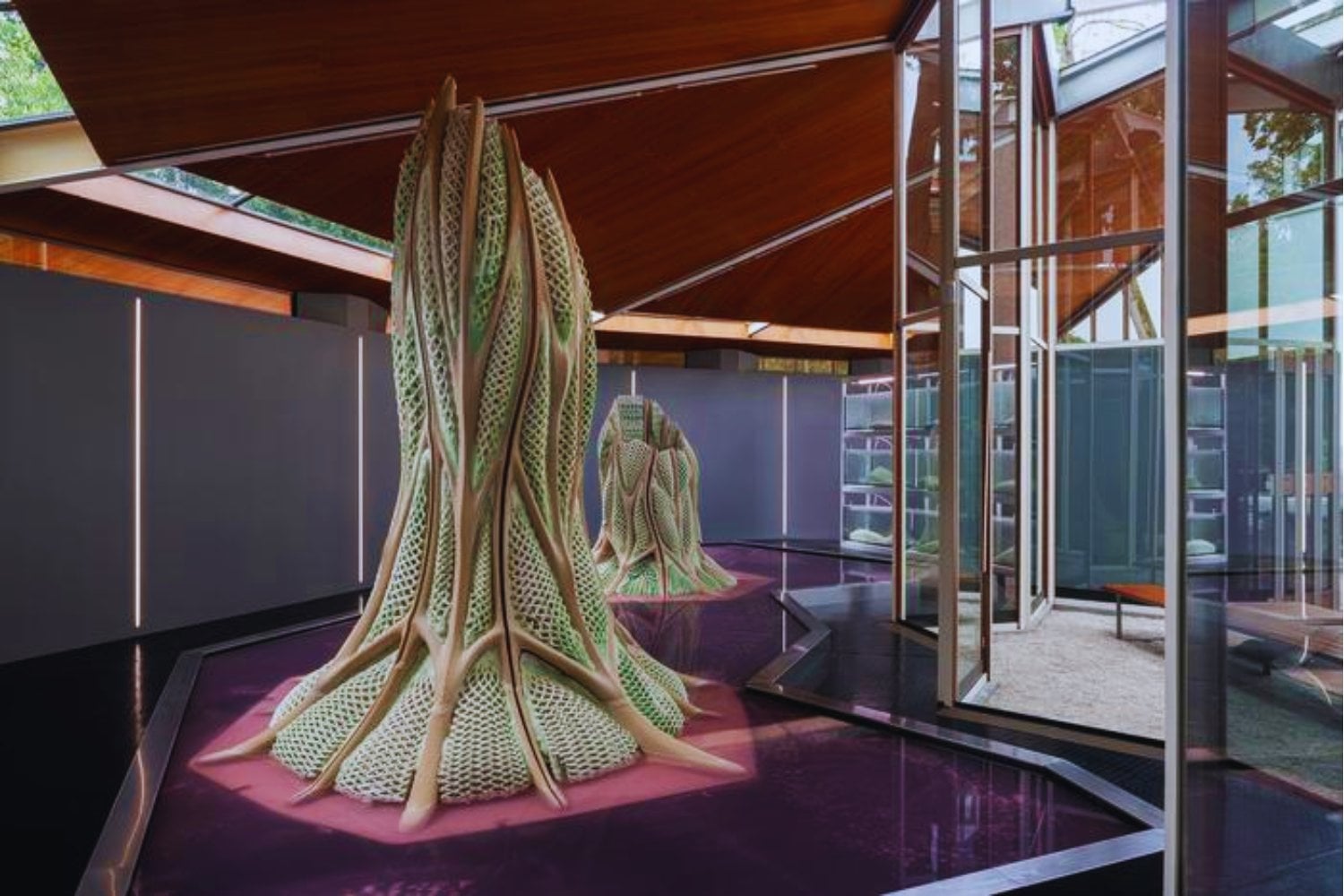
Andrea Shin Ling, the Canadian architect and biodesigner leading the collective, said in materials accompanying the exhibition that the project investigates the potential of co constructing built environments with living systems. The team seeks to transition away from extractive models of production by developing design methods grounded in natural systems.
The structures themselves serve as both demonstration and experiment. Because the organisms must remain viable throughout the exhibition, the project tests whether architectural scale living materials can be maintained over months rather than days.
Quantified Performance and Current Constraints
The laboratory data establishes baseline performance for these materials under controlled conditions, but the numbers also reveal the scale of the engineering challenge. Extrapolating from the 30 day data, a metric ton of hydrogel material would capture approximately 2.2 kilograms of CO₂ per month under optimal light and nutrient conditions. Achieving meaningful atmospheric impact would require material volumes far beyond current fabrication capabilities.
The Nature Communications researchers explicitly note that biological carbon sequestration through such systems is typically slower than industrial carbon capture methods, which require energy intensive conditions and proximity to emission sources. The advantage of the living materials approach lies in passivity: once fabricated and installed, these systems require no external energy input and produce no toxic byproducts.
This contrasts with other biological approaches to material reinforcement. The report notes that ureolytic microbially induced carbonate precipitation, while attractive due to short incubation periods, poses substantial environmental concerns due to associated production of large amounts of ammonia. Ureolytic MICP also requires constant urea supply. Photosynthetic MICP requires no additional feedstocks and produces no toxic byproducts.
Material Behavior over Extended Timelines
Neither the laboratory research nor the architectural installation resolves fundamental questions about how these materials would perform over decades rather than months. The Nature Communications data shows biomass accumulation reaching a plateau after approximately 25 days, suggesting an eventual steady state between growth and mortality that would limit continued carbon uptake. Whether periodic harvesting or structural redesign could extend the sequestration period remains uncharacterized.
The researchers observed that the mineral phase accumulating within the hydrogels mechanically reinforced the living materials over time. This suggests potential for self strengthening construction materials, but whether this reinforcement follows predictable engineering parameters remains to be determined through extended testing.
First Appeared on
Source link






Leave feedback about this