

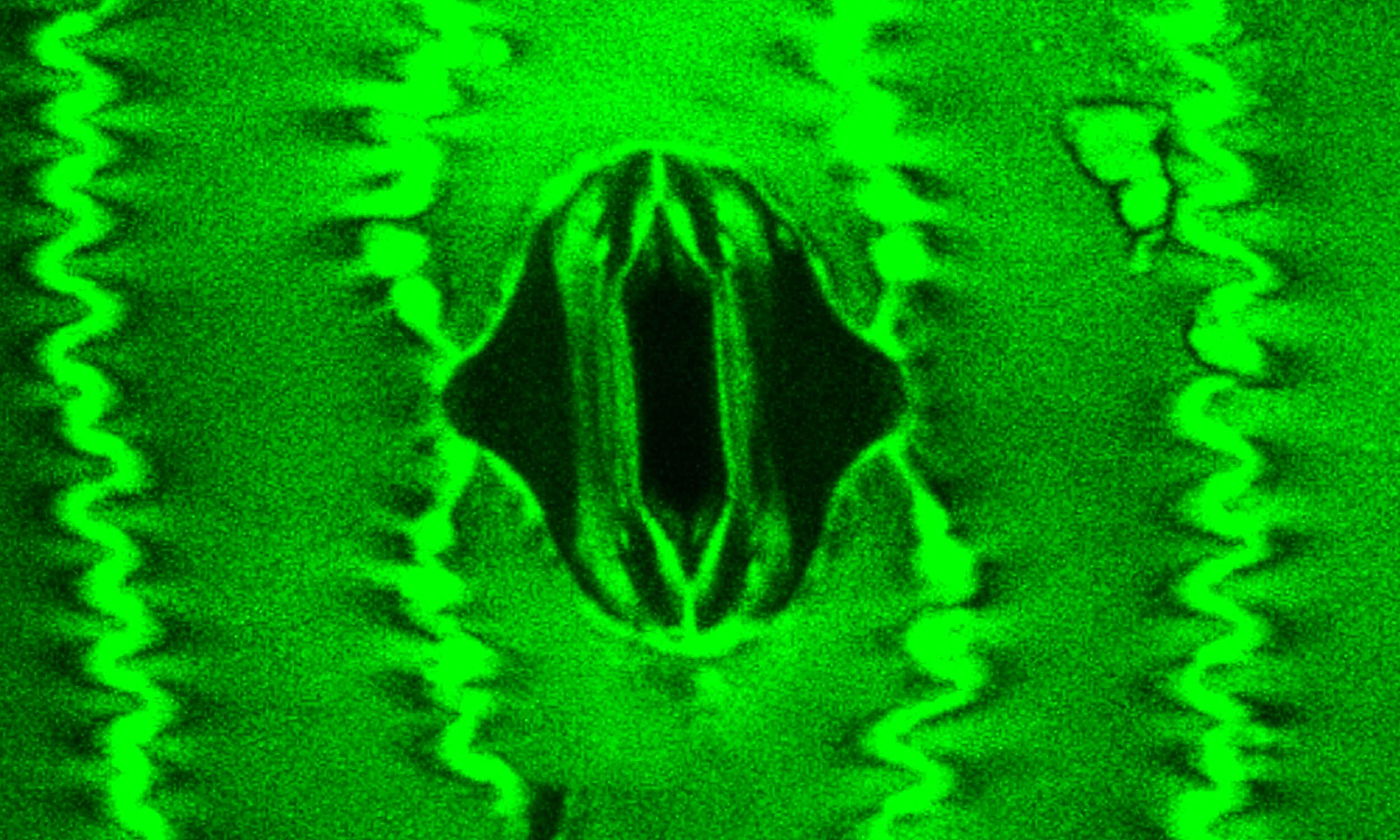
For the first time, scientists can watch how plants “breathe,” regulating air and water in real time, pore by pore, as conditions change around them.
A new system developed in Urbana, Illinois, links live leaf imaging with gas measurements – capturing the behavior of dozens of pores at once.
How leaf pores work
Leaf stomata, tiny pores that open and close on leaves, open when surrounding cells swell with water, letting carbon in but leaking vapor.
The work was led by Professor Andrew D.B. Leakey at the University of Illinois Urbana-Champaign (UIUC).
His team tracks how crops handle heat, drought, and rising carbon dioxide, linking leaf biology to yields in the field.
Limits of traditional microscopy
Microscope views can look beautiful, but they often miss the changing air, light, and humidity that stomata sense quickly.
“Traditionally, we’ve had to choose between seeing the stomata or measuring their function,” explained the researchers.
That choice limited what scientists could learn about how leaf pores respond to real-world swings in weather.
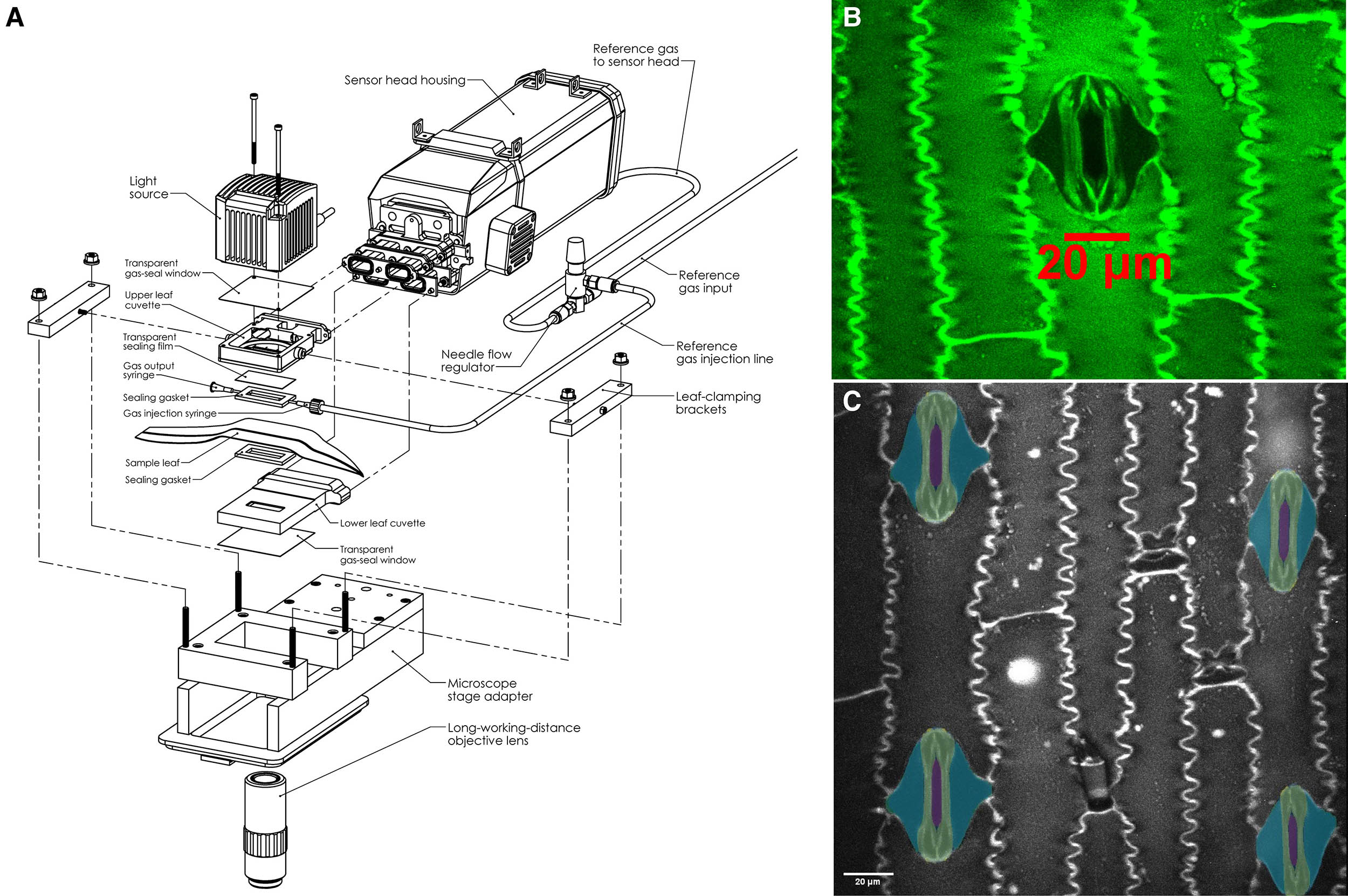
At UIUC, the Stomata In-Sight system joins a laser microscope, gas sensors, and a sealed chamber in one routine.
By controlling light, temperature, humidity, and carbon dioxide, the chamber keeps the leaf stable while cameras and sensors record together.
Because those measurements happen at once, the system can tie a pore’s motion to the exact gas flow it produced.
Imaging live leaves
Confocal microscopy, laser scanning that builds crisp optical slices, lets researchers measure pore openings in living leaves without cutting tissue.
Lasers excite natural leaf light signals, and software rebuilds a three-dimensional view so pore edges stay clear while conditions change.
This approach keeps pores in their working state, but it also demands steady mounting so vibration does not blur the frames.
Measuring carbon and water
Gas sensors track carbon dioxide entering and water vapor leaving the leaf, creating a running tally of gas flow.
The system seals a small patch of leaf, then compares gases in and out, so differences reveal uptake and loss rates.
Without matching images, those numbers average across tens of thousands of pores, which can hide uneven behavior across a leaf.
Creating steady conditions
Environmental control matters because pores react within minutes when light or humidity changes, even if the plant looks unchanged.
Inside the chamber, researchers can set air temperature near 82 degrees Fahrenheit (28 degrees Celsius) and humidity near 70 percent.
When conditions stay steady, a change in pore width points to biology, not a sudden draft or stray heat.
Automating stomata analysis
Machine learning software traced pore outlines in images without a person drawing each one.
In tests, the automated measurements matched human readings closely for pore area, though the software tended to run high.
Because models learn from training images, new crops or new cameras will require fresh training before the results stay reliable.
Getting reliable numbers
Sampling too few pores can skew the average, especially when many pores are fully closed under some conditions.
The team used repeated resampling to pick a practical target, then captured dozens of pores each time conditions settled.
That choice kept uncertainty small enough to compare treatments, while keeping imaging fast enough for routine experiments.
Light and carbon dioxide tests
The team’s first UIUC experiment exposed a single maize leaf patch to five stable light and carbon dioxide conditions.
In darkness, nearly all pores remained closed, but they opened wide under bright light and low carbon dioxide.
Those responses matched the gas readings, showing that pore movements tracked the leaf’s changing demand for carbon.
When averages hide the story
Pore openings did not settle around a single average, and some remained closed even as nearby pores opened.
That variation matters because averages can hide groups that respond quickly, slowly, or not at all.
With direct images, future studies can test whether uneven opening reflects local signals, slow adjustment, or limits of measurement.
Modeling whole-leaf behavior
A model converted measured pore sizes and pore counts into a predicted gas flow rate for the leaf patch.
When the researchers compared those predictions with sensor readings, the match stayed strong across the full range of treatments.
That link helps explain how pore size and pore density work together, instead of forcing scientists to guess from totals alone.
Saving water in crops
Irrigation uses a large share of freshwater withdrawals in the United States, and drought can cut yields when evaporation outpaces roots’ supply.
Water use efficiency, carbon gained per water lost from leaves, rises when pores admit enough carbon while slowing vapor loss.
By linking pore motions to gas costs, the system could help breeders spot plants that save water without starving growth.
Engineering traits without surprises
Changing pore number or pore size can backfire, because plants may compensate by opening wider or staying open longer.
Work in sorghum showed that reducing pore density improved drought performance, yet the best lines still depended on careful trait balance.
Systems that watch pores and gases together can reveal those compensations early, before a promising trait fails outside the lab.
Across microscopes, sensors, and controlled air, the system turns pore behavior into numbers that models and breeders can use.
Future work will need to test more species and longer stress periods, but the same framework can keep experiments comparable.
The study is published in the journal Plant Physiology.
—–
Like what you read? Subscribe to our newsletter for engaging articles, exclusive content, and the latest updates.
Check us out on EarthSnap, a free app brought to you by Eric Ralls and Earth.com.
—–
First Appeared on
Source link





Leave feedback about this