

Photo: Schubert/ROW Pictures/Walker+Worm Film/Gerald Kerkletz
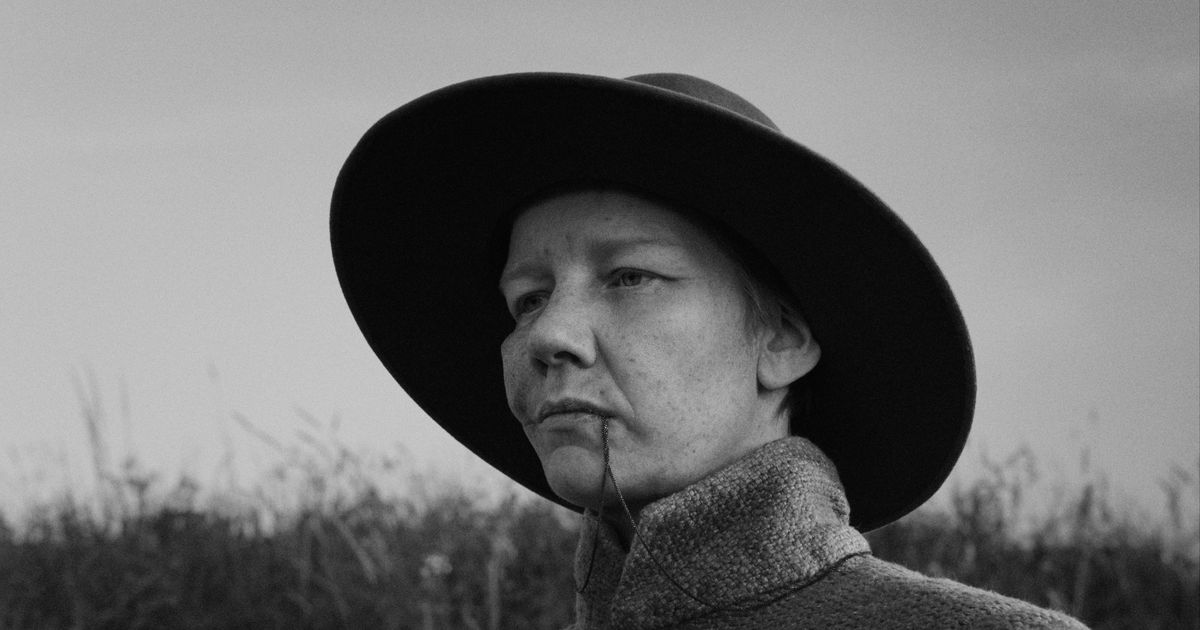
In Markus Schleinzer’s Rose, the lead character, played by the mesmerizing Sandra Hüller (Anatomy of a Fall, The Zone of Interest, Toni Erdmann), never utters her real name, nor is she ever asked it. The narration (spoken with dry, devastating efficiency by Marisa Growaldt) calls her Rose, but among the characters she is simply referred to as “the Master” and spends most of the film posing as a man. (We never learn what his name is either.) The mutability of identity thus subtly looms over the entire movie, in sharp contrast with the film’s hard-edged austerity. The setting is an isolated 17th century farming community in the wake of the Thirty Years’ War, but the specificity of the location and the period is a loose, general one. This is a desolate corner of Europe, divorced from history and context, and the spareness of the dialogue gives it an unearthly quality; it could be medieval Russia or the surface of the Moon, for all we really know. The film, which premiered at the Berlin Film Festival, is nevertheless rich in detail. Shot in luminous black and white, it delights in the textures of this life. Every piece of wood, every strand of rope, every rolled rock has a solidity that reinforces the idea that this world is made up of never-changing facts. We imagine the people here have lived like this for hundreds of years, and may well do so for hundreds more, which helps explain their fear of anything that doesn’t match their experience.
We first meet Rose as she’s returning from the savagery of war, a huge scar across her face. As a soldier, she’d already been posing as a man for years, and she now arrives in a small village with papers laying claim to a sizable plot of land. The villagers regard her with suspicion, but she relates to them a childhood memory of the local chapel catching on fire after a lightning strike, and this satisfies them that she used to live here in her youth. The land needs to be worked hard, and the farm building itself is dilapidated. Rose throws herself into the labor and soon becomes a man of influence and means. Which of course means that a wedding is in order, and so she’s quickly betrothed to Suzanna (a delightful Caro Braun, alternately retiring and naively bold), the daughter of one of her partners. That’s when things get really interesting.
The story is fictional, but Schleinzer and co-writer Alexander Brom reportedly based it on numerous accounts of women posing as men during this period, and it has the ring of truth. That’s partly owing to the rigor of Schleinzer’s filmmaking, which matches the severity of this world. Not an image is wasted. Not a single line of dialogue feels unnecessary, or a subplot tangential. To convey the horror of war, he gives us one shot of a smoking field, and several shots of skeletons; we get it, immediately. Early on, as she works in the woods, Rose sees a bear casually wandering by, and freezes in place, absolutely motionless. The moment feels grounded in reality, but it could also be both a metaphor for her character and a stylistic apologia: She is determined to keep her head down and not attract any attention, lest her ruse be discovered, and the picture appears to have absorbed that lesson formally. The more spare the film is, the greater the depths it reaches.
Hüller is magnificent in the role, a still and stern figure whose vulnerability we can subtly sense. When she first arrives, Rose tells everyone that she wants to “try her luck in this glorious community,” and she seems to mean it.
There is lots of talk in this place of the sacred bond of community, of everyone working to try and build a life for themselves and each other. Rose perhaps buys into this idea more fervently than anyone else; it’s really her determination which gives the film its power. As well as its transcendence: The villagers view Rose as a mystery, and frankly, so do we, but this moves us more, not less. She occasionally chews on the flattened bullet that scarred her, which she’s fashioned into a necklace — proof of her toughness, perhaps, but also a sign of her anxiety. Much of what we know of her is revealed through the narration, which occasionally evokes Michael Hordern’s in Barry Lyndon, an omniscient voice that nevertheless feels like it too belongs in the past. The narrator tells us very little, but it’s all we need: The freedom Rose felt when she first tried on a pair of trousers; the relief, when it comes, “of no longer carrying her secrets alone.”
I don’t want to reveal too much of what happens in the film, but we do eventually hear more from Rose, and Hüller delivers one particular monologue with a fury that manages to be shattering without breaking the film’s period spell. It’s not a concession to supposedly enlightened modern viewers; rather, it feels like something someone in Rose’s position at the time would actually say. Watching Hüller, already a master of submerged heartbreak in so many previous parts, we might begin to suspect that we’re witnessing her greatest role yet.
First Appeared on
Source link



Leave feedback about this