

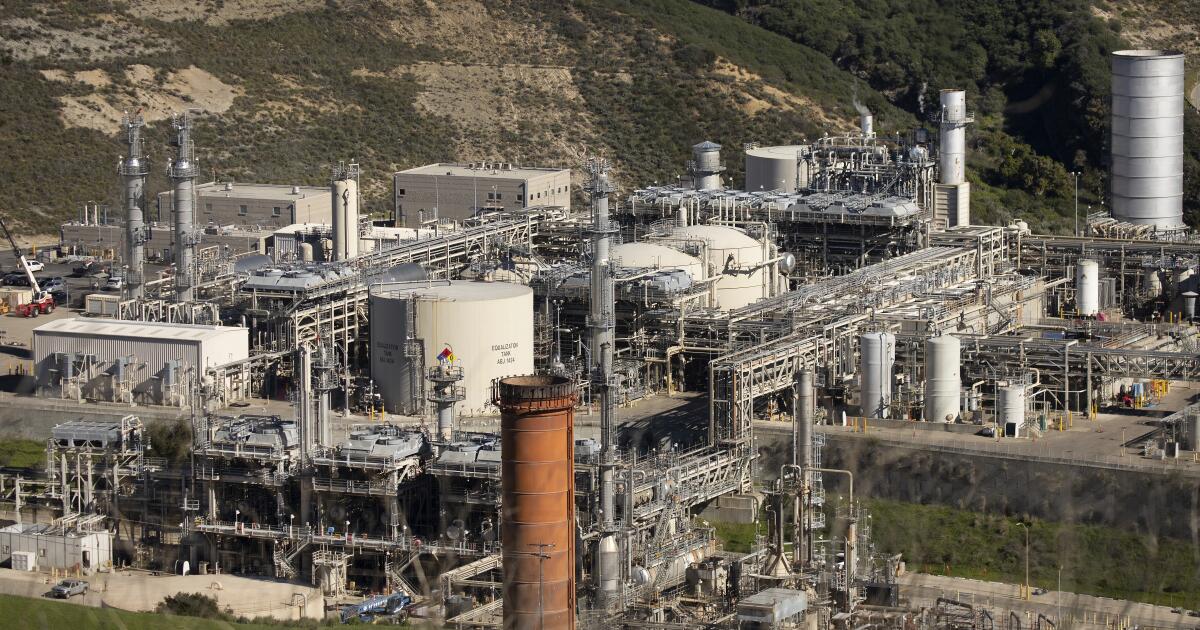
For the first time in more than a decade, offshore oil is again flowing through a controversial network of pipelines that run from California’s Central Coast to Kern County.
Following an executive order from President Trump last week, Sable Offshore Corp. announced Monday that it resumed oil flow through pipelines that run across Santa Barbara, San Luis Obispo and Kern counties. The infrastructure is part of an offshore oil operation that the Houston-based company has been trying to restart for more than a year.
The resumption of oil transport through the pipelines marks the latest escalation in a long-running battle between between California officials and the Trump administration over energy policy and safeguards.
The oil network had been closed since 2015, when a corroded pipe burst and caused one of the state’s worst oil spills. The so-called Santa Ynez unit was under different ownership at the time.
Sable had struggled to secure necessary approvals and permits from California regulators to restart the offshore oil operation. In the process, Sable has been accused of repeatedly ignoring the directives of state and local officials, as well as criminal acts related to California environmental and coastal laws.
On Friday, Trump and Energy Secretary Chris Wright invoked the the Cold War-era Defense Production Act and ordered Sable to restore operations at the Santa Ynez Unit, arguing that the nation’s energy needs supersede state and local regulations.
It’s a move that California officials have derided and already started to fight.
On Saturday, California’s Department of Parks and Recreation demanded that Sable “immediately remove the pipeline” from where it runs through Gaviota State Park, formally denying the company’s application to operate the line through that protected area.
The agency said it ceased its review of Sable’s project “due to Sable’s excessive drain on state resources and incompatibility of their project with the park unit.” The letter said the agency will “pursue legal action to defend the state’s property’s rights” if Sable didn’t respond with plans to imminently close down.
Given Sable’s announcement Monday morning that it had restarted operating the pipelines, a spokesperson for State Parks said the agency will “be taking further action” but declined to detail those plans.
The California State Lands Commission, which had been overseeing inspections of Sable’s offshore pipelines, called an emergency meeting Monday night to consider additional litigation addressing a possible violation of the federal consent decree that delegated oversight of the pipelines to certain state agencies.
Sable acknowledged the letter from California State Parks in its announcement Monday, but noted that it had filed a new lawsuit against the agency the day before. The suit, filed in federal court, seeks confirmation that Sable has the right to operate through the park under Trump’s executive order.
Sable remains tied up in several lawsuits with California officials and environmental groups over the pipelines, but this would be the first to test the authority of the Defense Production Act to override California laws, regulations and the federal consent decree.
Gov. Gavin Newsom has called Trump’s use of the Defense Production Act “an attempt to illegally restart a pipeline whose operators are facing criminal charges and prohibited by multiple court orders from restarting.”
The Center for Biological Diversity, an environmental nonprofit that has pushed for more oversight of Sable’s work, called the use of the DPA “radical and unprecedented.”
“The cynical misuse of a national security law for the benefit an oil company that has repeatedly broken the law is a shocking development, even from this administration,” Brady Bradshaw, senior oceans campaigner at the nonprofit, said in a statement. “The courts shouldn’t put up with this brazen abuse of power. … We’ll keep fighting as hard as we can to protect Santa Barbara’s coast and end offshore drilling in the state once and for all.”
Alex Katz, the executive director of the Santa Barbara-based Environmental Defense Center, said he worried not only about the precedent this could set, but also the climate concerns it brings.
“Critically, this operation brings back the largest single source of greenhouse gas emissions in Santa Barbara County, degrading our air quality and potentially adding millions of tons of carbon to the atmosphere every year,” Katz said in a statement. “A defective pipeline operating at high pressure with no legal guardrails is a threat to public safety, to our economy, and to the entire coast.”
Sable officials and the Trump administration, however, argue the project is essential for national security and will benefit consumers.
“Sable Offshore is putting California consumers first by increasing domestic supply of crude oil into the California market by approximately 17% and we look forward to continuing to execute as so ordered,” Jim Flores, Sable’s chief executive, said in a statement. “We look forward to working closely with the Department of Energy in fully complying with the DPA and working with the Trump administration to take all necessary steps to deliver the energy necessary for the security and defense of the country.”
Sable said it had resumed production at one of its three offshore oil platforms last May, but was unable to transport the oil through the onshore pipelines because of ongoing legal and regulatory blocks.
The company said it had 540,000 barrels of processed crude oil in storage as of this weekend, and it planned to bring its two other offshore rigs — all in federal waters — online by June.
Sable plans to begin sales by April 1 at a rate of 50,000 barrels per day.
“Sable is fully staffed and will continue to implement the conditions of the emergency special permit,” the company wrote in its update.
First Appeared on
Source link





Leave feedback about this