

The multiverse can be a black hole. While the concept of infinite parallel realities has been a staple of speculative fiction for a long time, in recent years, pop culture has frequently leaned on this idea for fan service. What if one version of your favorite character met a different one? What if a fateful death could be averted? What if familiar events could be remixed, with old stories repackaged in the guise of something new? It’s a setup that seems limitlessly vast, but often ends up curbing any traces of originality while flattening everything on screen with the suggestion that this is just one version in a limitless assortment of similar, slightly different permutations. It very much fits a corporate vision of “storytelling” where well-established intellectual property can be slightly altered without fundamentally changing or challenging anything.
Through its opening chapters, Romeo Is A Dead Man, the latest from SUDA51 and Grasshopper Manufacture, is quite self-aware about how much of a drag the multiverse can be. As a result, instead of being diminished by its space-time warping premise, it fully leans into absurdity, contradicting its own logic and throwing out any sense of continuity as it escalates to hilarious extremes; at its best, it understands that the ideal answer to this kind of cosmic convolutedness is to make us laugh.
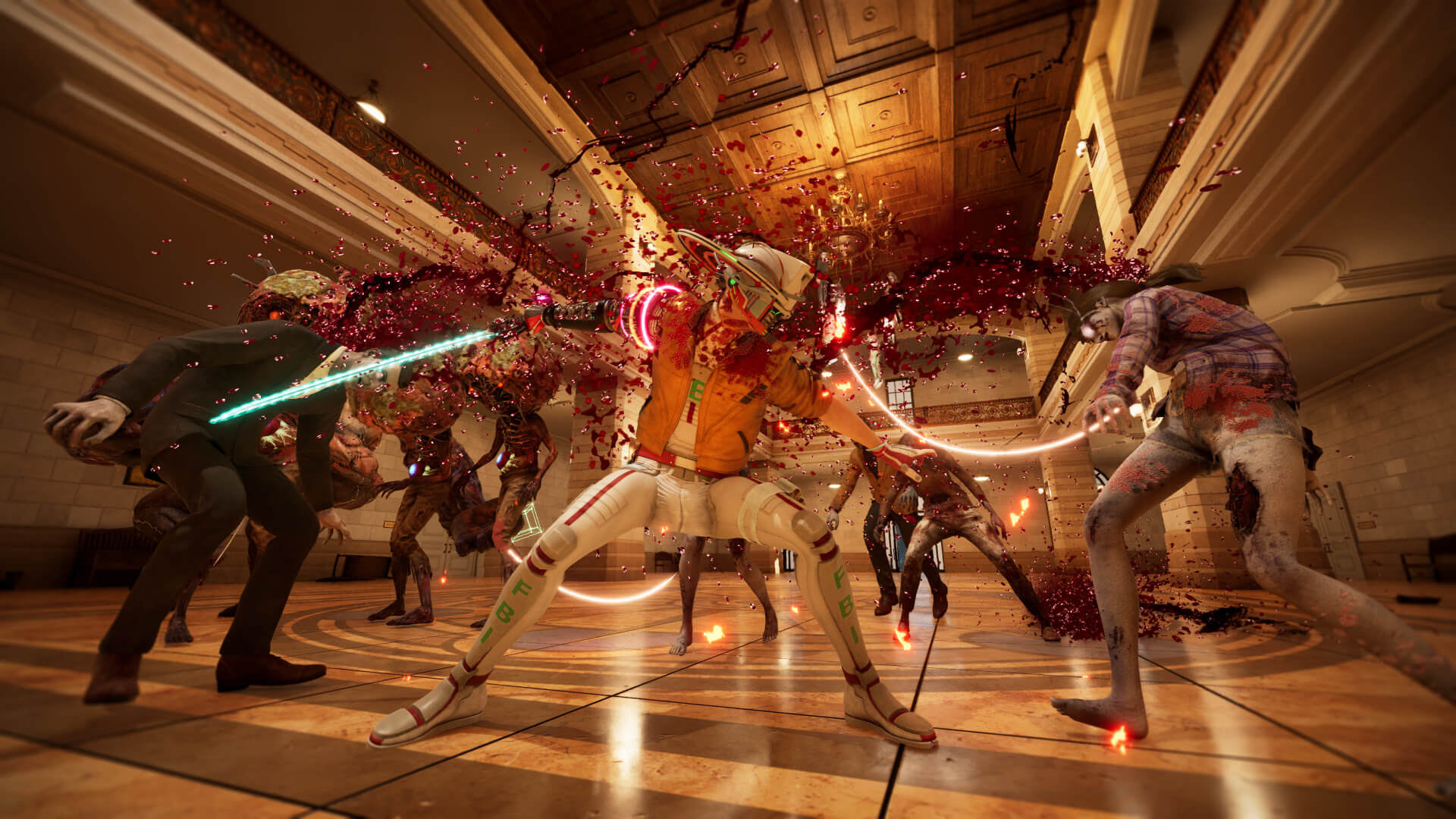
This tongue-in-cheek vibe is very present in the game’s mile-a-minute introduction. Romeo Stargazer is a conspiracy theorist and sheriff’s deputy in the small Pennsylvanian town of Deadford. His life is normal until one day, while on patrol, he is suddenly mauled by a pale monster that rips his arm and half his face off, leaving him for dead. Luckily, his grandfather (who has more than a slight resemblance to Doc Brown) suddenly appears on a time-traveling motorcycle and injects him with some strange substance that saves his life; after a trippy bit of hand-drawn animation, he’s transformed. He isn’t just Romeo anymore; he’s Deadman, a henshin hero-looking crime fighter.
While that all makes some amount of sense, this intro quickly begins to fold in on itself. The previously mentioned events were all a dream, but also not? A “Previously On” comic book recap tells us that Romeo is in love with Juliet (subtlety is for cowards, as SUDA51 has long believed), a mysterious woman who is also a harbinger of doom; after her appearance, reality was destroyed, leaving shards of specific times and places scattered throughout the cosmos. Also, Romeo’s grandpa, Professor Benjamin, died off-screen and is now a talking decal on the back of Romeo’s jacket. Our protagonist joins the FBI Space-Time Police to find his (sort of) girlfriend, hunting down her variants and other time criminals while trying to reunite with the “real” Juliet he knew before Deadford was scattered across four-dimensional space.
It’s a lot, man. The first 15 minutes play out at such an unhinged pace that it feels like a deliberate parody of confusing interdimensional storytelling. To get across this reality-hopping vibe, the game switches mediums and modes with abandon: The introduction goes from live-action diorama footage, to an in-game cutscene, to a 2D animated sequence, to a series of comic book illustrations. The Game Over screen is an all-timer stop-motion nightmare that may or may not be a reference to a face-melting moment from Raiders of the Lost Ark. When you return to base, the Space-Time Police’s mothership, the aesthetic switches to pixel art that’s completely different from the main game’s 3D visuals. Among other things, this base is home to an unusual leveling mechanic where you navigate a little creature through a maze to grab permanent upgrades; what if skill trees were replaced with retro arcade simulacrums?
Everything’s here, and it’s all swirling in an orchestrated chaos punctuated by optional dialogue with your crew, at least one of whom has absolutely no narrative impact outside of talking about Manchester United players (sorry, Liverpool fans). The nonsense logic isn’t just a one-off gag but is fundamental to a weirdly cohesive presentation that embraces pulp curiosities and fine art alike—there are references to Edward Hopper and Shakespeare, alongside professional wrestling finishers and The Clash.
First Appeared on
Source link





Leave feedback about this