

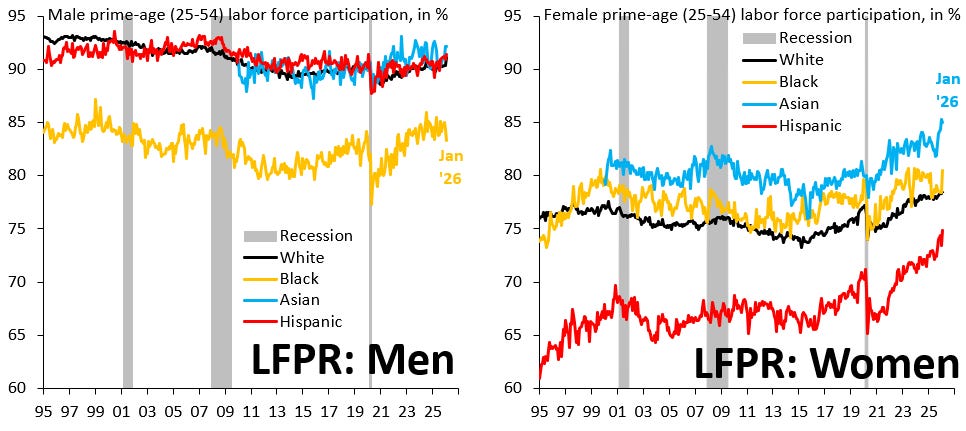
On Friday, I published a post about labor force participation rates across different segments of the US population. Across the board, participation is at historically high levels and rising, which isn’t the kind of thing you’d expect to see if we were teetering on the verge of recession. After all, you wouldn’t think people would be crowding into the labor market if it were getting harder and harder to find employment. If anything, you’d expect the opposite, i.e. “discouraged workers” dropping out of the labor force.
Some of my readers were quick to comment that looking at participation alone is only part of the story. Participation rates measure what portion of the population is in the labor force, but of course some of those in the labor force may be unemployed, so it’s better to look at employment-to-population ratios. Those factor in how many people in the labor force are actually employed, which means they’re a better measure.
This post gives a broader perspective of the US labor market. Black unemployment rates have risen, but this happened around a year ago and hasn’t spilled over to other population groups. There just isn’t a recession signal in the labor market.
The two charts above show labor force participation rates for prime-age men (left chart) and prime-age women (right chart). As I noted on Friday, participation rates are at historically high levels and rising. The only exception is participation among black men, but – since the drop here looks like it’s an outlier – this is most likely noise.
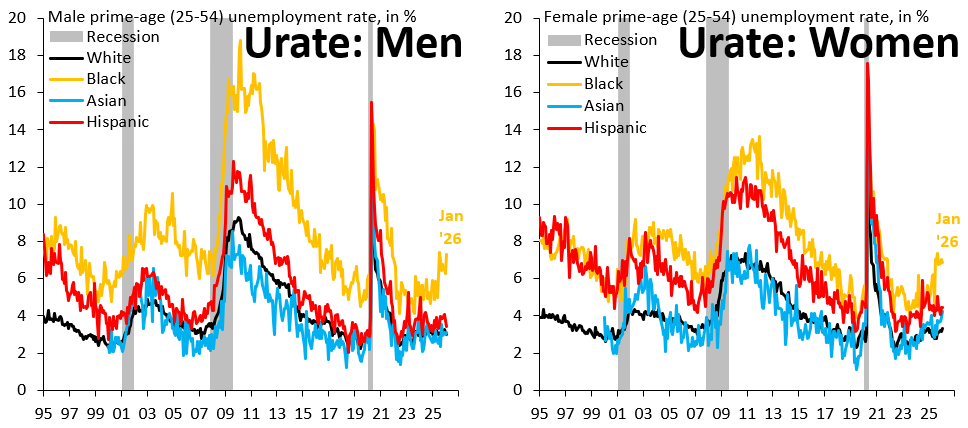
The two charts above show unemployment rates for prime-age men (left chart) and prime-age women (right chart). Unemployment rates are at historically low levels, but there is a pretty clear rise in black unemployment, which began in early 2025 and has persisted since then. It’s tempting to link this rise in unemployment to tariffs and volatile policies, but I’m not sure the timing works for that. Black unemployment started rising in February 2025. That just seems a little too fast for a Trump effect.
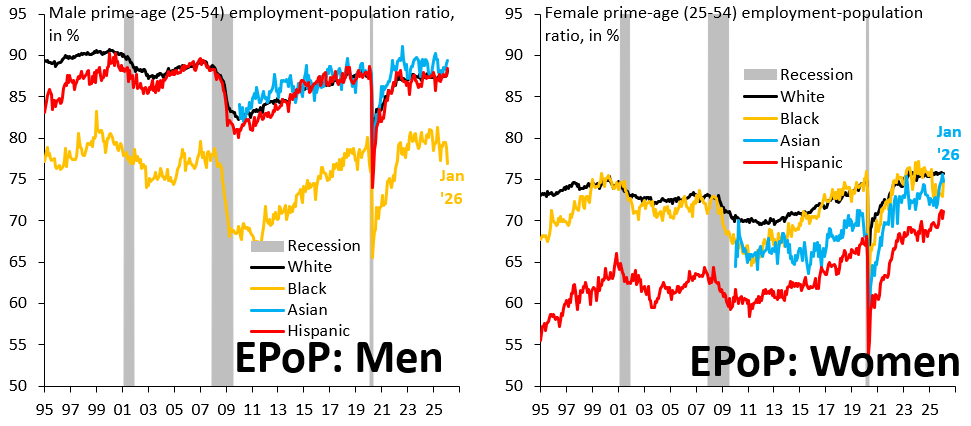
The two charts above put both of these things – participation and unemployment – together. The left chart shows the employment-to-population ratio for prime-age men, while the right chart shows the same data for prime-age women. There just isn’t a recession signal here. Employment is down for prime-age black men, but it’s at or near historical highs for every other population group. The bottom line – I think – is that the labor market is nowhere near as weak as anecdotes make it out to be. That also explains why private consumption remains so strong.
First Appeared on
Source link






Leave feedback about this