

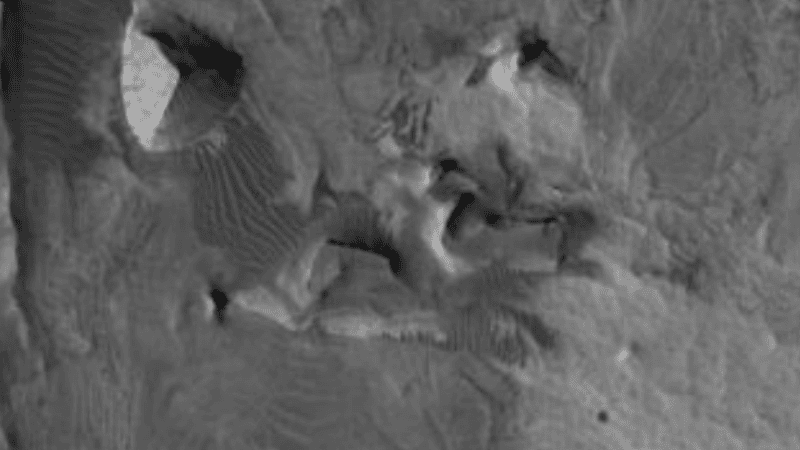
Geometric structure seen on Mars | ©Image Credit: NASA/JPL/University of Arizona
Space image processing and anomalies specialist Keith Laney wasn’t looking for anything extraordinary.
In 2001, while reviewing publicly available images from NASA’s Mars Global Surveyor (MGS), he noticed a striking geometric formation in Valles Marineris—a canyon so vast it would stretch across the continental United States, dropping four miles at its deepest points. The feature has three sides, appears roughly symmetrical, and is about the size of the Great Pyramid in Egypt.
Laney flagged it on his website and in online anomaly communities, highlighting its unusual symmetry and suggesting it warranted closer scrutiny. Nothing much happened, and no official investigation followed, and the structure remained a niche curiosity in the public data archives.
However, the formation showed up three more times in imaging through 2016, in the same shape at each visit. It spent the better part of two decades sitting quietly in the data until documentary filmmaker Brian Dobbs (director of the Mars anomalies film Blue Planet Red—2023) posted footage on X recently, and the conversation caught fire again.
The Case for Closer Scrutiny
Valles Marineris, the solar system’s largest canyon system, a colossal east-west gash along Mars’ equator east of the Tharsis volcanic bulge, is the kind of place that chews rock into strange shapes. In the simplest of terms, it’s inundated with layered cliffs, sheer drops, and geological chaos on a scale that dwarfs anything on Earth.
Unusual geometry, therefore, isn’t rare here, especially in its central chasms like Candor Chasma, where the structure sits in the western region. That’s the sensible explanation, and Dobbs is aware of it. What he keeps returning to is the consistency—three sides, held across 25 years of observation, in a canyon that should be grinding things into rubble.
Mars researcher George Haas published a paper back in 2017 making a similar case. The geometry, he argued, isn’t the kind of erosion that tends to produce. Rocks and sculptures look different, he said, and this looks like neither. Laney put it simply back in 2001. Something this shape, found on Earth, would already have people digging.
Nobody is planting a flag on alien civilization. The argument is quieter than that—just that an anomaly sitting in the most dramatic canyon in the solar system might be worth a closer look than it’s received.
Sources: NASA, ScienceDirect, NYP, HiRise, George HAAS 2017 Paper
Read the original article on GEEKSPIN.
Affiliate links on GEEKSPIN may earn us and our partners a commission.
First Appeared on
Source link






Leave feedback about this