

Final victory over Napoleon elevated the Russian Empire to the heart of European politics. Yet reformers were eager for more. How, they asked, could a depleted Russia, still utterly agrarian and with little culture of its own, build on its triumph and march into the future? The answer, in the short term anyway, was that it couldn’t. Following the botched Decemberist Revolt of 1825, the country returned to ideological rigidity. The new tsar, Nicholas I, embraced a reactionary doctrine: “Orthodoxy, Autocracy, and Nationality”. In response, the philosopher Pyotr Chaadaev penned an excoriating criticism of his country and its politics. Signing his letter from “the Necropolis” — the city of the dead — Chaadaev suggested that the nation’s perpetual cycle of war, revolt, and repression had left it moribund. The author was promptly declared insane and placed under house arrest.
Two centuries on, Vladimir Putin has framed his crusade against Ukraine as the path to recovering Russian vitality once more. Putin has repeatedly invoked memories of the Westernising 18th-century Tsar Peter the Great, and of the Soviet Union, to equate expansion with renewal — and war as a method of national rejuvenation. Through its battle against Ukraine, Putin promised, Russia would reshape the international order, overturn Western dominance, and forge itself as a stronger, more unified society. A new, vibrant Russia could emerge from a conflict in which its army has slaughtered thousands of Ukrainians and faced death and destruction itself.
For years, state propaganda has ceaselessly pushed this vision. Occupied cities such as Mariupol are presented as showcases of a coming “new Russia”: rebuilt, modernised, and cleansed of European influence. A rash of new school textbooks describe a rising power reclaiming its historical destiny. Official imagery projects motion born of war: construction sites, patriotic festivals, soldiers as founders of a renewed nation. Even diplomatic theatre — including the Russian media reception of Putin’s red-carpet welcome in Alaska — reinforces the impression of restored prestige, of a country returning to its rightful place at the centre of global affairs. The war serves as the engine of historical revival; it is the catalyst for life renewed.
Exactly four years after the full-scale invasion of Ukraine, of course, Russia’s war has failed. Endless casualties have bought barely a fifth of Ukrainian territory. The world has not reorganised itself around Russian power, while the promised internal renewal has failed to materialise. Behind the spectacle of official optimism, meanwhile, death has moved to the demographic, economic and cultural heart of public life. The mechanisms meant to restore national strength are instead consuming the human and institutional resources on which that strength depends. Russia’s leaders set out to escape the Necropolis. Now, though, the country is addicted to war, and entrenching itself as a land of the dead.
Wherever Russians live, death has found a burrow. Each month, some 30,000 new recruits depart from country towns and industrial outskirts, and another stream of wounded traipses back the other way. Official promises of rehabilitation, employment, and social prestige often dissolve into bureaucratic delay and indifference. Despite promises of grand new veteran support centres, complaints rumble on social and even state media about the difficulty of actually accessing them. Still, the wounded are the lucky ones. As many as 325,000 soldiers have been killed since the full-scale invasion began. The life expectancy of a Russian soldier in some places may be as low as 12 minutes. No major power has sustained losses on this scale in a single conflict since the Second World War, yet on and on the cycle of recruitment and casualty is repeated.
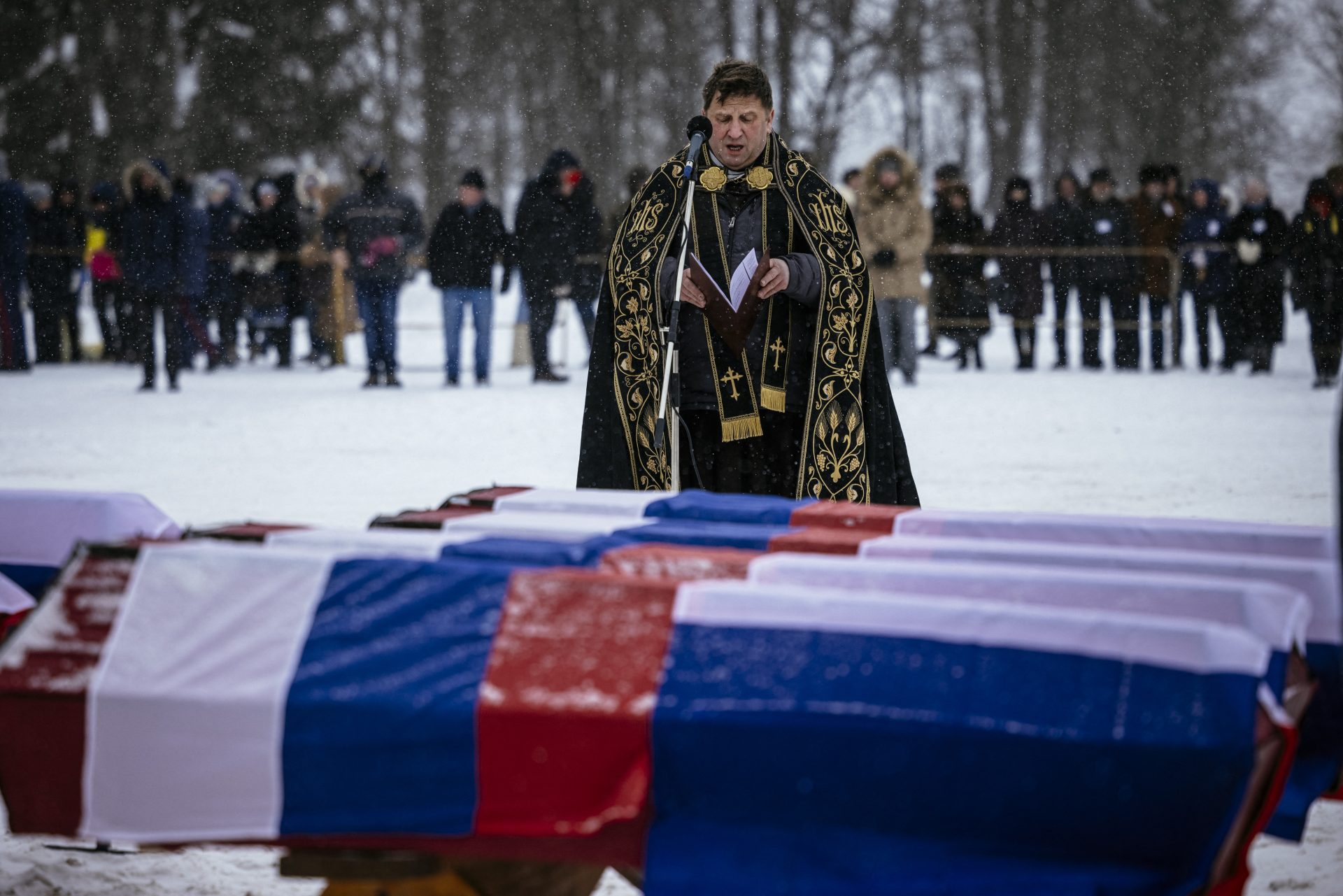
The consequences are already visible far from the battlefield. Across provincial Russia, amputees hobble over icy streets; families reorganise themselves around absence; cemeteries spill over their old boundaries as the dead are put to rest. In one tiny village in far-flung Kamchatka, almost all the young men are gone: of 39 who signed contracts to fight in Ukraine, 12 are missing or dead already. Life is more brutal in other ways too. Domestic violence is up and veterans, accustomed to the amorality of the front, have committed a spate of murders. Just this week Rustam Nogmov, a former soldier, was jailed for the apparently motiveless murder of an 86-year-old woman.
Russia’s leadership makes no attempt to conceal this creeping presence of the funereal. A Kremlin-approved blend of Orthodox Christianity is today bound up with worship of the fallen from the Second World War and the casualties of the present struggle. Death in Ukraine, the Orthodox Patriarch Kirill has claimed, “washes away all sin.” Images of fallen soldiers proliferate across everyday space, as if imitating icons of Orthodox saints. Roadside billboards bear uniformed portraits; official websites praise the young dead; memorial plaques fixed to school walls hang over children who sit at “heroes’ desks” commemorating the dead. Enrolled in state-sponsored youth organisations that teach military skills and the inevitability of battle, Russia’s youth are being fed into the same pipeline that is killing their elders.
Older Russians are roped in too. In carefully staged media stories, parents declare pride at their children’s death at the front. One mother from Stavropol claimed that, after her son died, she had dedicated herself even more fully to patriotic activities. “I focus,” she said, “on teaching lessons about bravery in schools, visiting museums, and attending exhibitions related to the special military operation.” The state’s commemorative machinery absorbs individual tragedies into a pantheon of sacrifice, where ordinary citizens, through death, can be elevated into symbols of national heroism — even as their living relatives are obliged to prostrate themselves before the very machinery that brought annihilation. The boundary between the living and the dead has begun to erode; participation in national life is parsed through the language of sacrifice and loss.
Thanks to the war, meanwhile, household finances across Russia’s shabby provinces now too contend with death. Enlistment, for all its risks, has become one of the few reliable paths to economic stability available to young men outside major cities. Recruitment bonuses, combat salaries, compensation payments to families of the dead — some of these bonuses, if the sometimes-reluctant state bothers to pay them, reach figures of $60,000 and more — have funnelled vast sums into pockets after years of stagnation. Provincial towns that struggled to sustain small businesses now see new cafés, gyms, dog groomers, and other big-city amenities.
This influx of money creates the impression of renewal, but the new prosperity depends on citizens turning themselves into “human capital” out there on the western steppe. Without the war, there would be no boom. This is, as one analyst has put it, “deathonomics”. And where local economies go, so too the federal government has created a wartime overheating effect. Yet as the economist Alexandra Prokopenko starkly put it, the economy is destroying itself in its pursuit of war by “metabolizing its own muscle tissue.” Military expenditure absorbs an ever larger share of state resources, sustaining defence industries while weakening civilian sectors that depend on long-term investment. Factories linked to arms production operate at full capacity, but labour shortages intensify elsewhere as workers enlist, migrate, or are redirected toward wartime production. State spending — as much as 40% of it is now linked to the war effort — desperately prioritises military needs over infrastructure, healthcare, and education, narrowing the foundations from which future development might come.
Output rises in sectors connected to the war effort, but the money is running out. All that is left is consuming more human capital — flesh-and-blood boys from Buryatia and Belgorod and Tatarstan. Skilled workers vanish from local economies. Younger cohorts face increasing incentives to exchange long-term prospects for short-term financial security at the front. Deprived regions in the provinces have become increasingly dependent on transfers that cannot exist without continued fighting: even as their men perish in the so-called “meat grinder,” the system demands ever more sacrifice. Economic stability begins to rely on conditions that steadily erode the society meant to benefit from it. And at the bottom of it all, “deathonomics” draws individuals into sacrificing themselves in the name of war.
“Deathonomics draws individuals into sacrificing themselves in the name of war.”
Peace, under such circumstances, is all-but impossible. Demobilisation would remove income streams that can sustain entire communities, while returning veterans would require medical care, employment, and social reintegration on a scale the state has rarely managed. Indeed, the history of Russia’s modern wars in Afghanistan and Chechnya suggests that this latest venture will not see troops integrated peacefully into society. Ending the conflict would expose weaknesses that wartime spending conceals — a paradox that the Kremlin has no plan to avoid. Death has not just become central to Russia as a visible category and a political religion. Today, it’s at the very heart of the Kremlin’s self-destructive economic programme.
All the while, Russian culture, which has given birth to some of the greatest works in human history, has slipped into a coma. The Kremlin’s wars have often produced music and books of genuine import, their authors forcing Russians to confront what violence does to a society. Tolstoy’s early sketches from Sevastopol repudiated the bombastic heroism of official propaganda; Isaak Babel turned the Civil War into a record of cruelty, racism, and moral disintegration; Vasily Grossman produced the great tragedy of the Second World War in Life and Fate.
Each of these works bears witness to the ways that leaders justify their wars through sacrifice — and how, for ordinary people, morality can be corrupted by the temptations of death. Yet this distinguished tradition of war writing depended on the ethical insights of an intelligentsia willing to frankly confront corrosive wartime violence. Today, though, Russia’s most popular and insightful artists have mostly fled the country. Alla Pugacheva, perhaps the country’s most beloved singer and a familiar face for half a century, has been an outspoken critic from abroad, slamming the war as “terrible” and declaring that “to tell your homeland that it is wrong, that is patriotism”. But voices like these are barely heard in the motherland. Most of those that remain acquiesce to a state that now uses culture to promote its cult of death.
Russia in 2026 certainly doesn’t want for cultural production. Indeed, it produces a great deal. Unfortunately, what passes for culture here is increasingly administered with bureaucratic tedium. Patriotic grants, competitions, publishing initiatives, and a constant stream of “heroic” content optimised for online circulation — all comprises the most visible output. What the state’s organs desire, above all, are odes to soldiering and sacrifice. “Fan art” competitions and children’s poetry contests fill social media with images of soldiers in battle and death. Soldiers crop up on light entertainment shows on television. The state hands out awards to aging producers and writers who beat the drum of war most loudly.
A constant stream of identikit, state-funded (and mostly ignored) Second World War movies clog up movie theatre screens. The greatest state praise today is reserved for the purveyors of so-called “Z Literature”: the war veterans who write of their own experiences in Ukraine, meditating as they go on the necessity of bloodshed in crude and gruesome doggerel. A line in a poem by Alexander Pelevin, a veteran in his thirties whose writing has been awarded and praised by state media, sums up the genre: “‘Alive’ means only ‘not yet dead’. / I am the abyss; the one that reigns supreme.” Defined by the moment of death, the soldier’s life exists in limbo. He is morally empty — an abyss — yet by fighting and dying, he can become “supreme”. State commissions seek out such writers and lavish them with prizes.
But in a bitter twist, the state breaks even those it praises. Pelevin recently posted on Telegram about his own poverty: “Your Russian writer is broke, ruined, and in debt.” He begged for financial help from subscribers. The same state that fills public spaces with heroic portraits, sanctified language, and everyday rituals of death — this state struggles to provide stable support even for the poets who reinforce its narrative. Individuals, whether soldiers or writers, remain instruments in the hands of the state. Their cultural value lies only in what can be extracted from them: death.
The state insists that war generates new life. The longer the war continues, however, the more the Kremlin and society as a whole cannot escape its clutches without economic and social collapse. Yet all the while, the war itself is a burden, dragging Russia into an economic and cultural morass. This country stuck in its own moral stagnation, just like the Russia of the 1820s, is the inescapable necropolis of late Putinism.
A decade from now, Moscow may continue to glitter, sustained by media spectacle, distance from the front, and economic support from China. But elsewhere, the necropolis will surely have taken hold. Imagine a typical small town. The war memorial has been renovated again, its granite polished and its list of names extended. Across the street, the roof of the school — now named after a local dead military “hero” — still leaks. A café opened during the wartime boom stands all but abandoned, its prices beyond what most residents can afford. Recruitment notices take up space on a bulletin board alongside funeral announcements and pleas for money for wounded veterans. The faces of the dead look down from the local church. The living cling to the hopes of a new war to inject more money into their ailing town and empty bank accounts, even as they know it will take yet more sons and brothers from them. More war — more death — is the only way out of the catastrophe. In attempting to destroy Ukraine, Russia has not revived itself: it has turned itself into the land of the dead.
First Appeared on
Source link


Leave feedback about this