


Phil Lord and Christopher Miller haven’t brought a film they’ve directed to theaters since 2014’s “22 Jump Street,” which only came out about four months after their “The Lego Movie” — a now somewhat shocking example of how prolific they were at the time, compared with what would wind up being a 12- year wait for their next film.
Of course, there’s the whole Han Solo situation, something I’m fairly confident the filmmaking duo would rather skip over, but it’s kind of hard to put their seemingly triumphant return (“Project Hail Mary” currently sits at 95 percent on Rotten Tomatoes, as this is being typed) into context without mentioning their last outing as directors.

The “too long; didn’t read” version: their vision of what a Han Solo movie should be conflicted with the studio’s vision. They were then offered what was essentially a demotion, they refused, then the two “Star Wars” obsessives (who even appear as Stormtroopers in “The Empire Strikes Back Special Edition”) were no longer directing the Han Solo movie. (And this is why, during this interview, sometimes the length of time that has passed since their “last movie” is different, depending on if their movie was released or if we’re discussing the last time they were actually sitting in director’s chairs.)
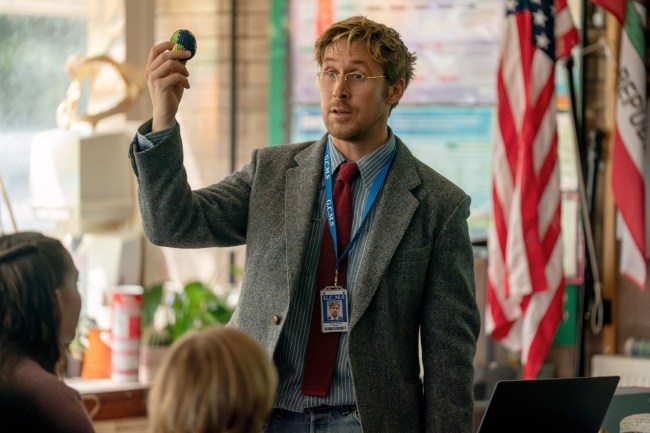
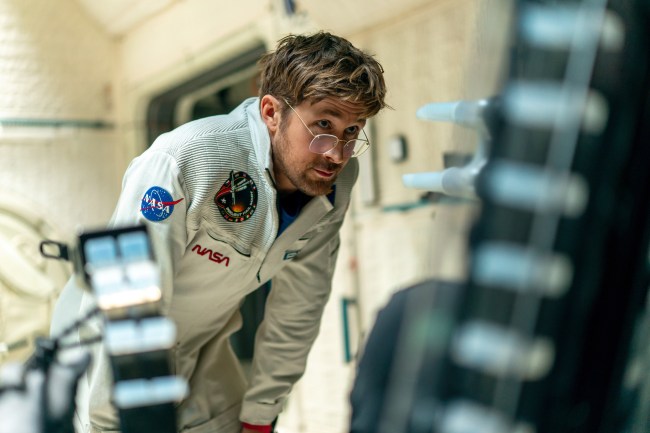
In their “Project Hail Mary” (based on Andy Weir’s novel of the same name), Ryan Gosling plays Dr. Ryland Grace, a former scientist who is currently teaching elementary school after publishing some controversial opinions about what’s really necessary for life to flourish. Those same opinions are now needed when he’s recruited by a scientist named Eva Stratt (Sandra Hüller) to examine a group of tiny organisms that are slowly killing the Sun. In fact, all of the local stars in our galaxy are suffering the same fate, save one.
It’s soon determined that Grace will be part of a crew on a one-way journey to the unaffected star to figure out why, and then send the answer back to Earth. If all of this seems like a long shot, well, they know that and it’s why the mission is called Project Hail Mary.
Grace is the only member of his team to survive the trip. But he soon discovesr he’s not quite alone, meeting another sole survivor from another solar system who is there for the exact same reasons. Grace and the alien he calls Rocky — after Rocky Balboa and because the creature looks like a rock spider — have to figure out a way to communicate if either of them have any hope to save their respective home worlds.
Ahead, Lord and Miller poo-poo any notion that “Project Hail Mary” had to be an “eff you” movie in any way to any would be detractors or anyone doubting their competence as directors. They are quick to point out all the work they’ve done as producers, including, so far, two “Spider-Verse” films, with a third set for 2027. And while Lord admits, yes, he has a chip on his shoulder, he uses that chip for every project he’s working on. Still … all of this had to be on their minds at least somewhat, right?
The following interview has been edited and condensed for clarity and length.
IndieWire: Last night, I watched the new Paul McCartney documentary, “Man on the Run.” It reminded me a bit of you two…
Phil Lord: What if there were two Ringos?
He has what he feels are artistic struggles after The Beatles. He forms Wings, then members of Wings quit. He feels this is a setback, but he says his ego kicks in and decides, fuck you, here’s “Band on the Run.” “Project Hail Mary” feels like your “Band on the Run.”
Christopher Miller: I like that.
Lord: I like it, but unlike Paul we can’t just decide to make something good.
Miller: It takes many, many people working together.
Lord: And a lot of hard work.
My counter would be, it’s been 12 years since you had a directed movie out and I’m sure you’ve had opportunities to direct something since [“Solo”], but you waited for this one because I feel like it had to be an “eff you” movie.
Lord: [Laughs] Listen, I play with a chip on my shoulder and it’s a very useful chip. That was not the motivation for making this. I think we just really fell in love with Andy’s novel. And the idea of doing this with Ryan. There was something about this book, the spectacle of it, the problem-solving, the relationship at the center. The problem of making the audience fall in love with a rock with no eyes. They all felt like the kind of problems that would be fun to spend five years solving.
Miller: It felt like the type of thing where we could get the awe, wonder and spectacle and bigness of why we go to the movies. And then the intimacy of these relationships that make you cry and laugh at the same time. Hopefully, we can get you feeling both in the exact same moment.
Lord: Two feelings? Is it possible?
I will get to those feelings, but I have one more follow-up on this. And keep in mind I have no idea what I’m talking about here…
Lord: I like it! It’s fun to think about.
From the outside looking in, if I’m you, I’d be thinking, if we don’t make a great movie with our next movie, the press will start saying stuff like, “Well, they are good producers now, but it’s been so long. And what happened to movies like ‘The Lego Movie’ and the ‘Jump Street’ films?” So that would be in my head, that this has to be exactly the right project.
Lord: For one, we don’t need the context of any one moment in our lives to create the feeling that this has to be…
Miller: “Undeniably.”
Lord: “Undeniably great.” Everything we’ve done, we have that anxiety. That fear, undergirding all of our hard work. Because I do think that the standard has always been — someone told us this when we were pretty young — the standard is undeniable excellence. That’s what the audience demands. That’s what you have to give them.
Miller: Especially when you’re doing something original. The only way this succeeds in the marketplace is by being great. And part of it is being as original as it can be. And giving people a new experience with something they haven’t seen or felt before. So that’s the way we approach every single thing.
Lord: When Sydney Pollack would start a movie, he’d call his department heads and say, “Do you want to get scared?” Meaning, do you want to try to do something you don’t know how to do.
Miller: If you’re not a little bit scared, you’re not pushing the boundaries enough.
Lord: And when I think about what it’s like to try and deliver on a Spider-Verse movie, that looks like nothing has ever looked? Or a second Spider-Verse movie that has to deliver on the expectations set up by the first one. Let alone the third one that we’re mixing right now…
That was supposed to come out in 2024, so the anticipation keeps building.
Lord: Right. Anyone releasing a movie is terrified that they are not going to be able to deliver on people’s expectations. It really is a useful feeling to be like, it’s Sunday, I just want to sleep in, and you get up because you want the movie to be everything it can possibly be. And everybody that we work with is like that. They would do anything to make the movie better.
Miller: And I will say that I have a belief that anxiety is, at least partially, good. Anxiety is an expression of creativity. If you hear a sound downstairs in the middle of the night and you’re a creative person, you’re asking, what if it’s a dog that got in? What if it’s a burglar? What if it’s aliens? And the more what ifs you have, the more anxious you get and the more creative you are. You asking these questions is your brain being creative and it’s the thing pushing you to keep doing something about it.
Lord: The thing that’s interesting about this question is there is a parallel in the movie, right? Ryan plays a character who’s unbelievably skillful and unbelievably scared. The last thing he wants to do is go to space. The last thing he wants to do is meet an alien, right? The last thing he wants to do is fly a spaceship. He’s terrified. And yet, there’s a weird confidence about this guy. He just starts to do the steps, he has belief in the process. In the method.
So do you feel that way?
Lord: I feel that way!
It’s been eight or nine years since you’ve actually directed a movie…
Lord: Do I want to win? Of course I want to win! Of course I want to win and make everybody really happy and love the movie. But, we also have the confidence of the experiences that we’ve had. I think since the last movie we directed came out, we’ve made six movies, three seasons of television…
No one is accusing you of being lazy. I do realize how much you guys have done.
Lord: And that gives you so much knowledge. We got to work with so many great directors. And you just become really confident in your process. So you become really confident that, yeah, we can tackle hard things if we have a healthy process. That’s what the movie is about. Yes, there is going to be a new ice age and we might not survive, but we do have pretty good brains here on planet Earth and if we have a good process, we might be able to lick this thing.
You mention Gosling’s character, he had to be aggressively persuaded to go on this mission. Did one of you have to do that to the other?
Miller: No.
Lord: Not this one.
Miller: Not this one. We fell in love with the manuscript and it was the easiest yet.
Lord: People say that every interview you have, but it truly happened. We got the manuscript, we read it in a night. It was like 24 hours. It was the only thing about the movie that was easy.
You’ve got an Andy Weir book and Drew Goddard, who is great, writing the script. It’s set in space, the main character talks into the camera a lot to chronicle his thoughts. How did you avoid making “The Martian 2”?
Lord: So much of what we try to do with everything is try to approach it in a way you don’t expect and to challenge ourselves to do things differently than how we would do it. By the way, I love “The Martian.”
Right, people do love “The Martian.”
Lord: But, like, we are not Ridley Scott. If we tried to be Ridley Scott, we would fail. One of the things I’m interested in, creatively, is that space is messy. Spaceships are full of wires and pipes. The insides are on the outside. They are prototypes. There’s nothing slick about them. They are clumsy, right? Zero gravity space walking is messy, you bump into stuff. If you’ve never done it before, you will ass over teakettle. We wanted the whole movie to not feel like a Slick Rick Macintosh, we wanted it to be a PC. The guts are exposed. Nothing quite fits perfectly. The seams are showing. Even in the editing, the seams of the cuts are kind of palpable. We didn’t want anything about this movie to be smooth and we didn’t want space to be antiseptic and cold. We wanted it to be warm, right?
Miller: And I think, you know, Ryland Grace is not Mark Watney. Mark Watney is an astronaut who chose to go to Mars and do a daring thing. Ryland Grace is afraid and vulnerable and has to grow as a person before he can become a hero. Ryan is such a specific actor that he gave his own take on that that was very personal to him. And he’s such a gifted actor he was able to pull it off and keep the tone where it can go from comedy to emotional drama to excitement to terror — sometimes all in the same scene.
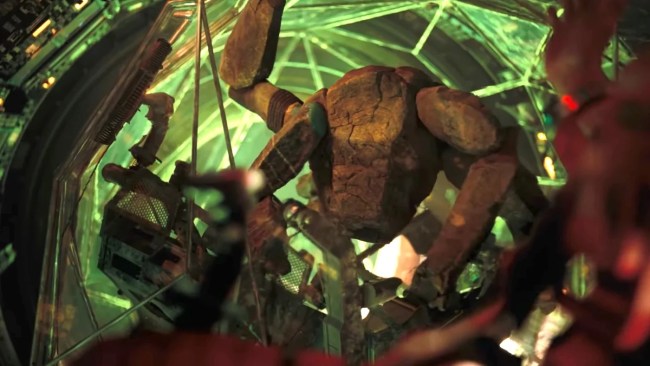
So, Rocky. I’m familiar with Neal Scanlan’s work on it and James Ortiz being the puppeteer, but what’s the key for an alien to still be alien, but also something audiences find adorable? I believe in the book it’s described as “spider-like.”
Lord: In the book he’s got five sides, he’s more or less symmetrical. And we didn’t want to take any short cuts. He has no face, he has no eyes, he has no mouth. And this is where we had a certain amount of confidence: his expression comes from his movement. Animation is storytelling through movement. So, we really felt confident if we built a great puppet that allowed you to project personality onto this seemingly empty facade.
Each one of them, we made it different. “This is the grouchy one. This one is really open. This one is skeptical.” They’d have different personalities and we figured, if we get the right movement, it will be expressive. If he’s expressive, we’ll just fall in love with him. There was a day we went to the creature shop and Neal showed us a few different clay sculpts of Rocky. And there was just one we kept coming back to and there was just something about him … I like that guy.
Miller: It’s appealing.
Lord: Do you know what it is?
Miller: It’s not conventionally cute.
Well, neither is E.T.
Miller: It’s this rock crab spider thing with five legs and nothing to grab onto. But, the way he moves and his personality, you fall in love with him. He becomes cute because he expresses himself in a way that’s really appealing.
Lord: And his design came out of character. It came from his soul. And it was expressed through rock and gemstone.
Miller: We also worked on these carvings that he would put onto his body. And they all had a story we had explanations for that we never explain in the movie. But he has a wedding band, a tartan, a “missing” patch, and a ruler he uses for engineering carved into his inner arm. All this stuff that hints at a rich history and culture and keeps visual interest for whatever angle he’s on.
Lord: It gives opportunities to the puppeteers and animators to make choices. When Rocky tells you his name he [extends his arms] to show you his tartan, but I don’t know if the audience picks up on that.
I think they will at least subconsciously. Your brain starts processing it.
Lord: Yeah! When you’re designing something like that, you’re just trying to create opportunities for the future and load the dice. So that everybody has enough toys in their sandbox.
He reminded me a bit of Yoda. Not the wise Yoda, but the one we first meet in “The Empire Strikes Back” who is stealing food from Luke and playing with flashlights.
Lord: That’s right!
Miller: Anti-Yoda!
Lord: The gag there is, he’s little, but he thinks of himself as big. He’s Labrador size, but he imagines himself as Grace’s superior.
Miller: What Neal Scanlan said to us about Yoda, the reason you believe Yoda is because Mark Hamill believes Yoda. Mark Hamill is taking him seriously.
Lord: Even though Yoda, the puppet…
Miller: It could barely move!
Lord: He had no elasticity. And poor Frank Oz is getting hand cramps, breaking his fingers to get expression out of this piece of rubber. Of course he did. And because it’s Frank Oz, it’s amazing. But so much of it, Neal would say, “Ryan is the sixth puppeteer.” Because Ryan’s belief and his engagement with this thing is part of what makes you believe.
Miller: Ryan believed that Rocky was real and he cares about Rocky, so we also do.
Lord: One of the things that James told us, when you’re doing live puppeteering on stage — like in “War Horse” or “Avenue Q” or whatever — suddenly the puppeteers were visible and what they look at directs the eyes of the audience. They all look where you’re supposed to look. Their attention guides you. So we’re watching Ryan for where he’s paying attention and that tells the story.
Stay tuned for next week, when we’ll have more (spoiler-y!) stuff from Lord and Miller.
Amazon MGM Studios will release “Project Hail Mary” in theaters, including IMAX, on Friday, March 20.
First Appeared on
Source link




Leave feedback about this