

Unlock the Editor’s Digest for free
Roula Khalaf, Editor of the FT, selects her favourite stories in this weekly newsletter.
The Pentagon and at least one Gulf government are in talks to buy Ukrainian-made interceptors to fend off attacks by Iranian drones, according to industry figures in Ukraine.
Gulf states had been using expensive Patriot missiles to defend themselves from waves of Iranian Shahed drones in the days since the US and Israel launched their war. But their stocks are declining, and they are looking to Kyiv’s experience for cheaper defence against Russian drone barrages.
Ukraine has pioneered using mass-produced interceptors costing a few thousand dollars to destroy Russian versions of the Shahed, launched against Ukrainian cities in swarms. Shaheds cost a mere $30,000, while interceptor missiles like the PAC-3s used in the Patriot system cost more than $13.5mn each.
One Ukrainian official described the discussions with the Pentagon as a “sensitive” topic. “However, it is obvious that there is a surge in interest in the Ukrainian drone interceptors, which can intercept the Shahed for a very low cost.” A local industry figure said any sales of Ukrainian systems, even those made outside the country, would have to be in co-ordination with Kyiv.
Ukrainian President Volodymyr Zelenskyy said on Tuesday that he had been in contact with Sheikh Tamim bin Hamad al-Thani, the emir of Qatar, and Mohammed bin Zayed al-Nahyan, the president of the United Arab Emirates, about the use of Ukrainian anti-drone technology.
“Ukraine’s expertise in countering ‘Shahed’ drones is currently the most advanced in the world,” Zelenskyy said. “However, any such co-operation aimed at protecting our partners can only proceed without diminishing our own defence capabilities.”
The Pentagon did not respond to a request for comment.
Experts say Iran may have stockpiled tens of thousands of Shahed drones. It has launched hundreds since it was attacked by Israel and the US, using them mainly on Gulf states to sow terror and to use up adversaries’ surface-to-air and air-to-air missiles.
Because they are easy to hide and can be launched from anywhere, the Shaheds are less vulnerable to US and Israeli tactics that rely on destroying launchers and stockpiles of missiles on the ground before they are fired.
Kyiv has moved to using cheaper weapons such as anti-aircraft guns and machine gun trucks to take down drones including Shaheds, which Moscow has used against Ukraine since it launched its full-scale invasion in 2022. Ukraine has also since autumn been using fast-flying interceptors that can reach speeds of 250km/h, capable of catching a Shahed, whose top speed is 185km/h.
So far Kyiv has not been able to field an effective interceptor for Russia’s new locally-produced, jet-powered Geran-3 drones, which fly at more than 550km/h. Moscow launched 54,000 of them at Ukraine last year, according to the Ukrainian defence ministry.

Kyiv is worried about its own supplies of anti-drone munitions. But it is betting that if Middle Eastern countries use its drone interceptors instead of the PAC-3 missiles for Patriot batteries, there will be more global supplies of PAC-3s left over for Ukraine, which needs them to defend against advanced cruise and ballistic missiles.
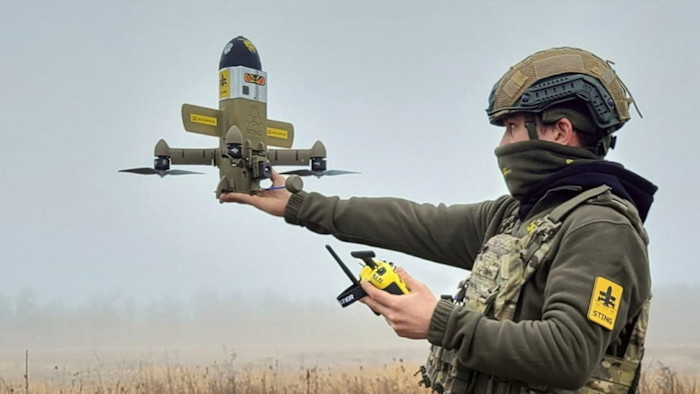
Ukraine’s deployed drone interceptors include the Merops, a fixed-wing drone made by companies funded by former Google chief executive Eric Schmidt. Another bullet-shaped quadcopter known as Sting, made by Ukrainian company Wild Hornets, has been deployed off the coast of Odesa on Magura drone boats made by Uforce, a start-up.
General Cherry, another Ukrainian company, also makes a fast “Shahed hunting” interceptor drone.

Iranian tactics in the Gulf mimic Russian tactics against the coastal city of Odesa, where Shahed drones skim the ocean on approach to avoid radar and confound missile interceptors. Drones deployed offshore had the best chance of intercepting them, said one Ukrainian expert.
Some interceptors are capable of using computer vision to lock on to a target, but others are remotely guided.
In Ukraine, “there are literally a dozen companies that make kinetic interceptors — little bullet-shaped quadcopters or fixed-wing drones — for a few thousand dollars apiece”, said one person familiar with the talks.
Iranian Shahed drones were previously judged to be a mere nuisance, and not worth an expensive interceptor, but in some cases have caused real damage. A video on Saturday showed a Shahed destroying a satellite antenna at a US naval base in Manama, Bahrain.
“The fact that Shaheds are getting through at all, let alone a military base that is the ops centre for the entire Middle East, and in broad daylight, is astounding,” said one person who has served at the US Navy’s Fifth Fleet headquarters in Bahrain.
Additional reporting by Steff Chávez and Abigail Hauslohner in Washington and Stephen Morris in San Francisco
First Appeared on
Source link



Leave feedback about this