

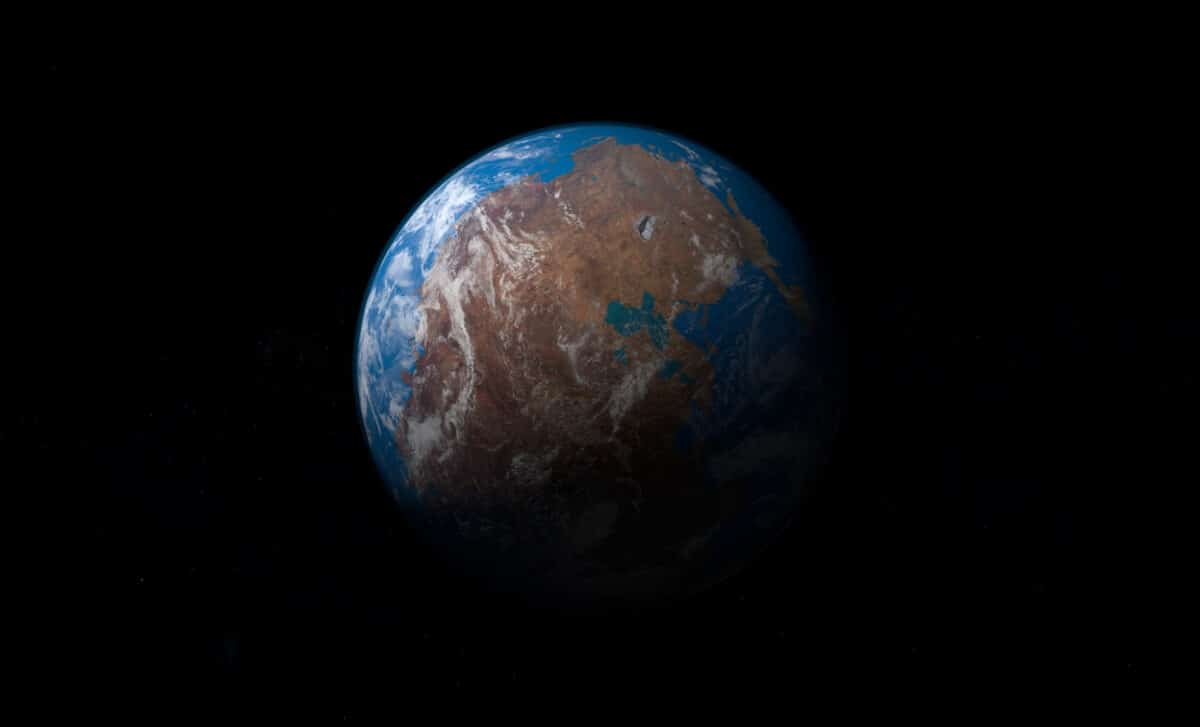
Pangea, the ancient supercontinent that once united all seven continents, began breaking apart roughly 200 million years ago. That breakup shaped the modern world map. Now, researchers say the tectonic forces that split Pangea apart may eventually reverse course.
According to a 2018 study published in Geological Magazine, there are four prevailing scenarios for how Earth’s next supercontinent might assemble. Each one depends on how today’s oceans evolve, whether they continue expanding or begin to close.
Four Ways the Continents Could Collide Again
One leading scenario assumes the Atlantic Ocean keeps widening while the Pacific Ocean continues shrinking. The Pacific is lined with subduction zones, where oceanic plates sink beneath continental plates and descend into the mantle. This intense activity explains why about 80 percent of major earthquakes occur around its edges, in the region known as the Ring of Fire.
Under this model, the Americas would drift farther from Europe and Africa before eventually colliding with a northward-moving Antarctica. That combined landmass would then merge with Africa, Europe, and Asia, which would already be joined together. Australia would dock with East Asia. The end result is a massive continent called “Novopangea.”
Another scenario, known as “Pangea Proxima,” envisions the Atlantic and Indian Oceans continuing to expand until new subduction zones pull the continents back together. According to Popular Mechanics, this would create a ring-shaped supercontinent encircling a small ocean basin at its center.
Then there is “Aurica.” The Pacific and Atlantic Oceans are about 200 million and 180 million years old, respectively. João C. Duarte, assistant professor of tectonics at the University of Lisbon and the originator of the Aurica hypothesis, told Popular Mechanics in 2022 that both oceans could eventually close. The Indian Ocean, at around 140 million years old, is the youngest. If it keeps opening while the Pacific and Atlantic shut down, all seven continents could merge along the equator into Aurica.
Finally, the “Amasia” model suggests the Atlantic and Pacific remain open while the Arctic Ocean closes. In that case, nearly all continents except Antarctica would migrate northward and cluster near the North Pole. Duarte described it as a configuration with a vast ocean surrounding Antarctica on the opposite side of the globe.
Climate Simulations Show Two Radically Different Worlds
In July 2021, researchers published a study in Geochemistry, Geophysics, Geosystems using 3D global climate models to simulate how Aurica and Amasia would shape Earth’s climate. The differences are stark.
If Amasia forms and land concentrates near the poles, the lack of land between them could disrupt the ocean conveyor belt, a deep-ocean circulation system that moves heat from the equator toward the poles. Michael Way, a physical scientist at NASA’s Goddard Institute for Space Studies who led the study, said this could make the poles colder and permanently ice-covered. Expanded ice sheets would reflect more heat back into space, reinforcing the cooling effect.
Aurica paints a warmer picture. Because it would sit near the equator, Duarte said it would likely be warmer and possibly drier than today’s Earth. Climate models suggest temperatures could rise by about three degrees Celsius. According to Duarte, this configuration might produce extensive Brazil-like coastlines, white-sand beaches, coral reefs, dune systems, and strong ocean currents.
Still, neither world would be gentle. Duarte warned that as continents merge, species would compete intensely for resources, increasing the risk of mass extinctions. In the Amasia scenario, widespread glaciation could eliminate most life on land, sparing mainly ocean-dwelling organisms.
Scientists Warn of Major Unknowns
Projecting 200 million years into the future comes with significant uncertainty. Alex Pullen, assistant professor at Clemson University, told yhe same source in 2022 that scientists cannot predict what vegetation will look like that far ahead. Plants strongly influence atmospheric chemistry, precipitation, cloud formation, and albedo, the fraction of sunlight reflected by Earth’s surface.
Volcanic carbon dioxide emissions in a future supercontinent state remain another open question. Pullen noted that greenhouse gas levels and the interaction between oceanic and atmospheric circulation are difficult to model. The 2021 simulations did not include aerosols, microscopic particles suspended in the air, which play a major role in climate.
Way also pointed to the unpredictability of human impact. According to his comments, it is unclear how climate change, ocean pollution, and plastic contamination will shape the planet’s long-term trajectory. He expressed confidence in Earth’s resilience, noting that for most of the past four billion years, surface conditions have remained relatively temperate, aside from brief intervals.
Duarte raised a final question about survival. Intelligence alone, he said, does not guarantee long-term success. Technological capability includes the power for self-destruction, referencing nuclear weapons in the context of the ongoing Russo-Ukrainian War. For a species to endure 50 to 250 million years into the future, he suggested, it would need to live in harmony with its ecosystem.
First Appeared on
Source link


Leave feedback about this