

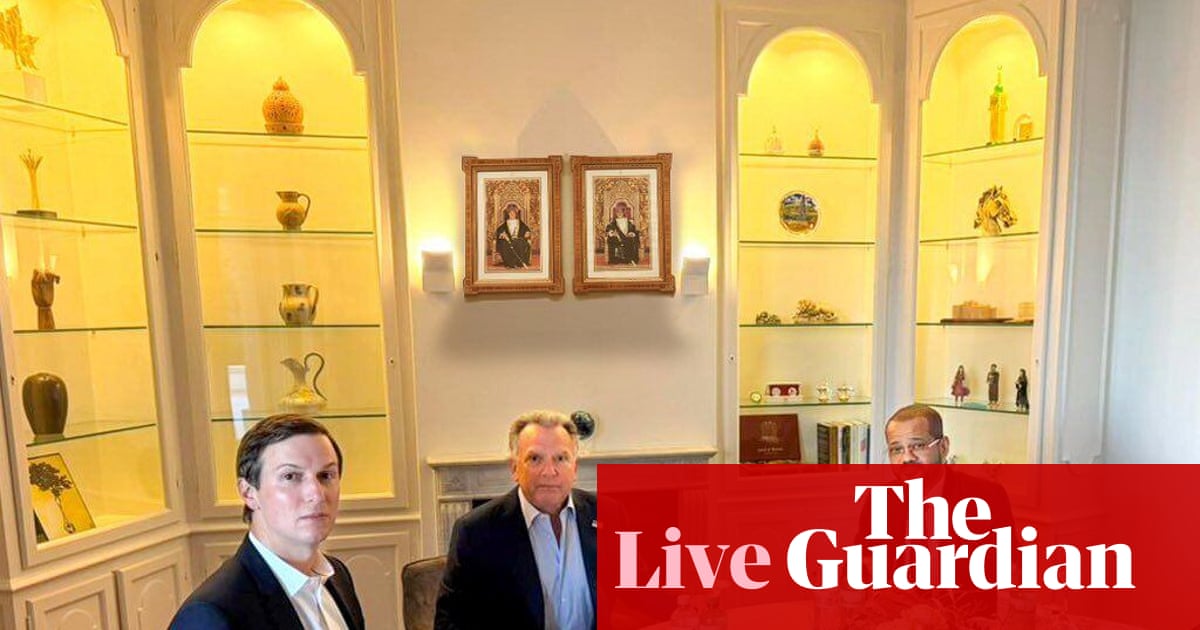
Oman says ‘significant progress’ was made as talks end but brevity appears ominous
Patrick Wintour
Talks between US and Iran in Geneva over the future of Tehran’s nuclear program ended on Thursday with the mediators Oman claiming “significant progress” had been made, and predicting the talks will reconvene at a technical level next week in Vienna.
But there was no immediate evidence to back suggestions that the two sides had drawn closer together on the fundamental issues of Iran’s right to enrich uranium and the future of its highly enriched uranium stocks still in Iran.
The talks in Geneva were held in two parts with reports that the US team led by Steve Witkoff, the US special envoy, had been disappointed by the proposals put forward by Iran.
The brevity of the second session of the talks also appeared ominous.
Iranian officials rounded on reports issued during the talks by US media suggesting Iran was going to be required to end enrichment and allow its stockpile of highly enriched uranium to leave Iran.
Key events
The day so far
-
High-stakes talks between the US and Iran over the future of Tehran’s nuclear programme ended without a deal, as Donald Trump weighs military action on a scale that would signify the US’s largest intervention since its invasion of Iraq in 2003. The world remains on edge as Trump has yet to decide on whether he will start a war with Iran.
-
We haven’t heard from the US side, but Iran’s foreign minister Abbas Araghchi said “good progress” was made on the nuclear issue and sanction relief, and said the two sides had begun to discuss “the elements of an agreement”. He described the talks as “one of our most intense and longest rounds of negotiations”, and confirmed that negotiations would reconvene at a technical level next week in Vienna. A reminder that on 19 February Trump issued a 10-15 day deadline for Tehran to reach a “meaningful deal” with Washington, which would bring us to next Friday, 6 March.
-
But despite the hopeful take from the Iranians and from the Omani mediators, there was no immediate evidence that the dial had shifted on the fundamental issues of Iran’s right to enrich uranium and the future of its highly enriched uranium stocks. A reminder that the US is demanding permanent Iranian guarantees on uranium enrichment and inspection mechanisms so that Tehran will never be able to build a nuclear weapon, a goal it has always denied.
Thank you for reading along. We’re pausing our live coverage now, and I’ll leave you with Patrick Wintour and Andrew Roth’s report.
As yet there has been no immediate comment from the Trump administration after the conclusion of indirect talks between the US and Iran in Geneva today. We’ll be sure to bring you any word from Donald Trump or US officials as we get it.
We have, however, heard from Iran, with foreign minister Abbas Araghchi telling reporters that “good progress” was made on the nuclear issue and sanction relief in this round of talks – but key differences remain. He described the talks as “one of our most intense and longest rounds of negotiations”, and said the two sides had begun to discuss “the elements of an agreement”.
Araghchi confirmed that further contacts would take place in less than a week. A reminder that on 19 February Trump issued a 10-15 day deadline for Tehran to reach a “meaningful deal” with Washington, which would bring us to next Friday, 6 March.
Here’s the full text of Araghchi’s statement:
Today I can say that one of our most serious and longest rounds of negotiations took place. The meeting lasted for about four hours in the morning and two hours in the afternoon.
These talks were held indirectly and with the mediation of the Omani foreign minister, and in some parts [IAEA chief Rafael] Grossi also conveyed the discussions between the two sides. His presence was useful from a technical point of view. The Omani foreign minister also played an active role, as in the past.
Overall, during these long and very intensive hours, good progress was made and we entered into a serious examination of the elements of an agreement; both in the nuclear field and in the sanctions field.
On some issues, understandings have come very close. Of course, there are still differences of opinion, which is natural, but compared to the past, both sides are more serious about reaching a negotiated solution.
It was agreed that, starting Monday, technical teams in Vienna and at the International Atomic Energy Agency will begin technical expert reviews to set some technical issues within a specific framework and then adapt them to the demands and political considerations of both sides.
It was also decided that the next round of negotiations will be held in the near future—probably in less than a week.
Here is the full story on today’s talks by my colleague Patrick Wintour.
High-stakes talks between the US and Iran over the future of Tehran’s nuclear programme ended on Thursday with the Omani mediators claiming that “significant progress” had been made and predicting the talks would reconvene at a technical level next week in Vienna.
But there was no immediate evidence to support suggestions that the two sides had drawn closer together on the fundamental issues of Iran’s right to enrich uranium and the future of its highly enriched uranium stocks.
Iran’s foreign minister, Abbas Araghchi, described the talks as “one of our most intense and longest rounds of negotiations,” but said that “good progress” had been made. He confirmed that further contacts would take place in less than a week.
The indirect talks in Geneva were held in two sessions, with reports that the US team led by Donald Trump’s special envoy to the Middle East, Steve Witkoff, had been disappointed by the proposals put forward by Iran.
Iran said the next round of nuclear talks with the U.S. is expected in less than a week.
Iranian foreign minister Abbas Araqchi described it the most serious exchanges with Washington, saying Tehran clearly laid out its demand for lifting sanctions and the process for relief.
Both sides needed to consult with their respective capitals, Araqchi said on Thursday to state TV.
Araqchi added technical-level discussions will start in Vienna from Monday.
Oman says ‘significant progress’ was made as talks end but brevity appears ominous

Patrick Wintour
Talks between US and Iran in Geneva over the future of Tehran’s nuclear program ended on Thursday with the mediators Oman claiming “significant progress” had been made, and predicting the talks will reconvene at a technical level next week in Vienna.
But there was no immediate evidence to back suggestions that the two sides had drawn closer together on the fundamental issues of Iran’s right to enrich uranium and the future of its highly enriched uranium stocks still in Iran.
The talks in Geneva were held in two parts with reports that the US team led by Steve Witkoff, the US special envoy, had been disappointed by the proposals put forward by Iran.
The brevity of the second session of the talks also appeared ominous.
Iranian officials rounded on reports issued during the talks by US media suggesting Iran was going to be required to end enrichment and allow its stockpile of highly enriched uranium to leave Iran.
Here is the full post from the Omani foreign minister’s account on X:
We have finished the day after significant progress in the negotiation between the United States and Iran. We will resume soon after consultation in the respective capitals. Discussions on a technical level will take place next week in Vienna. I am grateful to all concerned for their efforts: the negotiators, the IAEA, and our hosts the Swiss government.
Oman says round of talks concluded ‘after significant progress’
We’re now seeing lines on the news wires that the talks have finished for the day, with the Omani foreign minister saying there was “significant progress” in the negotiations between the US and Iran.
Per Reuters, Sayyid Badr bin Hamad Al Busaidi – who was mediating the talks – said “discussions on a technical level” would take place next week in Vienna. Talks would resume soon after consultations in the respective capitals, he said.
We’ll bring you more on this as we get it.
CNN is also reporting that the fresh round of indirect US-Iran talks has begun in Geneva after a few hours’ break, citing Iran’s state-run broadcaster.
Islamic Republic of Iran Broadcasting said the “second round of the third phase” of the talks had started, after both delegations arrived back at the Omani embassy.
Earlier, we reported that the convoy carrying US diplomats in Geneva had arrived back at the location, shortly after the convoy carrying Iranian diplomats.
Iranian foreign minister Abbas Araghchi and US envoys Steve Witkoff and Jared Kushner have resumed indirect talks mediated by Oman, Reuters reports citing Iranian state media, after having adjourned their earlier session.
A convoy carrying US diplomats in Geneva has arrived at the location of indirect talks with Iran over its nuclear program.
The convoy pulled into the compound on the shores of Lake Geneva. A convoy carrying Iranian diplomats arrived earlier.
The two sides had taken a several-hour break in the talks. The US side went to a meeting with Ukrainian officials during that time.

Helena Smith
And while negotiations continue, the build-up of US firepower around Iran goes on apace.
Earlier today, the USS Gerald R Ford, the world’s largest aircraft carrier, left the US naval base of Souda Bay on Crete for the Middle East – adding to what has become the biggest military presence in the region in decades.
The nuclear-powered carrier, the largest warship ever constructed, has spent four days at the deep-water port refuelling and resupplying.
The vessel, which is expected to reach the shores of Israel within 24 hours, will join the USS Abraham Lincoln aircraft carrier and other ships that arrived in the Middle East last month.
“It’s hard to see how such a powerful military presence can simply be de-escalated without very significant progress in today’s talks,” said one well-placed diplomat.
Geneva talks due to resume imminently
Just a reminder that, according to the Iranian foreign ministry, the talks in Geneva will resume shortly at 5.30pm local time (4.30pm GMT).
Stay with us for any news lines that may emerge in the coming hours…
Satellite photos shot Tuesday and Wednesday by Planet Labs PBC and analyzed by the Associated Press appeared to show that American vessels typically docked in Bahrain, the home of the US Navy’s 5th Fleet, were all out at sea.
Before Iran’s attack on a US base in Qatar during the closing days of the war last June, the 5th Fleet similarly scattered its ships at sea to protect against a potential attack.
If the talks fail, uncertainty hangs over the timing of any possible US attack.
If the aim of potential military action is to pressure Iran to make concessions in nuclear negotiations, it’s not clear whether limited strikes would work.
AP reports:
If the goal is to remove Iran’s leaders, that will likely commit the US to a larger, longer military campaign. There has been no public sign of planning for what would come next, including the potential for chaos in Iran.
There is also uncertainty about what any military action could mean for the wider region. Tehran could retaliate against the American-allied nations of the Persian Gulf or Israel.
Oil prices have risen in recent days in part due to those concerns, with benchmark Brent crude now around $70 a barrel.
Iran in the last round of talks said it briefly halted traffic in the Strait of Hormuz, the narrow mouth of the Persian Gulf through which a fifth of all traded oil passes.
First Appeared on
Source link


Leave feedback about this