

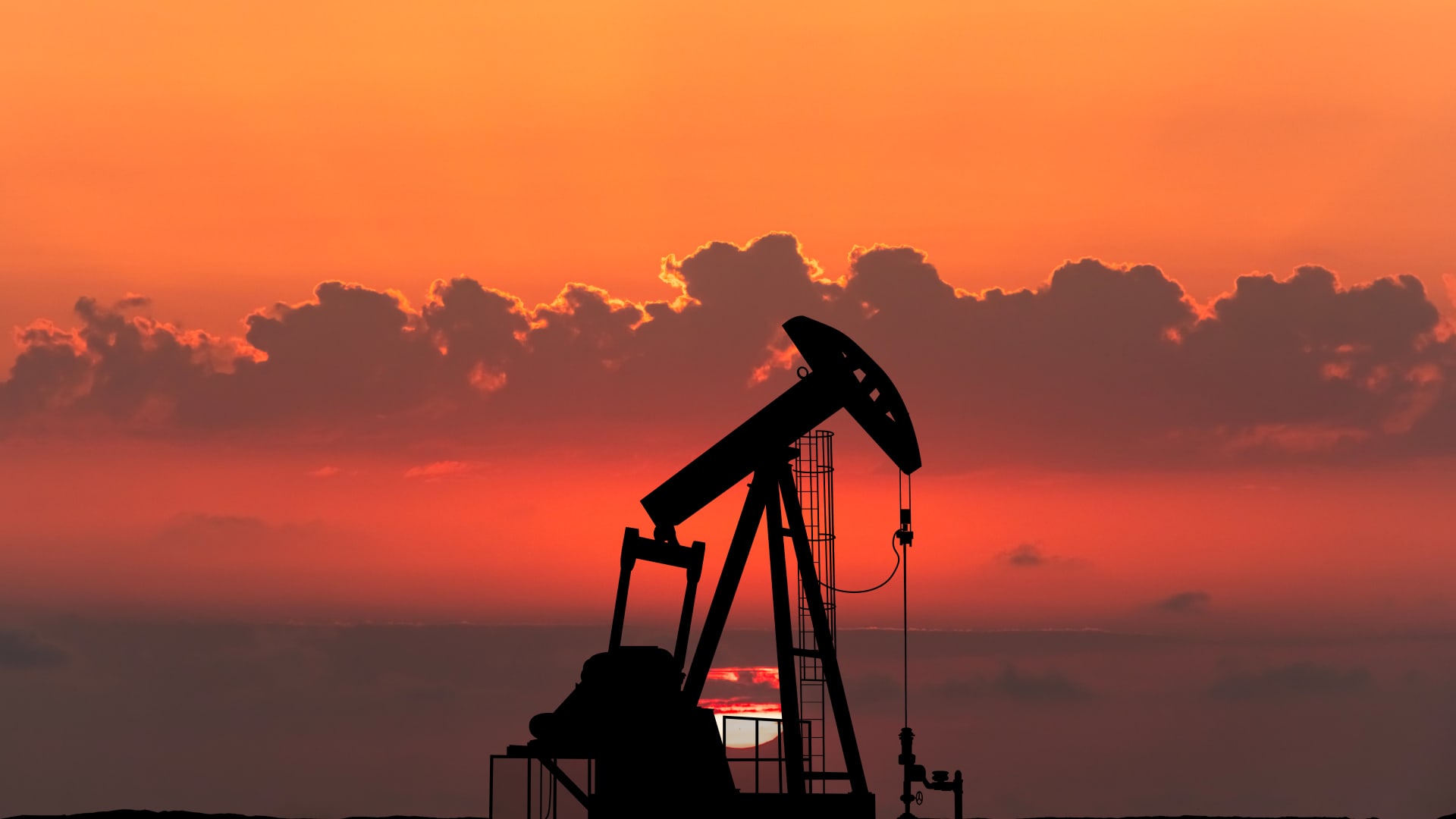
Oil prices surged about 20% on Monday as the U.S.-Israeli war with Iran continued, raising fears of prolonged disruptions to energy supplies.
Anton Petrus | Moment | Getty Images
Oil prices plunged 10% Tuesday after U.S. President Donald Trump warned that Tehran would be hit “twenty times harder” if it attempted to halt oil flows through the Strait of Hormuz, while also signaling that the conflict with Iran could end soon.
International Brent crude was down nearly 11% at $88.36 per barrel at 9.25 p.m. ET Monday. U.S. crude oil fell more than 10% to $85.17 per barrel. The declines come after oil surged past $100 on Monday.
“If Iran does anything that stops the flow of Oil within the Strait of Hormuz, they will be hit by the United States of America TWENTY TIMES HARDER than they have been hit thus far,” U.S. President Donald Trump said in a post on Truth Social Monday stateside.
Located between Oman and Iran, the Strait is a vital transit route for global energy markets. Roughly 13 million barrels passed through the waterway in 2025, accounting for about 31% of global seaborne oil flows, according to Kpler.
It connects major Gulf producers including Saudi Arabia, Iran, Iraq and the United Arab Emirates to the Gulf of Oman and the Arabian Sea.
“This is a gift from the United States of America to China, and all of those Nations that heavily use the Hormuz Strait. Hopefully, it is a gesture that will be greatly appreciated,” Trump said in his post.
The comments come as a spokesperson for Iran’s Ministry of Foreign Affairs warned on Monday that oil tankers transiting the Strait of Hormuz “must be very careful.”
Oil prices year-to-date
Earlier in the day, Trump told CBS News over phone that ships were continuing to pass through the Strait of Hormuz, adding that he was “thinking about taking it over.”
At a press conference on Monday Trump also said the war against Iran will end “very soon,” and oil prices will drop.
Trump comments have soothed nerves on the energy supply shock, and the disruption to oil flows.
“I think there’s a lot of optimism in the market,” said Bob McNally, president at Rapidan Energy Group. “We saw that today with the collapse in oil prices on what we used to call verbal intervention from the President.”
McNally said the market is still struggling to process the scale of the disruption, noting that for decades traders assumed no country would be allowed to shut the Strait of Hormuz, the world’s most critical oil chokepoint.
The fact that it has happened at all is “completely calamitous and unexpected,” McNally said, pointing that that even during the tensions of the 1980s the waterway was never fully closed.
For now, markets appear to be betting the situation cannot last long and that navigation through the Strait will ultimately be restored, he added.
While Trump’s comments have lifted markets, Lipow Oil Associates’ President Andy Lipow believes it is still too early to draw concrete conclusions.
“We will have to wait and see how Iran responds to the President’s comments and whether or not Iran will attack any oil infrastructure in the coming hours,” he said.
Separately, energy ministers from the Group of Seven nations are set to hold a virtual meeting later in the day to discuss a potential release of emergency oil reserves aimed at easing supply disruptions caused by the Iran war, sources told CNBC.
The discussions follow a meeting of G7 finance ministers on Monday, where officials considered tapping strategic reserves but stopped short of reaching a decision.
Talks among member states have been “positive,” the sources said, adding that any coordinated move to release stockpiles would likely follow the energy ministers’ meeting.
According to the sources, the U.S. believes a joint release of between 300 million and 400 million barrels, roughly 25% to 30% of the group’s combined 1.2 billion-barrel reserves, would be appropriate.
— CNBC’s Eamon Javers and Spencer Kimball contributed to this report.
First Appeared on
Source link



Leave feedback about this