

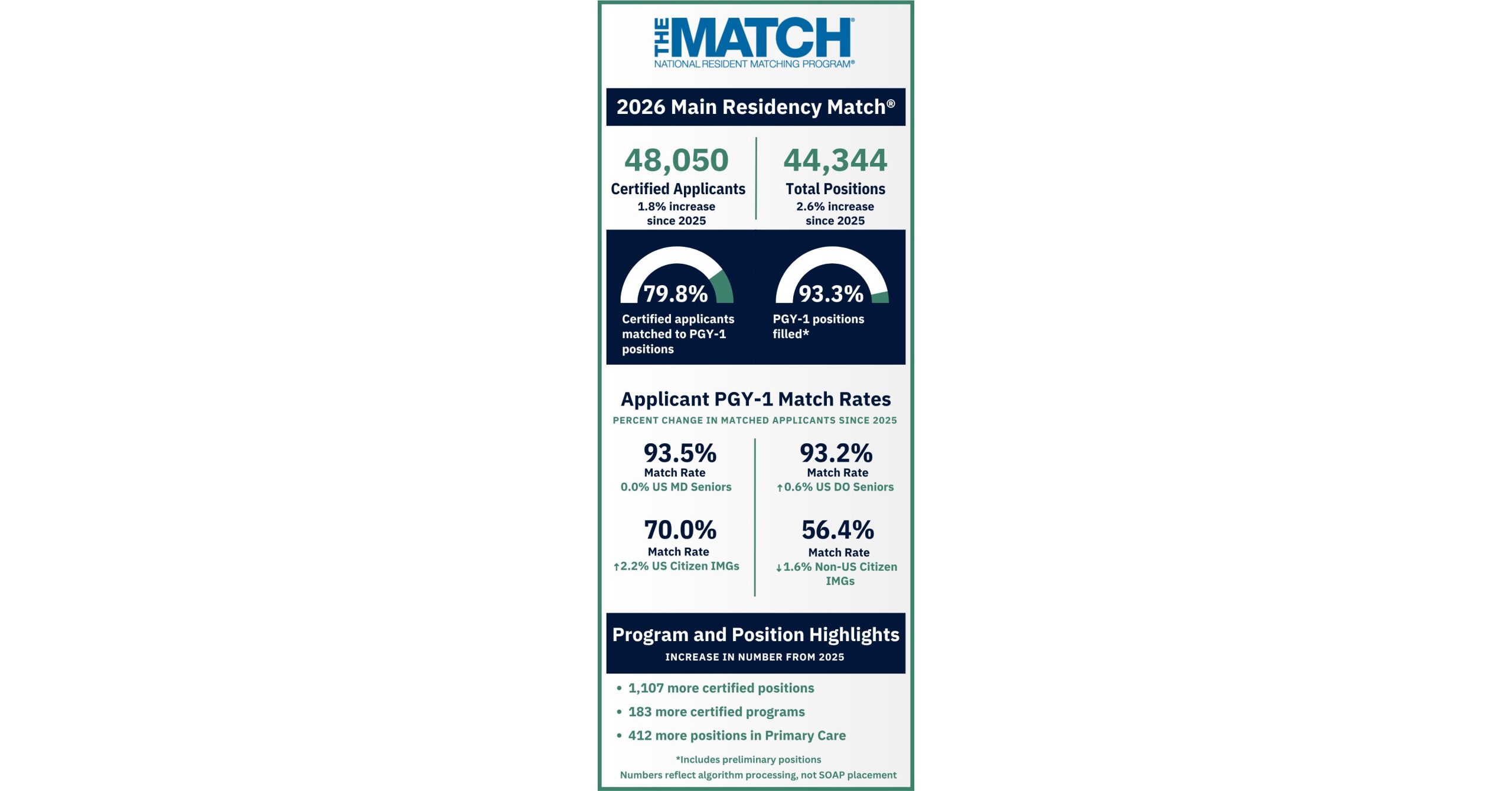
WASHINGTON, March 20, 2026 /PRNewswire/ — The National Resident Matching Program® (NRMP®) today announced the results of the 2026 Main Residency Match®, the largest in the organization’s history, with over 53,000 applicants registered and more than 44,000 residency positions offered in over 6,800 program tracks across the United States. The 2026 Main Residency Match demonstrated continued strength in residency placement, with more than 93 percent of positions filled nationwide. Today at 12:00pm ET, matched applicants learned where they will begin their clinical training.
“Every year, we look forward to sharing Main Residency Match outcomes and celebrating the hard work and achievements of thousands of students and graduates from across the country and the world,” said NRMP President and CEO Donna L. Lamb, DHSc, MBA, BSN. “Match Day represents an extraordinary moment for future physicians, and we are proud to see the Main Residency Match welcoming more positions and securing more training opportunities for applicants as they take the next step in their medical careers and begin practicing in communities across the nation.”
Applicant Data and Trends
Of the 53,373 applicants registered, 48,050 certified a rank order list (“active applicants”), representing an increase of 842 applicants (1.8 percent) over last year. Among active applicants, 38,354 matched to a post graduate year-1 (“PGY-1”) position, an increase of 687 (1.8 percent) from 2025. Across both PGY-1 and PGY-2, the Match filled a total of 41,482 positions.
- U.S. MD seniors continue to represent the largest applicant group in 2026 with 20,934 active applicants, an increase of 566 from last year. Once again, U.S. MD seniors achieved a PGY-1 match rate of 93.5 percent, a rate that has held constant since the 2024 Match.
- U.S. DO seniors achieved their highest PGY-1 match rate on record. There were 8,503 active applicants, an increase of 111 over last year, with a PGY-1 match rate of 93.2 percent, an increase of 0.6 percent from 2025.
- U.S. citizen international medical graduates (IMGs) accounted for 4,210 active applicants in 2026, a decrease of 377 from 2025, while the PGY-1 match rate rose to 70 percent, the highest on record. The PGY-1 match rate for U.S. IMGs has trended upward since 2022, even as the number of active U.S. IMG applicants has declined over the same period.
- Non-U.S. citizen IMGs accounted for 11,944 active applicants, an increase of 479 from 2025, while the PGY-1 match rate declined to 56.4 percent, the lowest level observed in five years.
Non-U.S. Citizen IMG Match Rates and Visa Sponsorship. IMGs play an important role in the U.S. physician workforce, and recent federal immigration policy changes have increased attention to visa sponsorship considerations in residency recruitment for foreign-born candidates. While PGY‑1 match rates are often reported in aggregate for non‑U.S. citizen IMGs, examining differences between applicants who require visa sponsorship and those who do not provides additional insight.
In 2026, foreign-born IMGs requiring visa sponsorship had a PGY‑1 match rate of 54.4 percent, a five-year low, compared with 67.9 percent for foreign-born IMGs not requiring sponsorship (U.S. permanent residents), a five‑year high. The highest match rate for foreign-born IMGs requiring a visa occurred in 2023 (59.1 percent), while foreign-born IMGs not requiring a visa peaked this year. These data highlight how broader policy conditions could shape future Match outcomes for non-U.S. citizen IMG candidates and inform future recruitment strategies of programs.
Program Data and Trends
The 2026 Main Residency Match included a total of 6,809 certified program tracks, an increase of 183 from the previous year. Of the 44,344 training positions offered, 93.5 percent (41,482) filled when the matching algorithm was processed.
Primary Care Specialties Maintain Strong Participation. Each year, the NRMP examines the outcomes of primary care specialties, including Internal Medicine, Internal Medicine-Pediatrics, Pediatrics, and Family Medicine. Primary care specialties continue to represent the largest share of positions in the Main Residency Match, with 20,712 positions offered this year, an increase of 412. Collectively, the specialties achieved a 92.1 percent fill rate, a decrease of 1.4 percent from 2025.
- Internal Medicine offered 11,632 categorical and primary positions — 280 more than in 2025 — and filled 11,078 positions, resulting in a 95.2 percent fill rate, a 1.6 percentage‑point decrease from last year.
- Internal Medicine-Pediatrics offered 404 positions — six more than in 2025 — and achieved a 100 percent fill rate, a 0.8 percentage‑point increase from prior year.
- Pediatrics offered 3,185 positions this year — eight fewer than in 2025 — and filled 3,006 positions, resulting in a 94.4 percent fill rate, a 0.9 percentage‑point decrease from last year.
- Family Medicine offered 5,491 positions in 2026 — an increase of 134 from 2025 — but the fill rate declined from 85.0 percent to 83.6 percent, leaving 899 positions unfilled; despite this decrease, the total number of applicants matching into the specialty increased compared with the prior year.
Reflecting on Family Medicine Workforce Trends. Family Medicine remains a cornerstone of the nation’s primary care workforce and a critical pathway for patient access to care. Over time, the specialty has faced growing challenges in attracting medical students, raising questions about how training pathways, professional expectations, and workforce needs are aligning. These trends have prompted broader reflection across the medical education community.
In response to these persistent recruitment trends, NRMP will convene a Blue Ribbon Panel of Family Medicine leaders and stakeholders in 2026 to closely examine medical student interest, evolving residency recruitment dynamics, and broader factors influencing the specialty’s growth and sustainability. The Panel will offer a space to thoughtfully consider how the specialty’s challenges and strengths have developed over time and how training pathways intersect with workforce needs. Insights from these discussions will be shared with the medical education community to deepen understanding and support continued conversation around the Family Medicine workforce pipeline.
Other Trends of Interest
Fluctuation in Emergency Medicine. In 2026, Emergency Medicine offered 3,198 positions, an increase of 130 positions compared with 2025, and achieved a fill rate of 95.6 percent. While the fill rate declined by 2.3 percentage points relative to the prior year, a total of 3,058 applicants matched into Emergency Medicine in 2026, representing a 1.8 percent increase in matched applicants. Following declines observed in the 2022 and 2023 Main Residency Match years during the COVID‑19 pandemic, fill rates in Emergency Medicine have been higher in subsequent Match cycles.
Strength in Psychiatry. Psychiatry offered 2,516 positions with a fill rate of 97.4 percent. The specialty added 30 programs, increasing available positions by 128 in the 2026 Main Residency Match. A total of 2,451 positions were filled, representing an increase of 71 filled positions compared with 2025; however, 65 positions remained unfilled, up from eight the prior year. Over the past five years, match rates for U.S. DO seniors and non‑U.S. IMGs in Psychiatry have shown a steady upward trend, while match rates for U.S. MD seniors have varied over the same period.
Supplemental Offer and Acceptance Program® (SOAP®)
Eligible applicants who did not match to a residency position had the opportunity to participate in the NRMP’s Match Week Supplemental Offer and Acceptance Program (SOAP). SOAP is a structured process that allows eligible applicants who are unmatched or partially matched to apply for and accept unfilled residency positions during Match Week. In the 2026 Main Residency Match, 2,862 positions across 941 programs remained unfilled after the matching algorithm was completed, an increase of 389 positions compared with the prior year. Of these, 2,581 positions were offered through SOAP, representing 330 more positions than last year. Detailed SOAP results will be available in the Results and Data: 2026 Main Residency Match report, which is published in the Spring.
View the Advance Data Tables, Match by the Numbers, and Match infographic for additional data and information.
About NRMP
The National Resident Matching Program® (NRMP®) is a private, non-profit organization established in 1953 at the request of medical students to provide an orderly and fair mechanism for matching the preferences of applicants for U.S. residency positions with the preferences of residency program directors. In addition to the annual Main Residency Match® that facilitates placement for more than 50,000 registrants, the
NRMP conducts Fellowship Matches through its Specialties Matching Service® (SMS®). The first SMS Fellowship Match was conducted in 1984 for Colon and Rectal Surgery. Since that time, the SMS has grown to encompass 23 separate Matches representing more than 75 subspecialties. The NRMP website provides a list of participating SMS Fellowship Matches, each including a summary statement, length of training, and applicant eligibility criteria.
For additional information or to schedule an interview with NRMP President and CEO Donna L. Lamb, DHSc, MBA, BSN, contact [email protected].
SOURCE National Resident Matching Program
First Appeared on
Source link




Leave feedback about this