

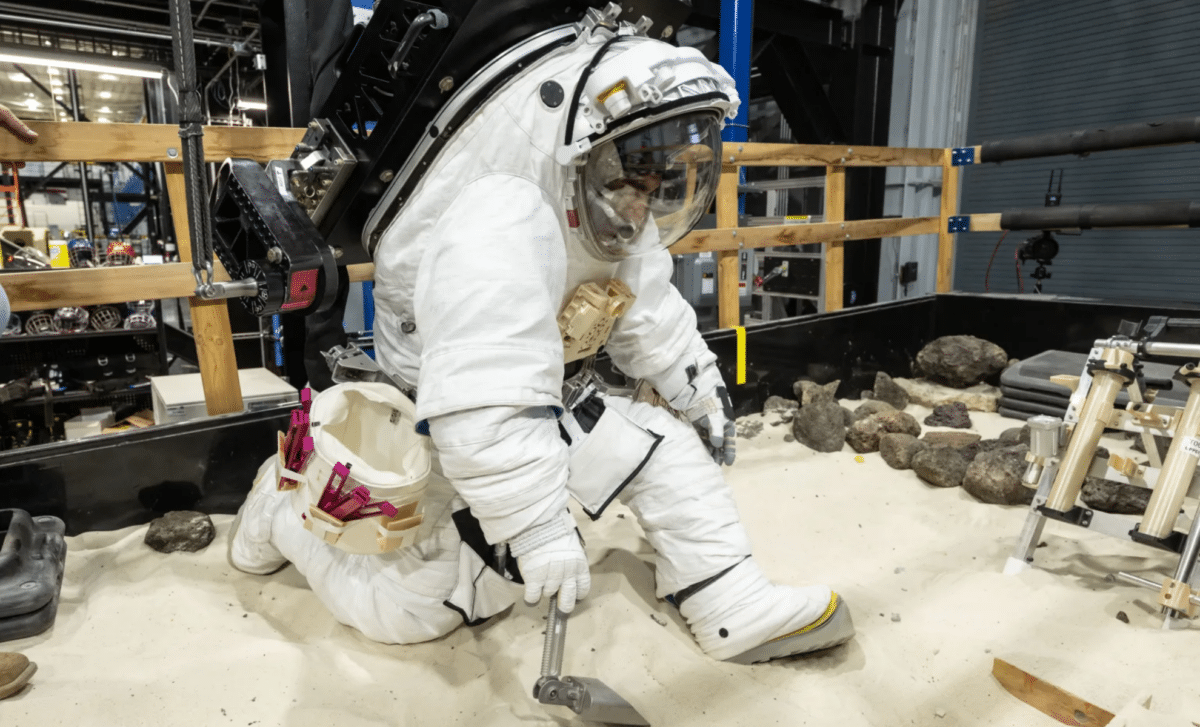
NASA’s Artemis III mission is progressing with a significant milestone as the new spacesuit designed for lunar exploration nears completion. Axiom Space, the contractor tasked with developing the next-generation spacesuit, has successfully passed a crucial technical review. Known as the AxEMU (Axiom Extravehicular Mobility Unit), the spacesuit is undergoing extensive testing to ensure its functionality and safety for astronauts preparing to journey to the Moon’s South Pole.
The Role of Axiom Space in Developing the AxEMU
Axiom Space, a leading contractor in the space industry, has played a pivotal role in designing the AxEMU spacesuit. The suit’s primary function is to provide astronauts with enhanced mobility and flexibility as they work on the lunar surface. A key feature of the spacesuit is its ability to allow astronauts to bend down and perform critical tasks like collecting geology samples and conducting scientific experiments. The design is tailored to fit astronauts of various sizes, thanks to its advanced adjustability, ensuring that more crew members can safely use the suit during missions.
“The completion of their internal review brings Axiom Space one step closer to delivering a next-generation lunar spacesuit,” said Lara Kearney, manager of the Extravehicular Activity and Human Surface Mobility Program at Johnson Space Center in Houston. “This achievement reflects our shared commitment to deliver a safe, capable lunar spacesuit that will enable astronauts to explore the Moon’s surface.”
Testing the AxEMU: From Underwater Simulations to Lunar Gravity
To ensure the AxEMU spacesuit will perform as expected on the Moon, NASA and Axiom Space have conducted extensive testing. One of the most vital aspects of this testing has been the use of NASA’s Neutral Buoyancy Laboratory, a 40-foot-deep pool where astronauts simulate movements in lunar gravity. The underwater tests are designed to replicate the one-sixth gravity of the Moon, allowing engineers and astronauts to assess the suit’s functionality in an environment that closely resembles the lunar surface. In these tests, astronauts perform various tasks, including walking, bending, and handling equipment, while engineers closely monitor the suit’s performance.
In addition to the underwater simulations, the teams are now conducting tests in NASA’s Active Response Gravity Offload System. This system uses an overhead lift to simulate reduced gravity, further helping astronauts adjust to wearing the spacesuit under conditions similar to those they will face on the Moon. As astronaut safety remains NASA’s top priority, these tests are critical in ensuring that the AxEMU can withstand the harsh conditions of the lunar surface, from extreme temperatures to radiation exposure.
Advanced Features of the AxEMU Spacesuit
The AxEMU is not just a traditional spacesuit; it represents cutting-edge technology designed to maximize astronaut safety and productivity on the Moon. The suit features advanced life-support systems that will keep astronauts safe while exploring the lunar surface. In addition, the AxEMU provides superior protection against the Moon’s harsh environment, which includes exposure to extreme temperature fluctuations and solar radiation. The suit’s advanced mobility system also allows astronauts to move with greater ease compared to previous models, making it easier for them to perform complex tasks while walking on the Moon.
Axiom Space is also developing specialized tools and equipment that astronauts will use while wearing the AxEMU, further enhancing their ability to gather geological samples and conduct scientific experiments. These tools will be instrumental in achieving the goals of the Artemis mission, which include scientific discovery and preparing for future human exploration of Mars.
First Appeared on
Source link






Leave feedback about this