

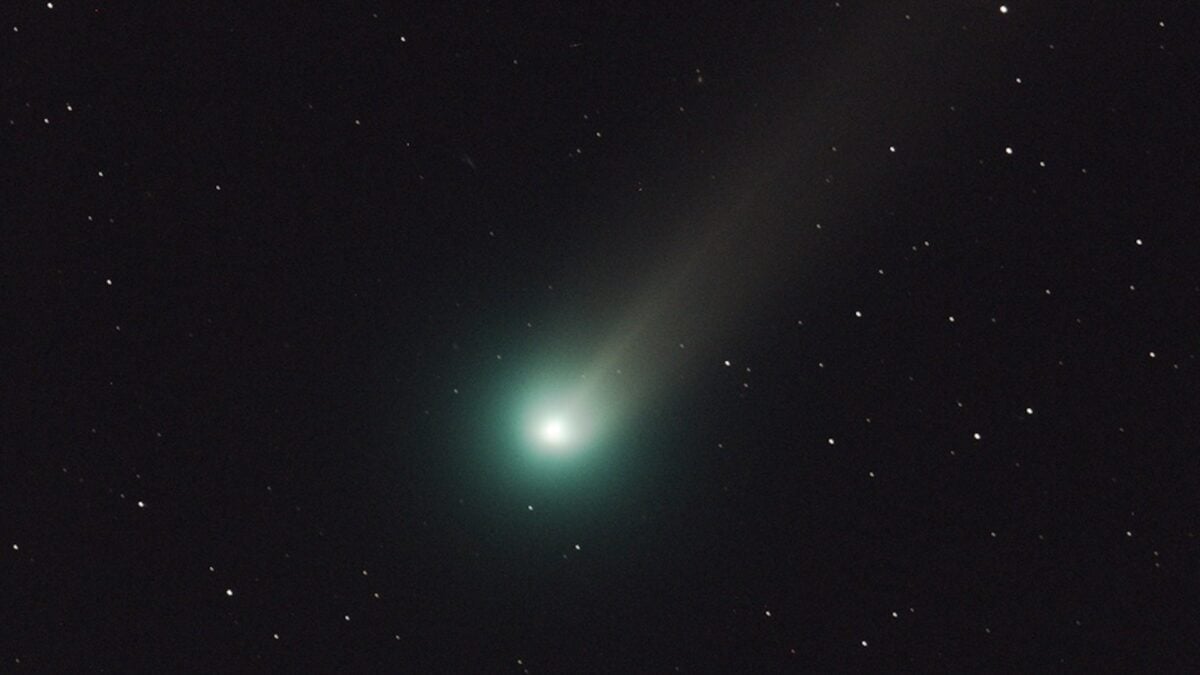
A recently discovered comet is plunging toward a fateful encounter with the Sun, which will determine whether it puts on a spectacular showing during the daylight or if it completely disintegrates into nothingness.
Comet MAPS (C/2026 A1) is set for its perihelion, closest approach to the Sun, on April 4, when it will come within 99,000 miles (160,000 kilometers) from our host star, according to Space.com. That’s incredibly close on a cosmic scale, and there’s a possibility that the comet may be torn apart by the Sun’s gravitational force or destroyed by the star’s heat. If it does survive, however, the comet could shine as bright as Venus in the evening twilight, Sky & Telescope reported.
The risky business of sungrazing
Astronomers first spotted the comet on January 13 from the AMACS1 Observatory in the Atacama Desert in Chile. The four astronomers behind the discovery run a near-Earth asteroid search program called MAPS, an acronym based on their last names: Alain Maury, Georges Attard, Daniel Parrott, and Florian Signoret.
At the time of discovery, Comet MAPS was 191 million miles (308 million kilometers) away from the Sun in the constellation of Columba the Dove. When it was first spotted, the comet was extremely faint at an 18th-magnitude brightness. Since then, it has dramatically increased in brightness to a magnitude of 11. That’s about as bright as Proxima Centauri, the closest star to the Sun, and visible to small telescopes.
The comet will likely become brighter as it races toward the Sun for a close encounter. Comet MAPS is part of a group of comets called Kreutz sungrazers, which get their name from their uniquely close approaches to the Sun during perihelion. Sungrazing comets are likely broken-off fragments from a larger object that may have broken apart centuries ago during its own solar meet-and-greet.
The Kreutz sungrazers tend to all be little guys; that’s why they either completely disintegrate or crash into the star during their close approach. Sungrazing Comet C/2024 S1 (ATLAS) met its unfortunate demise as it made its closest approach to the Sun on October 28, 2024, turning into a rubble pile.
Some lucky ones, however, do survive the encounter. Most famously, Comet Lovejoy, discovered in 2011, survived its perihelion and emitted a unique blue and green glow that lit up the night skies.
We’re rooting for you, MAPS
If Comet Maps isn’t completely destroyed by the Sun, it will put on one hell of a show. The odds are already in its favor since it’s slightly larger than most sungrazing comets at around 1.5 miles wide (2.4 kilometers).
The comet has the potential to become a bright object visible to the naked eye, with a peak magnitude of -4 (around the same brightness level as Venus). Its viewing prospects, however, are not so great, especially for skywatchers in the Northern Hemisphere, according to Sky & Telescope.
During its peak brightness, the comet will be very low in the western skies and too close to the Sun to spot clearly. As it moves farther away from the Sun’s glare, MAPS will begin to dim to a magnitude of 13 to 14. The best chances to see the sungrazing comet will be around 30 minutes after sunset.
It is likely that the comet will develop a long tail, which could be visible in the Northern Hemisphere during mid-twilight for several days. You should gaze toward the east-southeast low in the western skies for a peek at the comet’s elongated tail.
First Appeared on
Source link






Leave feedback about this