

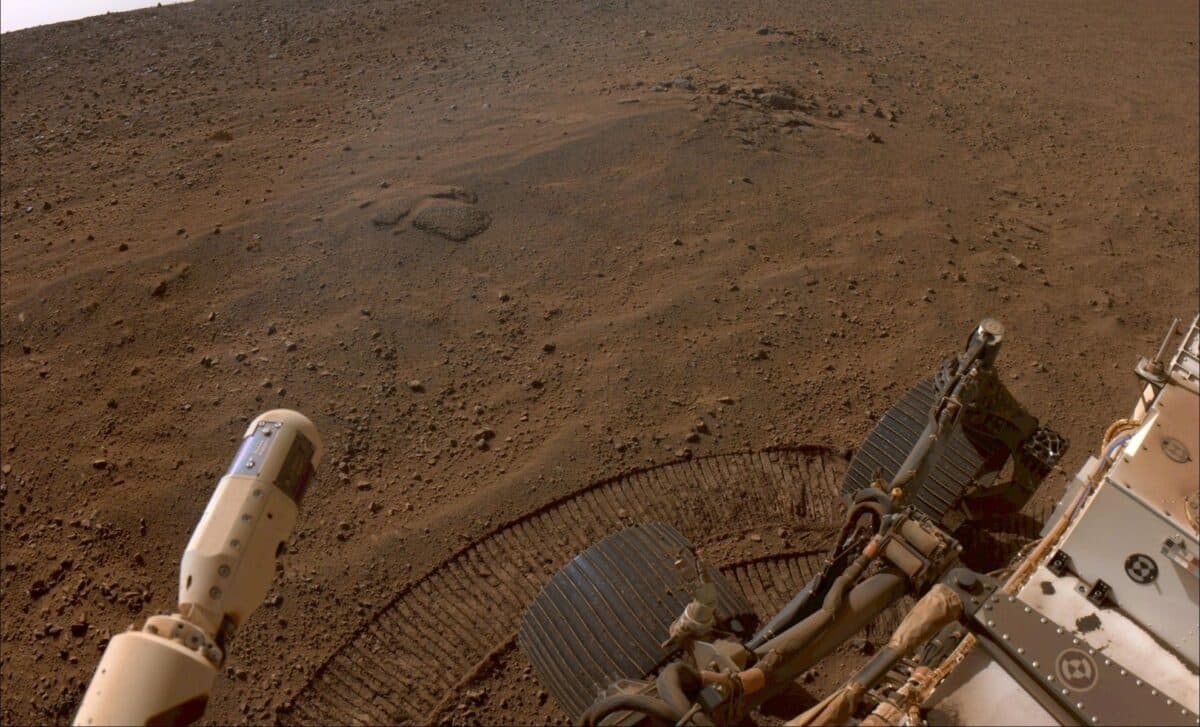
Two NASA spacecraft have detected different signals that point to possible lightning on Mars. One clue comes from orbit, the other from the planet’s surface, together strengthening the case that electrical discharges flicker through the Red Planet’s dusty skies.
Lightning has already been observed on Jupiter, Saturn, and Neptune. Mars, by contrast, has remained ambiguous territory. Its atmosphere is thin, and its magnetic field exists only in small, scattered patches, conditions that make any lightning harder to detect and likely very different from the bright bolts seen on Earth.
Scientists have long hypothesized that if lightning occurs on Mars, it would resemble faint electrical sparks generated by swirling, electrostatically charged dust. Now, recent findings based on data from NASA’s MAVEN orbiter and the Perseverance rover suggest those sparks may indeed be real.
A Rare Radio “Whistler” Detected by MAVEN
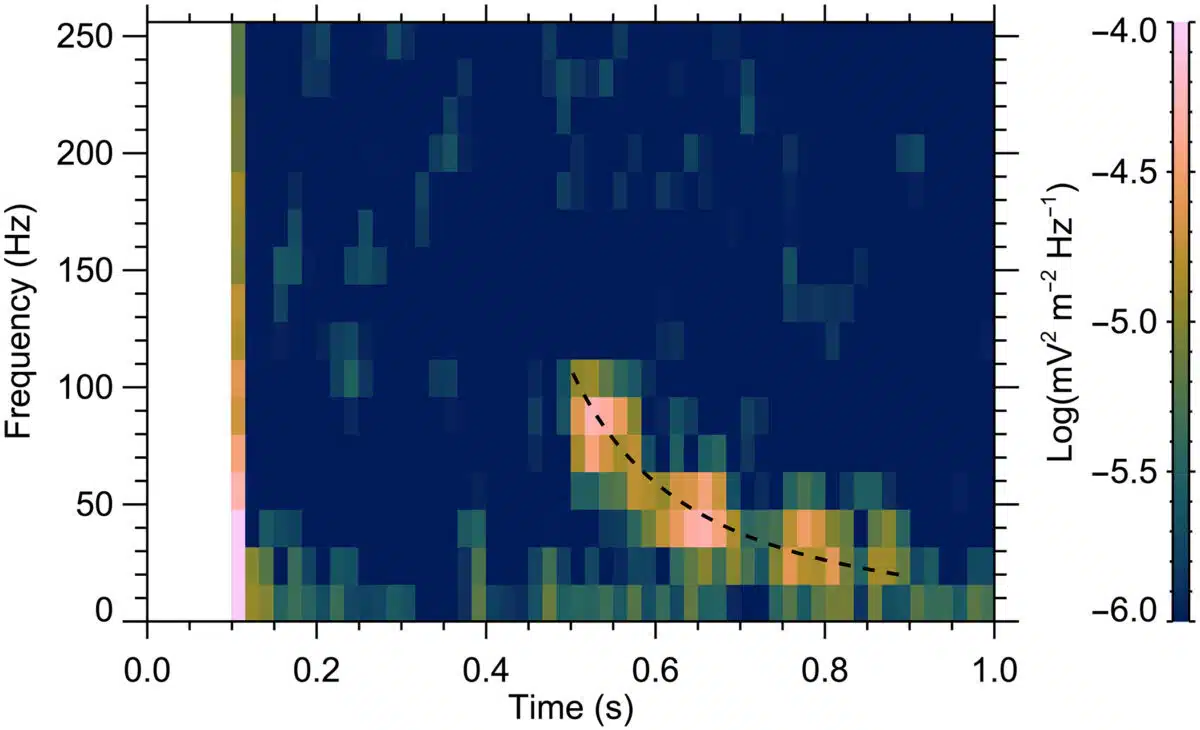
The most recent evidence comes from a study published on February 27 in Science Advances. According to the research, scientists identified a possible lightning signature in data collected in June 2015 by NASA’s Mars atmosphere and volatile evolution (MAVEN) spacecraft.
The team, led by Ondřej Santolík of the Czech Academy of Sciences, searched for radio signals known as “whistlers.” When lightning strikes, it heats and ionizes surrounding air, allowing radio waves to travel through the atmosphere and into space. On a receiver, these waves produce a characteristic whistle-like tone. Researchers reviewed 108,418 data snapshots from MAVEN. Santolík explained that:
“That needs to be done visually because it’s very hard to do it by a machine because of the noise features in the data”. Out of that extensive dataset, the team identified only one candidate signal. “It’s very surprising that we found it at all.”
The scientists then spent a year confirming that the signal matched what would be expected from lightning. NASA has reportedly been out of contact with MAVEN for nearly three months, leaving open questions about whether similar observations will be obtained in the near future.
Perseverance Hears Crackling During Dust Storms
A few months earlier, a separate group of researchers presented another form of evidence based on recordings from a microphone aboard NASA’s Perseverance rover.
The team identified dozens of crackling sounds produced by small electrical discharges during dust storms near the rover. These sounds likely reflect localized electrical activity within charged dust clouds rather than large-scale lightning bolts.
Karen Aplin, a space physicist at the University of Bristol who was not involved in either study, said the two findings together give “a feeling that we’re closing in on Mars lightning.” She noted that on Earth, different types of electrical discharges exist, ranging from thunderstorm lightning to the glow known as Saint Elmo’s fire, suggesting that Mars could host varied electrical phenomena as well.
A Discovery With Bigger Implications Than It Seems
Electrical discharges also influence atmospheric chemistry. As reported by Scientific American, lightning has been shown to spark chemical reactions that may contribute to the development of life. Understanding whether similar processes occur on the Red planet could help scientists interpret the planet’s chemical environment.
For Santolík, the findings are bittersweet. He was part of a team that developed a dedicated lightning detector for the Russian-made lander of the Rosalind Franklin rover, part of the European Space Agency (ESA) program. The mission, initially planned for 2022, was disrupted after Russia’s full-scale invasion of Ukraine.
ESA is now building its own lander for a 2028 launch but chose not to include instruments on the platform to speed construction. The lightning detector has since been returned to its creators and is not expected to fly to Mars.
At this stage, a single orbital “whistler” and crackling sounds detected at the surface stand as the strongest hints yet that the Red Planet may host elusive, dust-driven sparks in its skies.
First Appeared on
Source link






Leave feedback about this