

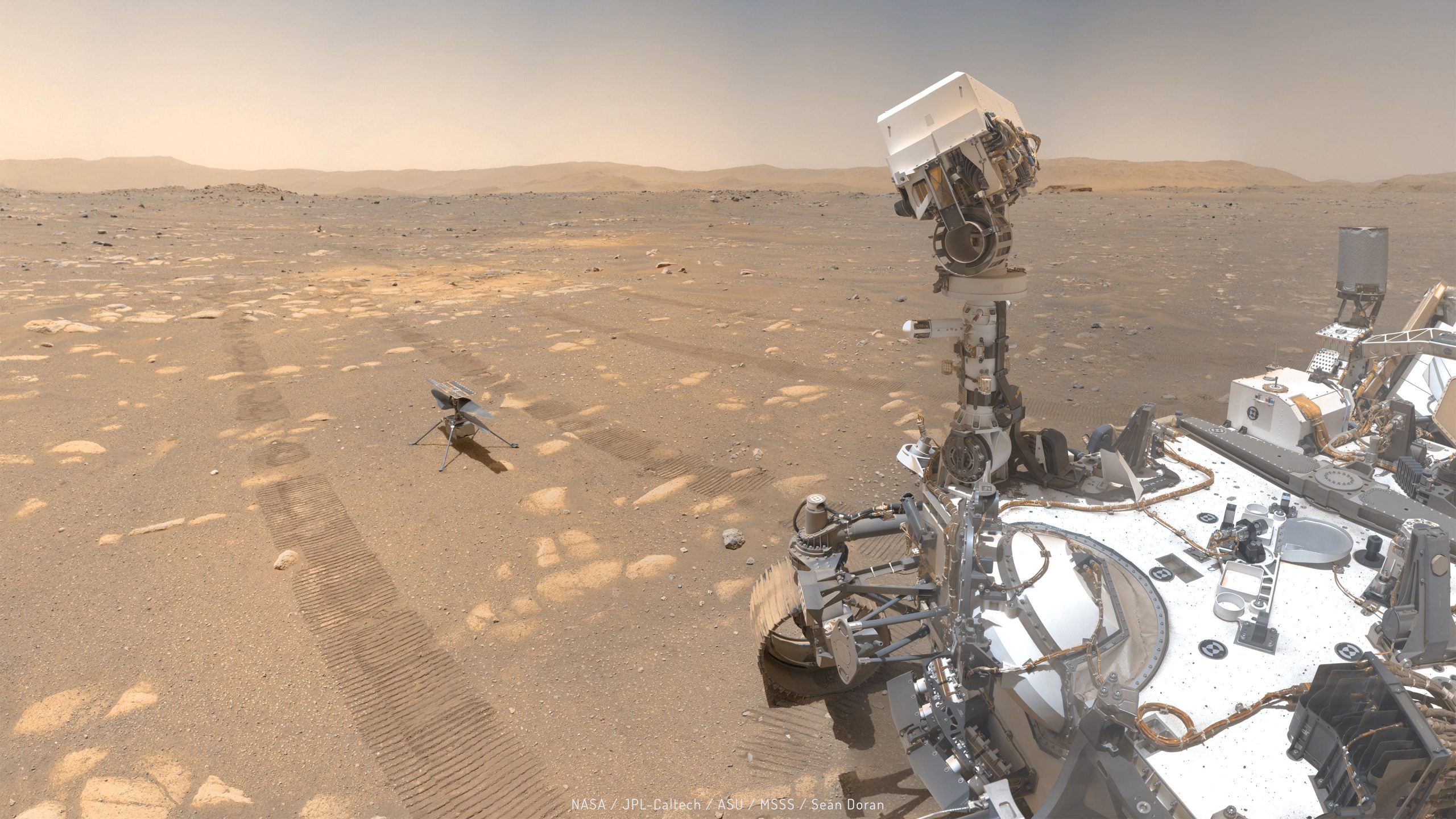
Unlike on Earth there aren’t dozens of satellites whizzing around Mars to provide satellite navigation functionality. Recently NASA’s JPL engineers tried something with the Perseverance Mars rover that can give such Marsbound vehicles the equivalent of launching GPS satellites into Mars orbit, by introducing Mars Global Localization.
Although its remote operators back on Earth have the means to tell the rover where it is, it’d be incredibly helpful if it could determine this autonomously so that the rover doesn’t have to constantly stop and ask its human operators for directions. To this end the processor which was originally used to communicate with its Ingenuity helicopter companion was repurposed, reprogrammed to run an algorithm that compares panoramic images from the rover’s navigation cameras with its onboard orbital terrain maps.
Much like terrain-based navigation as used in cruise missiles back on Earth, this can provide excellent results depending on how accurate your terrain maps are. This terrain mapping process used to be done back on Earth, but for the past years engineers have worked to give the rover its own means to perform this task.
Because the off-the-shelf processor in the rover’s Helicopter Base Station (HBS) is much faster than the custom, radiation-hardened processors that control the rover, the decision was made to try the algorithm on the HBS, especially since Ingenuity was left behind after it fatally damaged its propeller during a rough landing. This left the HBS unused and free to be repurposed.
Repurposing such OTS hardware also provided a good way to check for radiation damage to such standard hardware that was never certified for high radiation environments. To validate reliability the algorithm was run multiple times on the HBS, with the results compared by the main computer. This found some discrepancies, attributed to damage to about 25 bits out of 1 GB of RAM.
By isolating these damaged bits, the algorithm could run reliably, while giving another nod to the genius of the Ingenuity program that enabled such new features with what was at the time an unproven and relatively low-budget side-project tacked onto the Perseverance rover.
Thanks to [Nevyn] for the tip.
First Appeared on
Source link






Leave feedback about this