20 February 2026
Chicago 12, Melborne City, USA

Modi’s Chaotic AI Summit Showed India’s Clout and Constraints

Photographer: Ludovic Marin/AFP/Getty Images

Prime Minister Narendra Modi made his pitch this week that India can play a leading role in the artificial intelligence boom with a conference featuring tech stars from around the world. It suffered more than a few hitches.

Nvidia Corp.’s Jensen Huang dropped out after early promotion; Bill Gates withdrew later. Many attendees ran into trouble just getting into the grand Bharat Mandapam venue in New Delhi on Monday and logistics remained an ordeal all week. Mukesh Ambani, Asia’s richest man, had so much trouble getting through security that his speech — announcing the biggest deal of the India AI Impact Summit — was delayed.

Most Read from Bloomberg

Even so, Modi gave a forceful demonstration of the country’s influence. He gathered many of the most prominent names in the tech industry, including the chief executives of Alphabet Inc., OpenAI and Anthropic PBC, as well as the India-born CEOs of global corporate icons like FedEx Corp. The prime day of the summit was so jam-packed that celebrity leaders like Sundar Pichai and Sam Altman were allocated a mere five to 12 minutes each.

“It’s one thing to say you’re the leader of the Global South and it’s another to come across as the leader of the Global South,” said Reema Bhattacharya, head of Asia risk insights at advisory firm Verisk Maplecroft. “They’ve achieved what they wanted to achieve.”

The event mixed moments of genuine promise with evidence of India’s constraints as the global AI race accelerates. Similar to US President Donald Trump, Modi is able to elicit effusive praise and big promises from industry and government leaders, with Ambani pledging $110 billion for building out artificial intelligence projects across India over the next seven years. Speakers constantly praised the prime minister for his leadership and referred to him in the honorific, Shri Narendra Modi Ji.

But the country still lags in high-end computing infrastructure that’s necessary to build frontier large language models such as those produced by Silicon Valley companies or the coterie of Chinese upstarts that now sit atop many AI benchmark lists. Even the most efficient AI systems require tens of billions of dollars to build and operate, in a capital-intensive contest that US Big Tech in recent weeks escalated with plans for $650 billion in new spending in 2026.

The fight for artificial intelligence supremacy is between open versus closed systems rather than where those systems are built, according to Mistral AI’s chief executive officer, Arthur Mensch.Source: Bloomberg

Modi used the summit to argue for a model of AI development that sits in the middle lane between the corporate-led ecosystem of the US and state-backed China push. At the summit’s busiest day, inclusion and human-centered design took center stage.

“We have talent, energy capacity and policy clarity,” the PM said in Hindi, translated via AI into various languages. “AI is like GPS. It can show the direction, but where we want to go must be decided by us.”

He positioned India as the tech leader of the Global South — emerging economies, often previously colonized — that are eager to deploy AI but wary of aligning with one tech bloc or another. UN Secretary-General António Guterres reinforced that message, as did French President Emmanuel Macron, who sat alongside Modi at the gala with the ease of a longtime friend.

“The future of AI cannot be decided by a handful of countries or left to the whims of a few billionaires,” said Guterres.

The unifying message was that countries beyond the US and China want to be more than potential markets for AI companies. They want access to the best technologies, influence over regulation and the opportunity to share in the potential profits.

“India is trying to sort of set its terms,” said Bhattacharya. “The risk is India becoming this data colony for big tech where the proprietary, the value-added services are done elsewhere.”

One advantage the country has is the deep expertise of IT service firms like Tata Consultancy Services Ltd. and Infosys Ltd., leaders in helping the world’s corporations adopt new technologies like cloud computing and mobile services. They are now working with partners like Anthrophic and OpenAI to use their armies of consultants to help companies figure out how to use AI.

Natarajan Chandrasekaran, chairman of Tata Group, said on stage he sees the integration of AI and AI agents as a big opportunity for IT providers because of their understanding of the needs and opportunities for large-scale customers.

Demis Hassabis, Google DeepMind CEO, and James Manyika, Google’s Senior Vice President, on AI’s risks and potential.Source: Bloomberg

US companies, for their part, are accelerating expansion in India before local rivals catch up. Anthropic this week opened an office in the southern tech hub of Bangalore, while OpenAI is expanding operations following last year’s New Delhi launch.

“I was last here a little over a year ago, and it’s striking how much progress has happened since then,” Altman said on Thursday. India is the fastest-growing market for OpenAI’s Codex coding tool, he added, after Anthropic’s Dario Amodei had earlier said his company’s Claude Code had doubled its local users over the past four months.

“It’s important to move quickly. On our current trajectory, we believe we may be only a couple of years away from early versions of true superintelligence,” Altman, 40, said. The Tata Group, maker of Jaguar Land Rover SUVs, said this week that it will partner with OpenAI to create as much as 1 gigawatt in data center capacity.

While India has not had a national AI champion to compete with the world’s leaders, an Indian startup called Sarvam used the spotlight of the summit to launch its own AI model, tailored from the ground up for use in the South Asian nation. The service is voice-based and accessible through nearly two dozen Indian languages, which the company believes will be a competitive advantage in a country of 1.45 billion where the vast majority can’t read, write or type in English.

“Sovereignty matters much more in AI than building the biggest models,” said co-founder Vivek Raghavan at an event in Delhi.

Still, Indian startups have little chance to raise the kind of money their American counterparts have to build out AI models and infrastructure.

“India can catch up in the AI race not by outspending the US and China on frontier models, but by excelling in population-scale deployment in sectors such as agriculture, education and health,” said Brenda Mulele Gunde, global lead for digital transformation at the UN’s International Fund for Agricultural Development.

Modi’s administration has been supportive, providing subsidized computing capacity, access to public data and expanded AI training programs. India is also seeking to expand its manufacturing capabilities, including in high-tech sectors like semiconductors and smartphones. On Friday, the country formally joined a US-led initiative to protect supply chains, including for chips and critical minerals, along with countries like Japan and South Korea.

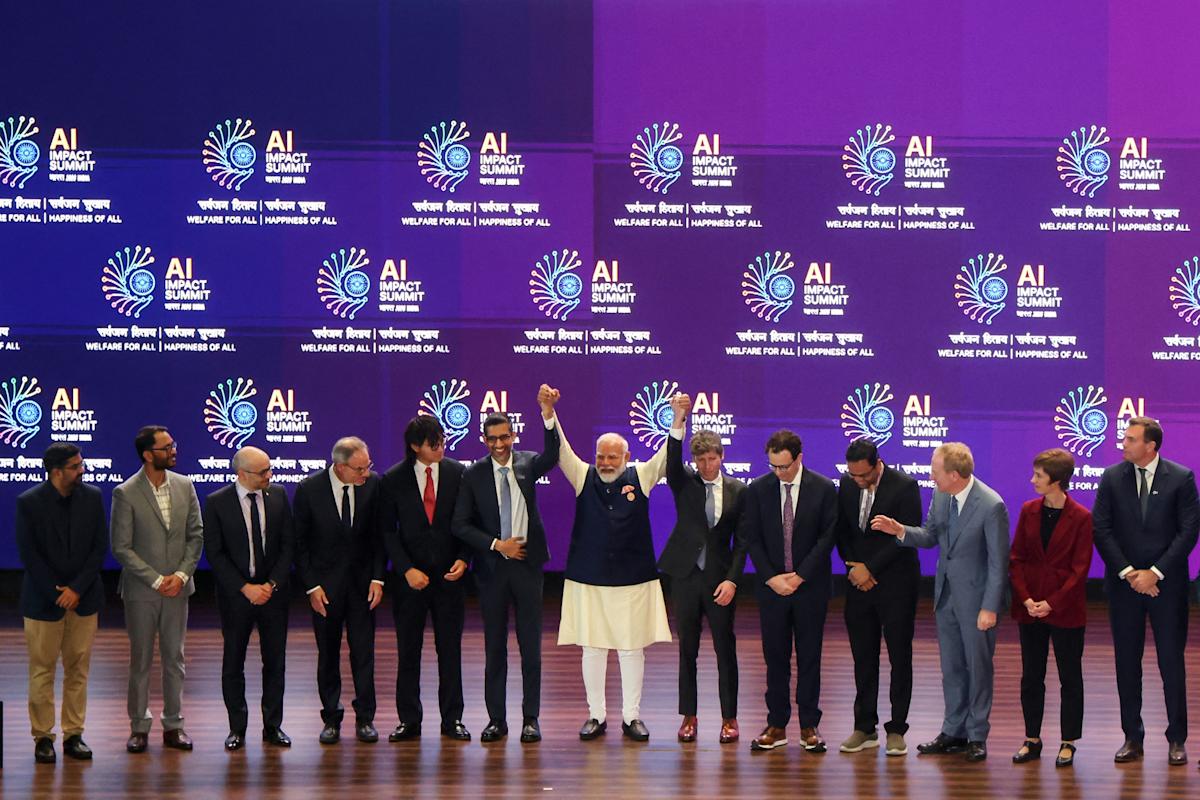
The miscues caught up with Modi on stage. In what was supposed to be a signature moment of the event, Modi pulled Pichai, Microsoft Corp. President Brad Smith and 11 others in for a group photo in the event’s main hall. Instead, as Modi and the others all clasped hands above their heads, Altman and Amodei — fierce rivals in the AI race — refused to hold each other’s hands, a glaring rift that quickly went viral on social media in India.

Another embarrassing incident came when a private university was booted out of the AI exhibition after it allegedly misrepresented a Chinese-made robot dog as its own product. The creator of that machine, Hangzhou-based Unitree, meanwhile was wowing viewers of the Chinese New Year TV gala with its latest humanoids performing acrobatics with humanlike fluidity.

India may not be able to match the US or China in the spending required for AI development, but it was clear that Modi’s conference tapped into a deep undercurrent of angst around the way this once-in-a-generation technology is evolving. In countries beyond the two giants, business and political leaders see the risk that they will end up at the mercy of American or Chinese tech giants — or worse at the mercy of Washington or Beijing. They want an alternative to that bleak future.

“We’re facing too much concentration of power in artificial intelligence,” said Arthur Mensch, CEO of France’s Mistral AI, speaking in Delhi on Thursday. “AI is going to change pretty profoundly the way the economy is being run in the next few years,” he added.

–With assistance from Vlad Savov, Saritha Rai, Shona Ghosh, Bhuma Shrivastava and Mark Anderson.

Most Read from Bloomberg Businessweek

©2026 Bloomberg L.P.

First Appeared on
Source link

Leave feedback about this

  • Quality
  • Price
  • Service

PROS

+
Add Field

CONS

+
Add Field
Choose Image
Choose Video