

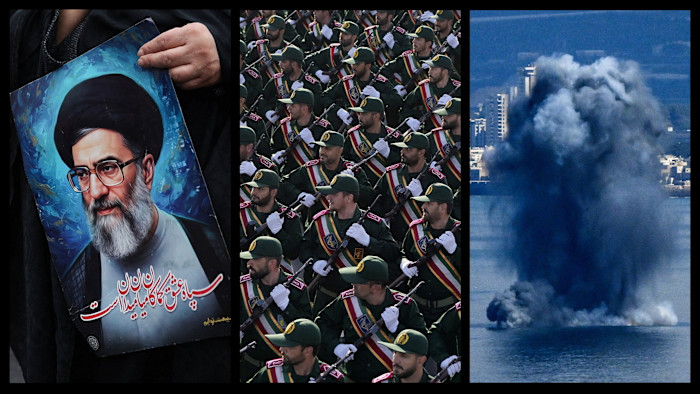
Iran appears determined not to fight the last war again.
After last year’s 12-day war with Israel — in which large barrages from Iran were heavily intercepted and launchers destroyed — Tehran has recalibrated its missile doctrine. In firing back at Israel, it has shifted from headline-grabbing salvos to a steadier campaign designed to stretch air defences.
At the same time it is using short-range missiles and drones for intensive attacks on US allies in the Gulf, targeting civilian infrastructure as well as American military bases. On both fronts, it is seeking to expend its least valuable munitions first, while depleting its adversaries’ interceptors and disrupting life across the region.
Since the US and Israel began striking Iran on Saturday, the Islamic republic had retaliated by launching ballistic missiles and drones “in over 25 waves” against targets across Israel, Bahrain, Qatar, the United Arab Emirates, Kuwait and Iraq, western officials said on Sunday.
Israeli officials said their country was being targeted with smaller salvos than in the previous conflict, but at a more consistent rate. This appeared to be a deliberate strategy of “attrition” by Tehran, referred to within Israel as a “drizzle” compared with last year’s attacks, said one former Israeli security official.
“Who said the Iranians will play by our rules?” the former security official added. “We don’t know where the Iranians will take it . . . but this [war] will likely not be measured in hours or days.”
The vast majority of Iranian barrages were intercepted by sophisticated air defence systems in Israel and the Gulf, but several kamikaze drones and missiles were either not judged dangerous enough to expend a valuable interceptor missile — or in a growing number of cases, simply evaded defences.
On Sunday the death toll from Iranian attacks was growing, though it was dwarfed by the toll within the Islamic republic, where the country’s supreme leader Ayatollah Ali Khamenei, top military commanders and the defence minister were killed, and total deaths were above 200, according to authorities.
Two direct Iranian missile strikes in Tel Aviv and Beit Shemesh on late Saturday night and Sunday, respectively, killed 10 people in total, Israeli emergency services said.
The UAE said three people were killed there by Iranian attacks and 58 lightly wounded as the country was hit by more than 150 ballistic missiles, more than 500 drones and two cruise missiles.
Damage and casualties were also reported in Bahrain’s capital Manama, Doha and Kuwait City. Sites hit in the region included a hotel and port. It was a stark contrast with the 12-day war, when Tehran launched heavily telegraphed strikes against a single US military base in the Gulf.
Political calculations might be causing Iran to escalate “hard, fast and early” against Gulf states, said BehnamBen Taleblu, an Iran expert at the Washington-based Foundation for the Defense of Democracies think-tank.
“If they create enough of a crisis, they believe that they can get US partners in the region to help pull the plug on any kind of Israeli or American operation against Iran.”
At the same time, as it did last year, Iran appears to be using its least advanced missiles first in an effort to deplete US and Israeli interceptors, potentially saving more advanced missiles for later in the conflict.
Video from a street in Doha in Qatar showed what experts said was likely a relatively low-tech, liquid-fuelled rocket — possibly part of an Emad or Shahab-3 ballistic missile — landing on a street after an apparent interception and exploding in a huge fireball.
“They are aware that the interceptors such as Thaad, Arrow and David’s Sling are exceptionally expensive and take years to accumulate,” said Robert Campbell, a former major and aerial weapons specialist in the UK military, referring to US and Israeli systems.
“They appear to be throwing older liquid-fuel missiles at Israel and the Gulf states to deplete these stocks and husband the newer solid-fuel missiles for later strikes.”
However, he said, “This relies on their launchers surviving.”
Another eyewitness video showed what was apparently a Shahed-136 — a low-tech Iranian mass-produced drone that has been used to devastating effect by Russia in Ukraine — striking a US naval facility in the Juffair district of Bahrain’s capital, Manama, where the US Navy’s fifth fleet is based.
“I am surprised and troubled that the US Naval HQ in Bahrain got hit by a Shahed drone, which is basically a toy aeroplane,” said Campbell.

Lynette Nusbacher, a former adviser to the UK cabinet on intelligence matters, said, “Iran would really like to ‘count coup’ — to get a warhead detonation on an Israeli or US military target.”
“The lesson the Iranians appear to have learned is that they can’t keep from being hit,” she added. “They anticipated the loss of command and control, and authorised regimental commanders or even lower to fire on pre-set targets. The people shooting are just shooting at co-ordinates off a spreadsheet.”
She said, however, that counter to any desire to save munitions, Iran also faced pressure to fire its missiles before Iranian launchers are destroyed on the ground. “[Iranian commanders] know that they need to use them or lose them.”
Israeli military spokesperson Nadav Shoshani on Sunday said Israeli attacks on Iran were “targeting launchers more than missiles”. An Israeli military official said on Sunday that 200 ballistic missile launchers had been dismantled and dozens more rendered inoperable, accounting for 50 per cent of the regime’s ballistic missile launchers, though those figures could not be independently verified.

Centcom, the US military command for the region, said on Saturday its forces successfully repelled hundreds of Iranian missile and drone attacks, but on Sunday said three US troops had been killed in action.
Israel’s military said on Sunday morning it was “not aware” of any impacts on IDF bases or other military installations.

Iran has spent the months since last year’s 12-day war replenishing its arsenal and upgrading its missiles. The IDF said Iran used more than 500 missiles against Israel during the 2025 war, of which almost 90 per cent were intercepted, while hundreds more were destroyed on the ground. Israeli intelligence assessments found that Iran’s arsenal was back up to 2,500 ballistic missiles by the start of the current conflict.
Most ballistic and cruise missiles today rely on multiple guidance systems to ensure they make it through widespread GPS jamming. The most advanced missiles use optical guidance, with onboard cameras or imaging sensors helping them to steer towards a target.
In Iran’s inventory only a few missiles, such as the solid-fuel Haj Qasem and Qassem Bassir — unveiled in 2020 and 2025, respectively — are reported to have this technology. The former reportedly struck the Haifa refinery last June, and there were no reports of the latter missile’s use in the previous war.
Iran’s other top-tier missiles emphasise payload over precision. Iran’s largest missile, the Khorramshahr, can carry a two-tonne warhead, potentially offsetting inaccuracy with destructive power. Iranian media claimed it struck targets in Israel last year, but western sources did not confirm this. Other advanced missiles used last year include the solid-fuel Fattah-1 and the two-stage, solid-fuel Sejjil.

“I think they are calculating that it’s going to be a lengthy war. And they’re calculating how they’re going to retaliate,” said Danny Citrinowicz of the Institute for National Security Studies in Tel Aviv.
Iran’s evolving tactics were evident by the end of last year’s war, said Taleblu.
“By the end they actually fired quantitatively fewer ballistic missiles at Israel than in the beginning [of the war] but . . . [were] able to score more hits. [Iran] was able to do that because it ran the clock on missile math when it came to interceptors.”
Citrinowicz said the constant barrages were also having a psychological effect in Israel. “It seems designed to create this overwhelming feeling, psychological feeling that you have to be near your shelter,” he said.
Despite that, Karim Sadjadpour at the Carnegie Institute for International Peace said Iran could choose to hunker down, “absorb the blow” and save some of its retaliation for later — for example, launching more attacks after the US has withdrawn military assets from the region and is more exposed.
“And that could be costly for us,” he said. “It’s not easy for us to maintain this enormous force posture for long periods of time.”
First Appeared on
Source link




Leave feedback about this