

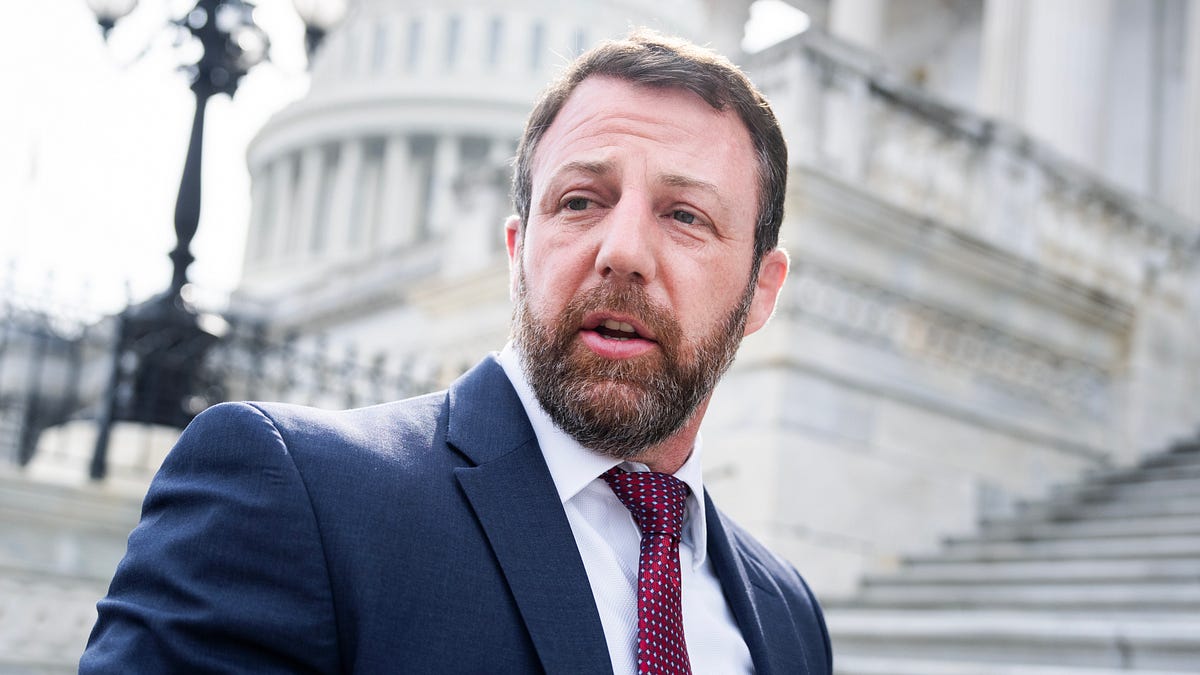
WHEN DONALD TRUMP announced he was dumping Kristi Noem as his secretary of homeland security and replacing her with Sen. Markwayne Mullin, some framed the decision as a much-needed refresh for a beleaguered agency.
Noem accumulated more than her share of baggage during her fourteen months atop the nation’s main immigration-enforcement department. She’s been accused of launching a massive ad campaign with her as the star; handing out a sweetheart no-bid contract for part of that PR blitz to a company that subcontracted some of its work to the firm of a top aide’s spouse; commissioning the purchase of a luxury jet with a bedroom in the back; and carrying on a brazen affair with her adviser and “special government employee” Corey Lewandowski.
But while Mullin hasn’t done anything quite like the above, the soon-to-be head of DHS can hardly be considered baggage-free.
Consider the chaos this winter that consumed Minnesota following the ramp-up of ICE and CBP forces there. The Oklahoma Republican repeatedly defended the aggressive enforcement actions, according to an extensive review by The Bulwark of his television appearances and public utterances during that time. He kept up the cheerleading even after two U.S. citizens were killed by federal agents.
When officers shot Renee Good as she attempted to drive away from the scene of an ICE protest, Mullin echoed Noem’s assessment that Good had engaged in an act of domestic terrorism. “They are terrorizing their city right now,” he told News Nation. “What [Noem] said was absolutely, 100-percent correct.”
During a CNN interview a few days later, reporter Kaitlan Collins pressed Mullin on whether authorities should investigate Good’s killing—something that Noem and the FBI have both resisted, even going so far as to refuse cooperation with local officials. “If they’re investigating anything, they need to be investigating the paid protesters, and who’s paying them to obstruct federal officers,” he declared at one point.
In another CNN interview, Mullin was presented with video showing that ICE officers shot Good two times from the side of the vehicle, in addition to once from the front. He discounted the video. “That’s very selective imaging that you guys are using,” he told host Jake Tapper.
Weeks later, when Alex Pretti was shot and killed on the streets of Minneapolis after he moved to protect a woman who had been pushed by ICE, Mullin again attacked the victim.
“Tell me what crime that ICE is doing other than doing their job,” he told Fox News. “Unfortunately, a . . . deranged individual that came in to . . . cause max damage, with a loaded pistol, with an extra mag that was completely loaded, was shot and killed. How much more of this is going to go on before the Democrat leaders there take responsibility for their words?”
In a separate interview with Fox Business, he responded to his colleague Sen. Chris Murphy (D-Conn.), who had said ICE was murdering U.S. citizens. Mullin made clear that he was mad as well—at Murphy. “Well, these American citizens are actually impeding federal officers from doing their job,” Mullin stressed.
Mullin is well liked by his congressional colleagues, and his comfort with media appearances has turned him into a messaging asset to the administration and helped sand down his once-gruff public image. Some former Mullin foes have come around. For example, Sean O’Brien, the head of the Teamsters union—whom Mullin once challenged to a fight during a public hearing—now sees the senator in a positive light, praising his nomination to lead DHS. But on the topic of immigration and border enforcement, Mullin took positions that were directly contradicted by publicly available evidence or were deeply insensitive to the families of the ICE victims. He has never recanted or walked them back, according to a review of the public record.
Mullin’s office did not respond to specific questions about his past comments.
MULLIN’S APPROACH to his upcoming nomination hearings will signal how both he and the Trump administration view the current politics of immigration. Last week, the senator said all of the right things when asked if he would meet with Senate Minority Leader Chuck Schumer (D-N.Y.), who has described DHS as being so far gone with “rot” that changing out the head may not meaningfully change the department’s culture.
“I want people to understand . . . when I go into this position, yes, I’m a Republican, yes I’m conservative, but . . . regardless of if you support me or don’t support me, regardless of what your thoughts are . . . my focus is to keep the homeland secure,” Mullin told reporters. “If Mr. Schumer wants to sit down and talk to me, I’m going to sit down and talk with him. I want to try to earn their support, and I’m going to be open and honest with them.”
His effort to present himself as open to various viewpoints, including those of his critics, mirrors the Trump administration’s own attempt at a revamp in response to the way its relentless and often unlawful immigration enforcement policies have made their brand toxic with the American people. In a closed-door briefing Tuesday in Florida, James Blair, one of the president’s deputy chiefs of staff, told House Republicans to stop talking about “mass deportations” and instead focus their rhetoric on the removal of violent criminals, Axios reported.
Of course, this doesn’t mean the administration actually intends to moderate its policies—only that they want voters to think they are moderating. But after a year of extreme rhetoric and nihilistic hype videos from DHS, it’s hard to imagine the public will simply give credit for a communications strategy that is more gentle and reasonable about immigration. As Bobby Pulido, a Tejano singer who won the Democratic primary to face Rep. Monica De La Cruz in Texas’s 15th Congressional District, put it: “Too late cabrones….ya’ll already said the quiet part out loud.”
Pulido told The Bulwark that Mullin’s nomination is just an effort to put lipstick on a pig of an agency that won’t change under Trump.
“People see it, this is not even about deportations anymore, this is about corruption,” he said. “Noem wasn’t doing this without their authority, she just fell on the sword for them. I have no doubt he [Mullin] is going to do what they tell him to do.”
Mullin certainly has been a steadfast ally of the White House, even when the going was tough: When reporters asked him to account for the most controversial policy pursuits of Noem’s tenure—the ones that alarmed Americans and plunged voter approval over the last year—he remained a dutiful loyalist, often parroting Noem’s talking points.
Mullin was unmoved by the attempted deportation of Liam Ramos, a 5-year-old child of an undocumented immigrant in Minneapolis. After pictures emerged of a bunny hat–wearing Ramos being detained outside his school, the senator said the press was deliberately misleading their readers and viewers about the circumstances of the case.
“This story that they’re blowing up about this 5-year-old kid is so false, is so untrue that honestly, there probably should be some lawsuits filed against this,” he said of an incident that even his fellow GOP senators insisted they found disturbing. “Because I spoke to Secretary Noem yesterday and today about the case. They’re not even reporting the facts.”
Mullin’s view of the unrest in Minneapolis following ICE’s larger deployment there was that the agency’s aggression and belligerence toward protesters was justified. It was the people following, filming, and whistling at agents who had gone beyond their constitutionally protected rights and were instead impeding law enforcement in politically motivated and potentially criminal ways. He accused them of being paid by liberal donor George Soros, who he insisted was “obviously behind this.” Despite no clear evidence, he said the Soros connection was “not even disputable at this point.”
Soros isn’t the only figure Mullin has chosen to villainize. He also accused the media of “stirring this discontent across the country, and they’re getting people killed because of their false reporting.” And he has attacked district court judges for issuing rulings that had forced ICE to slow, stop, or even reverse some of its most aggressive tactics. Asked by Fox News host Will Cain about the deportation of Kilmar Abrego Garcia to El Salvador, which proceeded despite a judicial order prohibiting the administration from sending him to that country, Mullin went after the judge for overstepping what the senator considers his proper zone of authority.
“I’m not an attorney,” the former plumbing-business operator said. “But when you are a guest inside the United States, you don’t have the same due process, if you wanna say, as an American citizen or even an LPR, a legal permanent resident.” The U.S. government had at this point already admitted that the deportation of Abrego Garcia was an “administrative error,” and they later brought him back to the United States.
These statements are all in line with things Noem said that contributed to her position atop DHS becoming so tenuous. They also reflect some of the main points of contention that emerged during her participation in oversight hearings just before she was fired.
In spite of his controversial statements, Mullin is unlikely to lose support among Senate Republicans, who have the votes (assuming there are no more than three defections) to get him confirmed when his nomination is considered in the coming weeks. That’s because many of the positions he advocated have become matters of doctrine for the GOP, such as the belief—which Mullin articulated in December 2020—that the 2020 election was “stolen” from Donald Trump; or his argument—expressed years later—that the January 6th riots were the result of inaction from then-Speaker Nancy Pelosi.
But Mullin’s positions could spark contentious questioning from Democrats at those confirmation hearings. The senator might soon be on the spot to explain his support for sending National Guard troops into Los Angeles, and to explain his argument against requiring ICE to obtain judicial warrants in order to carry out some of their deportation-related activities.
“If they actually required you to have a judicial warrant on every individual you picked up that was here illegally, the entire country would become a sanctuary city,” he told Fox News.
Mullin also has an aggressive position on one of the biggest sticking points in the current debate over funding DHS: a Democratic demand that legislation be passed requiring that ICE agents no longer wear masks. The senator, like Noem before him, is vehemently opposed.
“The reason why they want the ID and they want the mask taken off is because they want to dox these individuals, and they want to threaten them,” Mullin told Fox News host Brian Kilmeade. “There’s no other reason why.”
First Appeared on
Source link





Leave feedback about this