

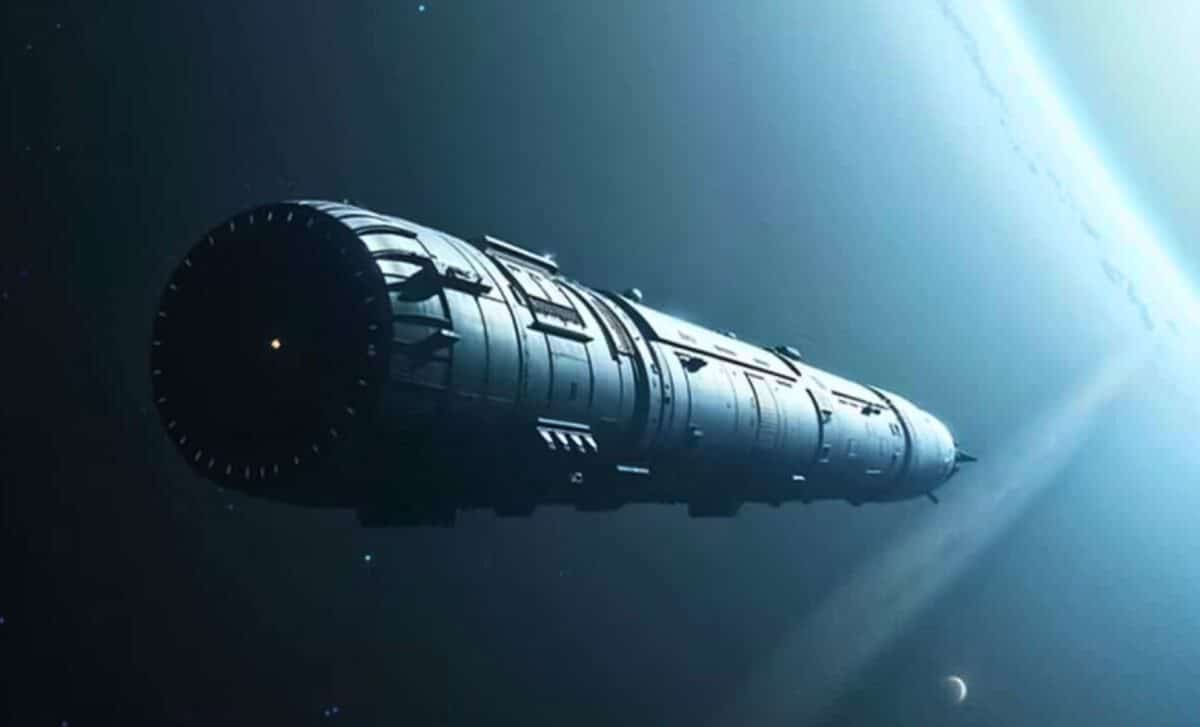
It would take four centuries to reach its destination. It would carry 2,400 people who would never see the world they left or the world their descendants would eventually inhabit. It would need to generate its own gravity, grow its own food, recycle every molecule of water and air, and preserve enough technical and cultural knowledge across 16 generations to complete a voyage no human has ever attempted.
The Chrysalis design, which won an international competition in 2025, specifies how such a vessel might be built. The documents run to hundreds of pages. They include architectural renderings of interior landscapes, mass budgets for agricultural modules, rotation calculations for artificial gravity, and governance models intended to prevent social collapse over 400 years of confinement.
What makes Chrysalis different from earlier generation ship concepts is the level of systems integration. The design does not simply assume that closed-loop life support or long-duration propulsion will eventually become available. It specifies how those systems might connect, what redundancies would be required, and where current research falls short. The document functions less as a blueprint and more as a detailed inventory of what remains unknown.
The Physics That Demands 58 Kilometers
Artificial gravity shaped every structural decision in the Chrysalis design, and the physics of rotating habitats imposes unforgiving constraints. A detailed analysis published by ABC Science notes that humans experience disorientation when rotation rates exceed approximately two revolutions per minute. To simulate useful gravity at that low rotation speed, a habitat must be large. Very large.
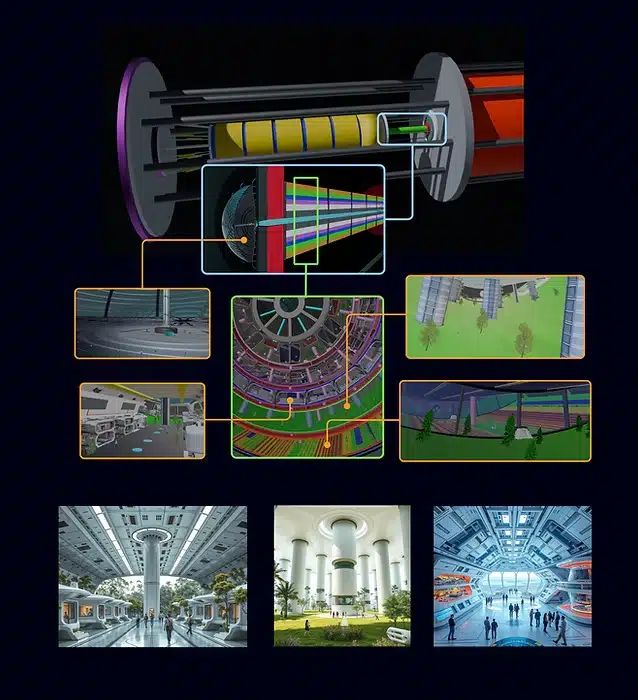
The Chrysalis team arrived at a 58-kilometer structure with nested cylinders rotating in opposite directions. The outermost layers produce centrifugal force equivalent to 0.9 times Earth’s gravity. Inner shells rotate counter to the outer ones, a configuration intended to reduce structural perturbations that could propagate through the vessel. The habitat module sits at the forward end, tapering to minimize collision risk with interstellar debris during acceleration and deceleration.
The 58-kilometer dimension is not symbolic. It is the direct consequence of trying to keep human occupants comfortable while generating gravity through rotation. No existing orbital facility could assemble a structure of this scale. No launch system could lift its components from Earth. The design assumes assembly at one of the Lagrange points, regions NASA describes as gravitationally stable areas where spacecraft can maintain position with minimal fuel expenditure. Lagrange points are often cited in conceptual studies for large-scale construction because they avoid the energy costs of operating in deep gravity wells.
Life Support, Propulsion, and the Gap Between Concept and Hardware
The Chrysalis design assumes fusion power for propulsion and shipboard energy. The team specified a Direct Fusion Drive using helium-3 and deuterium, with one year of acceleration to reach cruising speed, 400 years of coasting, and a final year of deceleration. No operational fusion reactor suitable for spacecraft propulsion exists as of early 2026.
Government research roadmaps project demonstration reactors decades ahead, and none of those plans address the additional requirements of spacecraft deployment: radiators that function in vacuum, shielding that lasts centuries, maintenance access that remains possible when the reactor is too dangerous to approach. Radiation protection presents similar uncertainties. Deep space exposes crews to galactic cosmic rays and solar particle events. Shielding sufficient to block high-energy particles over multiple centuries would require material thickness beyond what current launch systems could deliver.
The Chrysalis documentation treats structural shielding as provisional, noting that adequate materials have not been developed or tested. Some competition entries addressed this through alternative approaches, including proposals to house the habitat inside a hollowed asteroid, but Chrysalis relies on engineered shielding that does not yet exist.
Ecological closure may be the most empirically constrained system. Experiments on the International Space Station achieve water recycling approaching 98 percent efficiency and support limited plant growth. Closed-environment studies on Earth, including the Biosphere 2 project in the 1990s, demonstrated how difficult it is to maintain stable atmospheric composition without external intervention.
The supporting modelling document released by Project Hyperion details the ecological cycles, water recovery systems, and agricultural integration required for a vessel operating without external resupply. The Chrysalis design assumes fully integrated biological loops operating for 400 years. No experimental facility has approximated that condition.
Social Architecture Across 16 Generations
The Hyperion competition required teams to address not only physical survival but also social cohesion across centuries. The Chrysalis proposal includes crew selection protocols modeled on Antarctic overwintering station experience, where isolation and confinement produce measurable psychological stress patterns. The design assumes that pre-mission training in extreme environments would help identify individuals capable of tolerating multidecade confinement.

Social structure received detailed attention in the design documents. The Chrysalis team proposed community-based child-rearing rather than nuclear family units, with population management through voluntary birth spacing. Knowledge preservation systems would maintain technical and cultural continuity across generations that will never meet. Governance would involve what the team described as AI-assisted decision-making.
These provisions address a research gap for which no empirical data exist. Submarine crews rotate. Antarctic stations winter over for months rather than lifetimes. The longest-duration space missions have measured confinement in months. The Chrysalis documentation identifies social stability as an open research domain requiring further study, not as a solved problem.
First Appeared on
Source link




Leave feedback about this