

For decades, most spacecraft carrying humans have been little more than compact capsules or orbital laboratories. Crews rarely exceed a handful of astronauts, and missions typically last months rather than years. Those limits reveal a central obstacle in human exploration: traveling beyond the solar system requires far more than rockets and navigation systems.
Engineers studying interstellar missions increasingly approach the challenge from a different perspective. Instead of designing a craft for a small crew, they imagine a self-contained environment capable of supporting an entire population for generations. A vessel attempting such a journey would need to produce food, recycle its atmosphere, and maintain a functioning society without any external support.
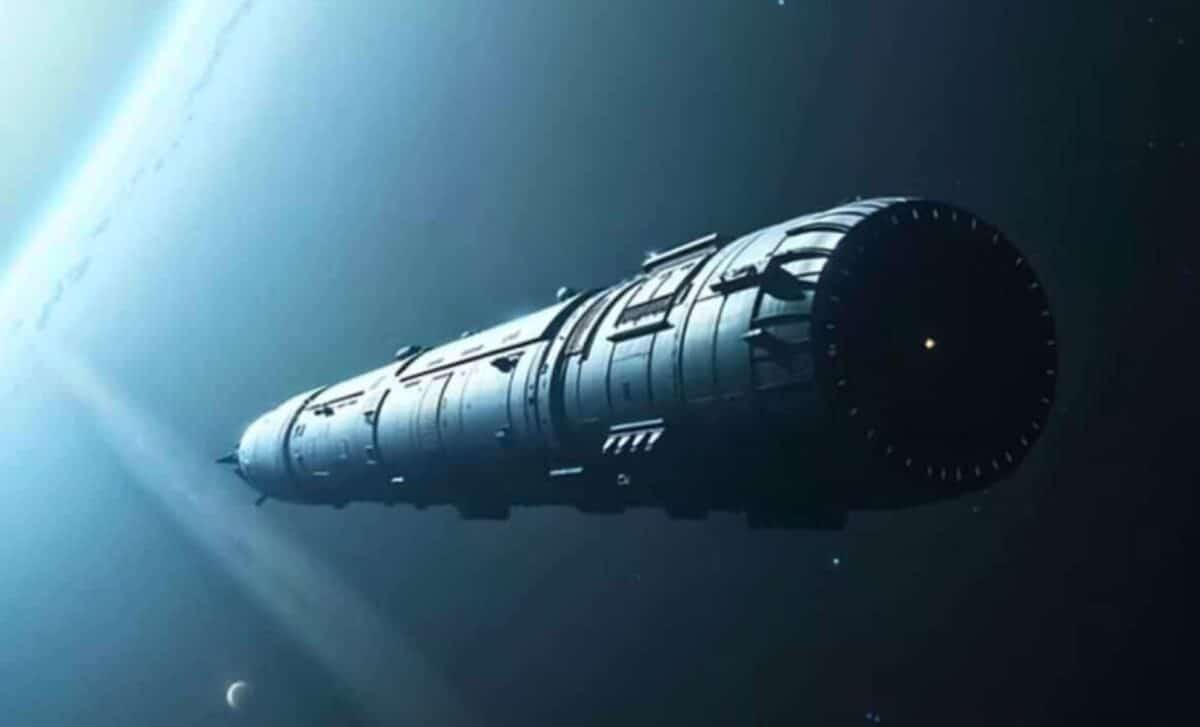
One concept exploring that possibility is called Chrysalis. Developed as part of the Project Hyperion Design Competition, the proposal outlines a massive generational spacecraft capable of carrying 1,000 people on a voyage lasting roughly 250 years toward a neighboring star system.
A Spacecraft Designed as a Permanent Settlement
The Chrysalis concept was proposed by a multidisciplinary team that includes Andreas M. Hein of the University of Luxembourg and designer Frederic Spiedel. Their approach treats the vessel less like a transport craft and more like a long-term settlement that happens to travel through space.
At the center of the design is a rotating habitat ring. Instead of drifting weightless, the inhabitants would experience artificial gravity generated by centrifugal force as the structure spins. This approach has long been considered one of the most practical ways to replicate Earth-like gravity conditions in space.
Artificial gravity is not merely a comfort feature. Extended stays in microgravity can cause bone density loss, muscle deterioration, and cardiovascular changes in astronauts. Research summarized in an ABC Science analysis on artificial gravity and rotating spacecraft habitats explains that rotation can counteract many of these effects by creating a constant downward force similar to gravity on Earth.
The size of the structure is critical for making that system work. Smaller rotating habitats must spin faster to produce gravity, which can lead to motion sickness and uncomfortable variations in force between a person’s head and feet. By increasing the diameter of the rotating section, the Chrysalis design allows slower rotation while maintaining a stable environment for residents.
Turning the Spacecraft Into a Closed Ecosystem
Supporting a population of 1,000 inhabitants over centuries requires far more than engineering the structure itself. The interior of Chrysalis is organized as a closed ecosystem designed to recycle its most important resources continuously.
Agricultural systems form the backbone of that environment. Vertical farming arrays and carefully controlled lighting systems would grow crops that provide food while also producing oxygen. Instead of carrying enormous stores of supplies, the spacecraft would generate many of its biological resources throughout the journey.

This approach transforms the ship into a functioning biosphere. Carbon dioxide exhaled by residents feeds plant growth, plants release oxygen back into the habitat atmosphere, and organic waste is recycled into nutrients for agriculture.
The original Project Hyperion design guidelines and technical proposal documents describe this system as a fully integrated environmental loop combining biological, mechanical, and social infrastructure. Such a system would need to remain stable for generations, making ecological balance just as important as propulsion.
Designers also considered the psychological needs of the people living inside the vessel. Agricultural zones and communal spaces are arranged to resemble natural landscapes where possible. These interior environments aim to reduce the sense of confinement for a population that would spend its entire life inside the spacecraft.
Shielding a City from Deep-Space Radiation
Outside Earth’s atmosphere and magnetic field, radiation becomes one of the most serious hazards facing human explorers. High-energy particles traveling through space can penetrate spacecraft hulls and damage biological tissue.
To reduce that risk, the Chrysalis design incorporates extensive radiation shielding across the outer layers of the habitat. Water reservoirs are a major component of this system. Water is particularly effective at absorbing high-energy particles, allowing the same resource used for life support to also function as a protective barrier.
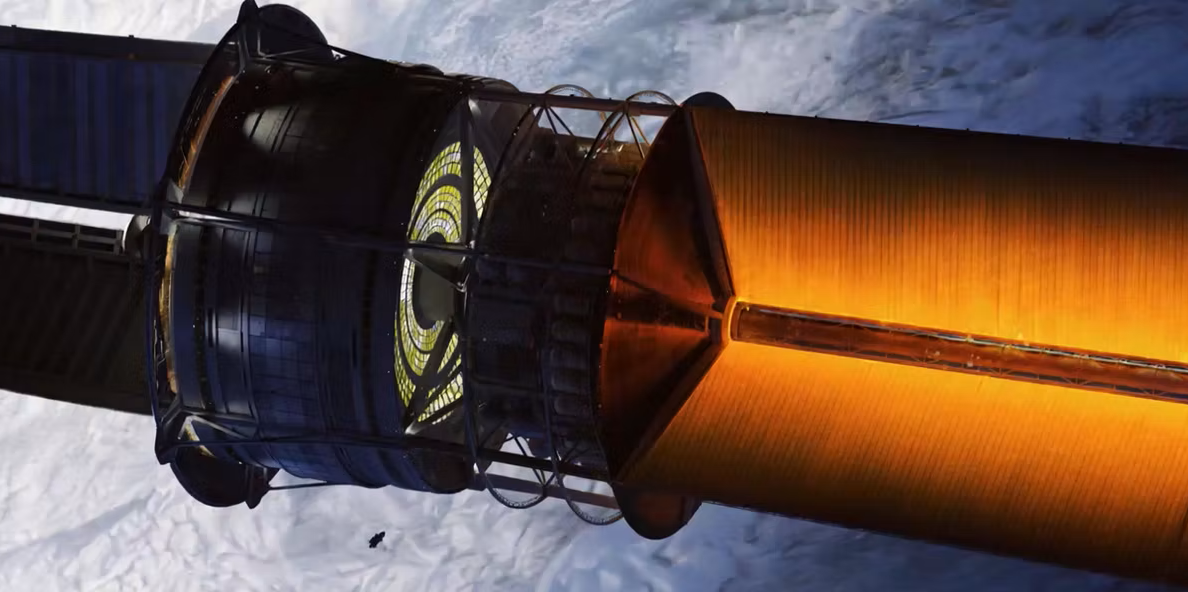
Additional composite materials strengthen the hull and help regulate internal temperatures. Space environments expose spacecraft to extreme thermal conditions, with surfaces facing sunlight heating dramatically while shaded areas drop toward deep-space cold.
The result is a structure that functions as both a spacecraft and a shielded habitat. Within these layers, the inhabitants would live inside a stable environment protected from the harsher conditions of interstellar space.
Building the Vessel Where Gravity Is Weaker
Launching a structure large enough to house 1,000 people directly from Earth would require enormous amounts of energy. The concept therefore assumes the spacecraft would be assembled in space rather than built on the ground.
Engineers often look toward gravitational balance points in the Earth-Moon system for projects of this scale. According to NASA’s explanation of Lagrange points and orbital equilibrium zones, these locations occur where the gravitational forces of two large bodies balance with orbital motion, allowing spacecraft to remain relatively stable with minimal propulsion.
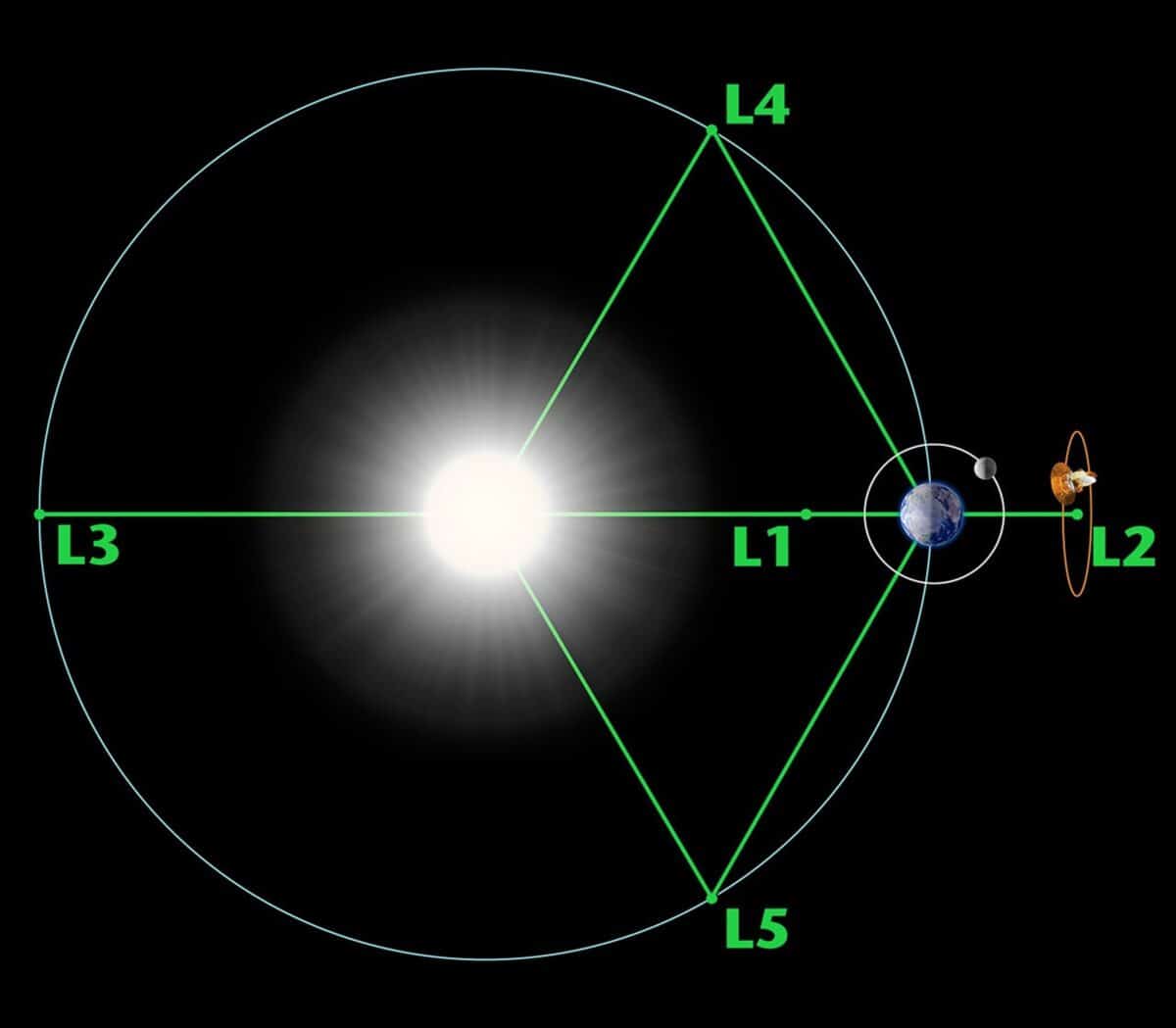
One of these regions, the Earth-Moon L1 Lagrange point, lies between Earth and the Moon and could serve as a construction hub. Components launched from Earth could rendezvous there and gradually assemble into the full structure of the generational starship.
After construction is complete, the vessel would begin its long departure from the Solar System. The propulsion systems explored in the proposal include advanced technologies such as nuclear thermal propulsion, which can provide significantly greater efficiency than conventional chemical rockets.
A Society Traveling Between the Stars
The technical challenges of building a generational spacecraft are immense, but they are only part of the problem. Maintaining a stable community for centuries inside a closed environment introduces equally complex social questions.
The competition required participating teams to address governance, education, and knowledge preservation across generations. Children born aboard the ship would eventually inherit responsibility for maintaining the systems that sustain the spacecraft.
To support that continuity, the Chrysalis design includes educational facilities, research areas, and community governance spaces. These institutions would help preserve technical knowledge and maintain the mission’s long-term objectives.
Robotic maintenance systems also form a critical component of the spacecraft’s infrastructure. Autonomous robots could inspect the outer hull, repair mechanical systems, and monitor environmental stability without exposing humans to the risks of deep-space operations.
First Appeared on
Source link



Leave feedback about this