

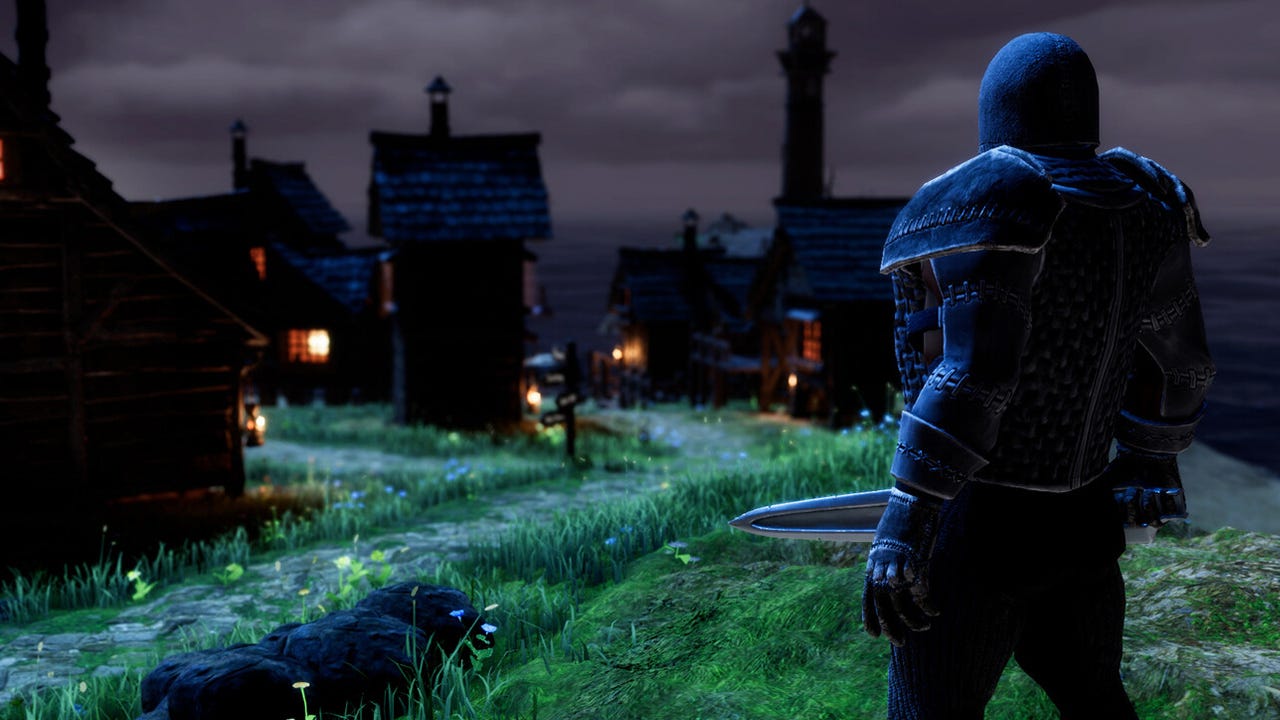
Masters of Albion is an almost nostalgically cute and sassy vision of the god game genre that veteran game designer Peter Molyneux made his name in. It brings in the elements of a city-builder and an exploration-focused action-RPG. I got an early look at the game by watching Molyneux play for about 45 minutes and found it, honestly, pretty refreshing—despite whatever marketing phrases might surround this game so far, it looked like the team at 22cans is just making a game that they think might be fun to play. It’s an oddly refreshing approach for a midsize development team in 2026, when every other game preview seems like it’s trying as hard as it can to blow your socks off.
In Masters of Albion, you’re a guy who’s now a god—which as we all know means you become a giant floating disembodied hand with magic powers. Your job is to complete the tasks that pop up for you each day, then survive the wave of enemies that tries to tear down what you’ve built each night. That’s all in the service of protecting the land of Albion, where more industrial technology has been developed but the ancient magic of Old Albion is still floating around. Differently, of course, than your giant hand is floating around.
So far so straightforward. To be frank, the best part of Masters of Albion that I saw was that it was a world unapologetically running on video game logic. That means that it is pretty absurd, the NPCs are rude even though you’re a god that can murder them, and the cool heroes you control are total meatheads that probably wouldn’t succeed without you pulling the strings. This is a world where you become a god and the first thing these people need from you is to open a successful pie factory because their economy is dying and also they’re very hungry. Could you do weapons next and then maybe clothes? Because they’re also defenseless against all these animate skeletons and dressed in rags.
So that’s one big part of Masters of Albion: the town management. There are resources used in production chains that you use to fulfill contracts and make money—more on that later. Like you might expect, there are buildings that take in one resource, say iron ore, and output another, like smelted iron. There’s then another building that makes the iron bars into swords and things. You’re able to design and assemble every building from diverse parts—snapping them together like little plastic bricks. You can tweak roofs and doors but you can also add a bedroom to your bakery, for example, so the guy who works there doesn’t waste time on travel to and from his job. That, however, would have moral implications for what kind of god you are, hinted the 22cans team.
It’s the step beyond that customization that makes things interesting. You can also design your own buildings to spec. Having both a smelter and a factory, said Molyneux, was probably a bit inefficient. “I’m going to say no. I’m gonna make this building a smelter and a factory,” he said as—using nothing more than mouse controls—he rapidly broke a factory into its component blocks and slapped them onto the nearby smelter building.
“You could combine all the buildings into one, and it can look something like Howl’s Moving Castle. A crazy design,” he said. Though that would definitely come with penalties to its overall efficiency and production speed, the developers later noted, hinting that it was yet another part of what kind of god you are.
You also design the stuff produced in your factories. When a peasant sent up an order for nine sets of “basic food” that was “all meat, no starch,” the player opened up the factory interface and combined the ingredients they’d unlocked to try and meet that demand. While it could be done with automated systems, if you cared to you were able to choose just exactly what went into your—in Molyneux’s case—chicken, rat, and soup stock pies.
“Cause it says all meat and, you know, rat is meat,” he said, dragging the rat in and increasing the sale price of the pies by a smooth £9.56. Which, we were assured, matters.
The point of all that town management and designing stuff is to make people happier, or at least to fulfill the requests and contracts they put up and make money. Money is what turns the wheels of Masters of Albion. There’s quite a more detailed economy than you would guess, with little market forces that change over time and how much things cost to produce based on the ingredients you add to them. Every single building and tech tree innovation and defensive tower and new weapon for your heroes needs money, and in the case of the tech tree especially, needs the favors you earn from completing contracts or wiping out monsters.
As far as what the tech tree unlocks? I saw stuff as concrete as new weapons or new buildings or increased wheat production, but I also saw things like making fancy clothes for everyone, throwing lightning blasts, or just making rude gestures with your giant hand. All of that, said Molyneux, was in the service of trying to cater to people’s diverse playstyles.
Which goes into the other big parts of Masters of Albion. While a lot of the game is clearly about customizing and controlling how your little world of Albion looks and functions, it sure seemed like exploring the world, expanding your influence in it, and defeating your enemies was just as big a part of the intended game.
“It’s a god game, a god game that allows you to play at any pace that you want, if you want to feast yourself on things you can, if you want to unlock tech trees you can, if you want to go out questing you can, if you want to specialize in combat you can,” said Molyneux.
During the daytime you’ve got tasks to complete, and many of those require that you activate magical beacons to spread your godly influence to new parts of Albion. To do that you’ve got to take direct control of your followers, specifically the heroes, and have them explore the world beyond your borders to find and activate those towers. The hero I saw was a beefy fighter using melee weapons—the statistics and style of which were built in a customized factory interface just like making pies—and took those weapons out into the world to battle enemies in a fairly simple action-RPG style, though Molyneux noted they were still refining the third-person combat at the moment.
The world to explore did seem fairly large, with puzzles that took you in and out of controlling a hero in order to use your giant hand to do stuff like reconstruct the beacon towers. There were also quests to get from local inhabitants that went beyond the contract requests—you know, rescue my husband rather than bake me ten pies. The world is clearly intended to be quite large, with expansive areas to explore both above and below—I saw a few mine and cave entrances scattered around but Molyneux never went down them. The map does make it look large, not astounding-stunning-biggest-open-world-ever large, but of a size that if it’s filled with bespoke stuff everywhere, it’ll fulfill and even reward that desire to explore the nooks and crannies.
Once you’ve fulfilled your tasks for the day—stuff like clearing a mine region of bandits so you can get an old smelter back on line and house workers near it—you proceed to the night phase. The nights are basically tower defense combat. You’re notified where enemies will spawn to attack your towns. You can then set your heroes to defend specific areas as a tower in and of themselves, which they do automatically or under your control, and you also build customizable walls or towers with ballistas and cannons and things as defenses. As the enemies come you can happily mow them down with god powers, throwing stuff like streams of lightning, but you can also, in true god game style, just pick up stuff with your giant floating hand to drop on people. Boulders seemed particularly effective at squashing skeletons, and there were a few suspiciously dangerous looking red barrels placed around the countryside too.
Masters of Albion clearly has a lot going on. This is a game made out of minigames, and whether or not it’s a good game overall will probably come down to whether or not all these different parts become smooth fun when stitched and glued and welded together into one whole. It’ll really depend on whether these fairly simple systems can be made satisfying to play—is the combat or town management or open world fun even though it’s simpler than an entire specialized game based on that idea?
We won’t know until we see more, but it seems clear that the team at 22cans is making a game that sounds fun to them. A game they’d want to play in their own unique styles. That’s usually a good sign in game development. There used to be a lot more games coming out that looked like this one: A budget, but not a huge budget. A vision, but not a huge vision. Fun, but not promising to revolutionize the world. Whether or not people still want that kind of game remains to be seen, but there’s always hope. And it’s good to see Molyneux back at the helm of a god game once again.
First Appeared on
Source link



Leave feedback about this