

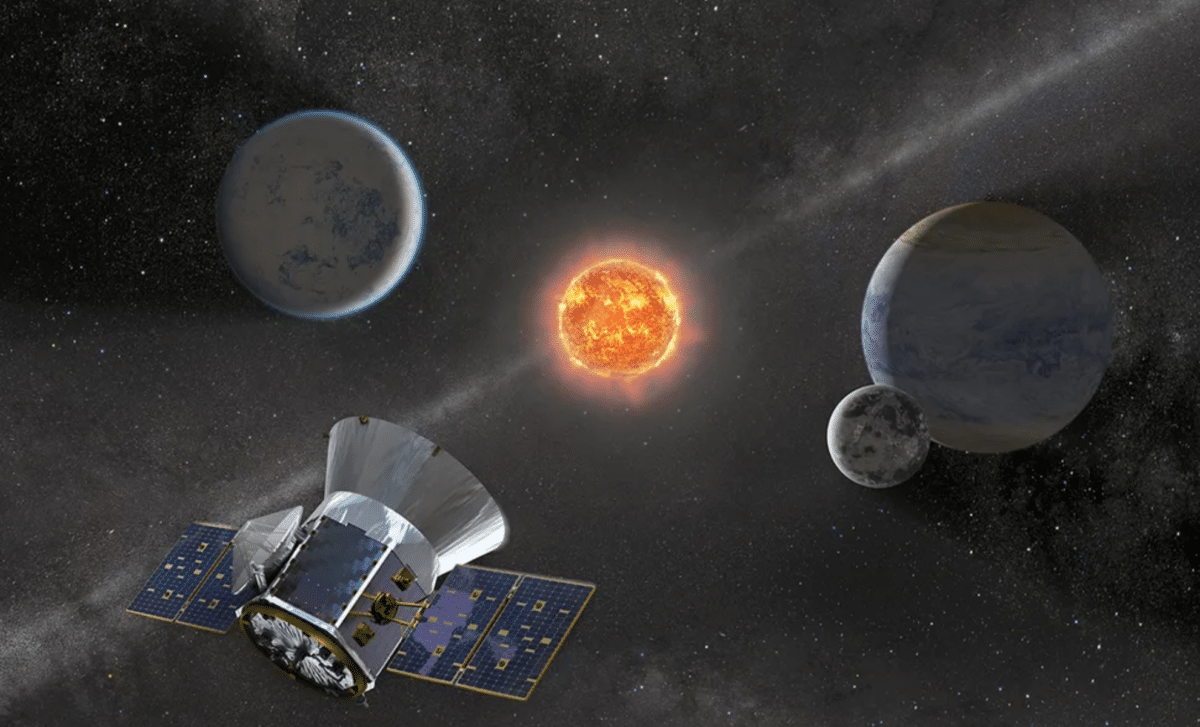
Astronomers have made an exciting discovery in the search for distant exoplanets. A new super-Jupiter, nearly five times the mass of our own Jupiter, has been found orbiting the star TIC-65910228, a metal-rich sun-like star located 864 light years away. This discovery, made by an international team of researchers using NASA’s Transiting Exoplanet Survey Satellite (TESS), was published in a study on the arXiv pre-print server. The new planet, named TIC-65910228 b, promises to expand our understanding of gas giants and their environments.
Discovery and Observational Campaign
TIC-65910228 b was first detected during a single transit observed by NASA’s TESS in sector 33, a significant milestone for astronomers studying distant planets. The initial discovery triggered further follow-up observations using both photometric and spectroscopic methods to confirm the planet’s characteristics. As noted in the study,
“TIC-65910228 b / NGTS-38 b was first detected from a single TESS transit in sector 33. We then initiated a campaign of spectroscopic and photometric follow-up that yielded an additional transit egress from NGTS and a full radial velocity solution from HARPS and CORALIE.”
These additional observations were crucial in confirming the planet’s size, mass, and orbit, setting TIC-65910228 b apart as a fascinating subject for study.
The collaboration involved various instruments, including the Next Generation Transit Survey (NGTS) and high-precision spectrometers like HARPS and CORALIE. These tools helped measure the star’s radial velocity, which allowed the researchers to deduce key details about the planet’s mass and orbital dynamics. With their combined efforts, the astronomers were able to confirm that TIC-65910228 b is a giant exoplanet with a radius slightly larger than Jupiter and a mass nearly five times that of the gas giant. These measurements were crucial in building a comprehensive profile of the planet.
Credit: arXiv (2026). DOI: 10.48550/arxiv.2602.12977
The Giant Planet: Size and Characteristics
According to the study, published on the arXiv pre-print server, TIC-65910228 b is a super-Jupiter, a type of exoplanet that is significantly larger and more massive than Jupiter. With a radius of 1.08 Jupiter radii and a mass of 4.78 Jupiter masses, TIC-65910228 b is a prime example of a gas giant. This planet’s density, calculated to be about 4.69 g/cm³, is also remarkable, highlighting its massive size and composition. It orbits its star at a distance of 0.7 AU (astronomical units), completing one orbit every 180.53 days. This orbit places TIC-65910228 b in the category of warm-Jupiters, exoplanets with temperatures higher than that of cooler gas giants, yet still cooler than the scorching temperatures of close-in hot Jupiters.
The study also notes the equilibrium temperature of TIC-65910228 b, which is estimated to be 458 K. While not excessively hot, this temperature is sufficient to support a variety of atmospheric phenomena. Given the planet’s significant size, its atmospheric composition is likely to differ greatly from those of smaller gas giants, such as those found in our own solar system.
Atmospheric Insights and Further Research Potential
While much of the planet’s composition remains unknown, the researchers hypothesize that TIC-65910228 b’s atmosphere likely contains molecular nitrogen species, which are uncommon in the atmospheres of hotter, close-in gas giants. This theory provides a fascinating avenue for further research. The study emphasizes that TIC-65910228 b’s atmosphere may offer new insights into the makeup of planets that are neither too close to their stars nor too far away. However, the study also points out the challenges of studying this planet’s atmosphere with current technology, noting that it is not yet suitable for atmospheric transmission spectroscopy follow-up studies with existing instruments.
Despite this challenge, TIC-65910228 b is considered one of the most promising candidates for future atmospheric research. The planet’s moderate temperature and size make it an ideal candidate for study with next-generation space telescopes, which could probe deeper into its atmosphere, revealing its composition and behavior in more detail. Additionally, as the study suggests, “Given that many transiting warm Jupiter systems have already been found to host smaller inner companions, the authors of the paper expect to find more planets around TIC-65910228.” The search for additional planets in this system could provide a wealth of information about the dynamic processes at play in such distant star systems.
A Long-Period Transiting Planet
One of the most intriguing aspects of TIC-65910228 b is its long orbital period. The planet’s 180.53-day orbit places it among the longest-period transiting planets discovered by TESS. In fact, it is one of only 13 planets found by TESS with orbital periods greater than 100 days. This makes TIC-65910228 b an especially interesting subject of study, as long-period planets like this are relatively rare in the data returned by TESS.
This long period, combined with the planet’s size and position, suggests that TIC-65910228 b might be a part of a system that differs from many other exoplanetary systems discovered so far. It stands out not only for its size but also for its potential to shed light on the architecture of planetary systems beyond our own. The system’s unique characteristics make it a target for further observations, particularly those aimed at understanding the dynamics of planets in longer orbits.
Exomoon and Ring Systems
The study also opens the door to the possibility of moons and rings around TIC-65910228 b. Due to the planet’s wide orbital separation from its star, it is thought that additional objects, including stable moons or even ring systems, may exist in the system. “TIC-65910228 b is one of the most likely transiting planets to host stable exomoon or ring systems,” the researchers suggest. This makes the system an exciting candidate for future exploration, particularly with advanced telescopes that could detect such smaller companions.
Exomoons, in particular, have become a key area of interest in the search for extraterrestrial life. The presence of stable moons could open up the possibility of habitable environments beyond Earth, making planets like TIC-65910228 b important targets for future missions. The detection of exomoons or rings would also provide valuable insights into the formation and evolution of planetary systems.
First Appeared on
Source link






Leave feedback about this