

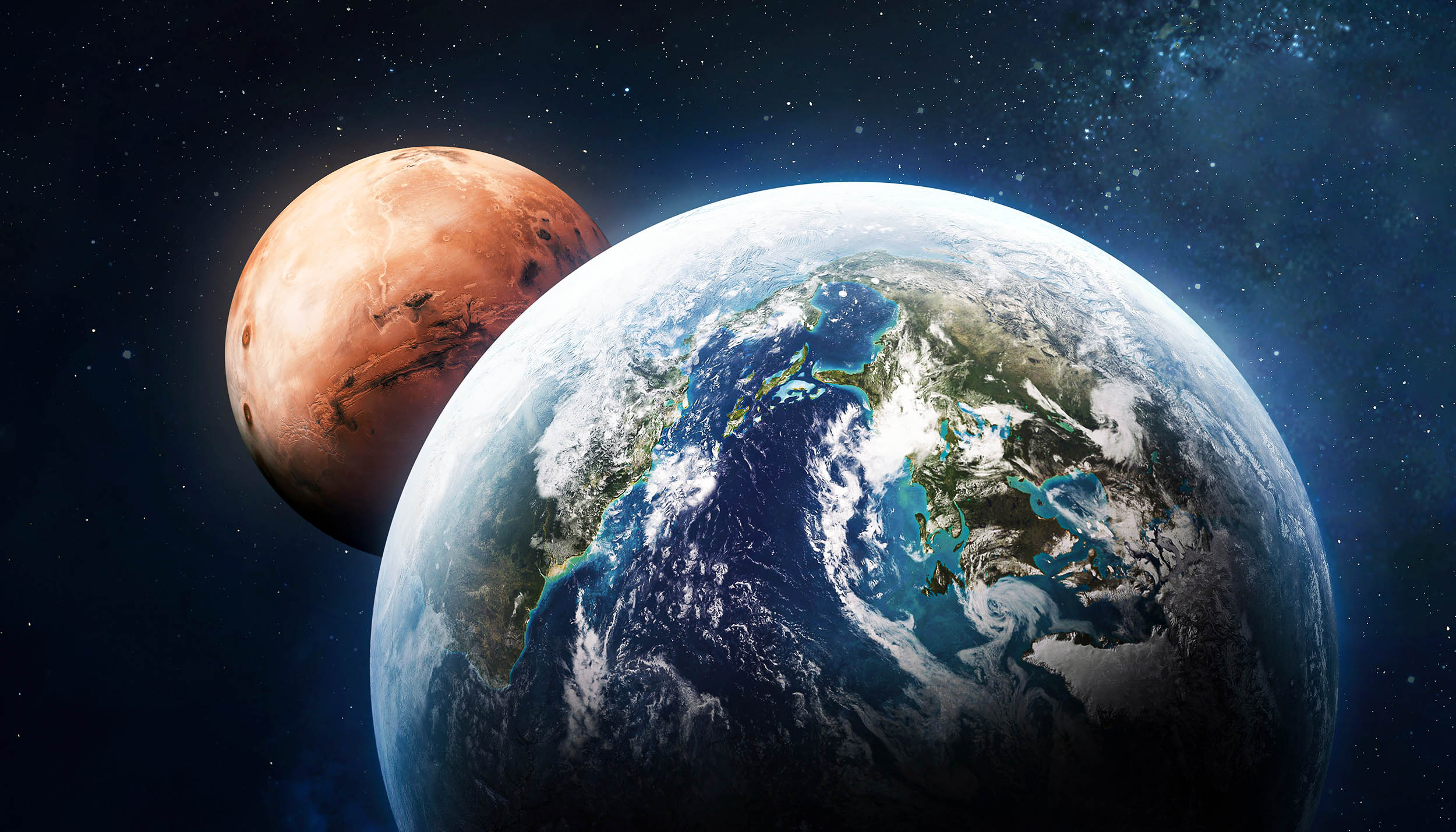
New simulations suggest Mars helps set a 2.4 million-year rhythm in Earth’s orbit that can steer the timing of ice-ages.
Scientists recently tested whether a small planet could leave a detectable trace in deep-time climate records.
Testing a planetary hunch
Computer runs allowed the experts to switch planets on and off, turning the solar system into a controlled test. The simulations were built at the University of California, Riverside (UC Riverside).
Stephen R. Kane, Ph.D., a professor of planetary astrophysics, started out doubtful and checked his own assumptions while modeling how planets tug each other.
“I knew Mars had some effect on Earth, but I assumed it was tiny,” said Kane.
Tracing the orbital rhythms
Long-term climate swings begin with slow changes in Earth’s path and spin that adjust where sunlight falls.
Scientists call these Milankovitch cycles, orbit-driven patterns in solar heating, and they match signals found in ocean sediments.
The simulations tracked the eccentricity, how stretched an orbit becomes, and the tilt that sets where summer sunlight concentrates.
Small changes in those parameters can alter summer melting, so ice sheets can expand when cooler summers let snow persist.
What vanished without Mars
To isolate Mars’ role, the team at UC Riverside reran their solar system model after deleting the red planet from the lineup.
A 430,000-year rhythm linked to Venus and Jupiter stayed, but a 100,000-year cycle disappeared in the no-Mars run.
“When you remove Mars, those cycles vanish,” said Kane after comparing the frequency patterns across each simulation run.
That difference pins the missing cycles on Mars, helping researchers connect orbital math to patterns preserved in rocks.
The weight of a small planet
Mars is about half Earth’s size and only about one-tenth of Earth’s mass, yet its orbit sits far enough out to matter.
In the model, boosting Mars made certain orbital frequencies speed up because a heavier planet tugs harder each pass.
“And if you increase the mass of Mars, they get shorter and shorter because Mars is having a bigger effect,” said Kane.
Even small differences in a planet’s mass could reshape long-term climate rhythms on nearby worlds, depending on orbital layout.
Earth’s tilt and its neighbors
Earth’s tilt changes slowly, and the Moon keeps those swings from becoming chaotic over long spans.
Scientists describe the tilt as obliquity – the angle between spin axis and orbit plane – and it shapes seasons.
Today the axis sits near 23.5 degrees, and the simulations tracked how that angle would drift under different Mars masses.
“As the mass of Mars was increased in our simulations, the rate of change in Earth’s tilt goes down,” said Kane.
From sunlight to ice
Orbital changes matter because ice grows when winter snow survives summer, and that balance depends on seasonal sunlight.
Higher eccentricity increases the contrast between Earth’s closest and farthest solar distances, changing the strength of seasonal heating.
Tilt adds another lever, since a slightly different angle can move summer heat toward or away from high latitudes.
These drivers can pace glacial advances, but greenhouse gases and ocean circulation still decide how big the temperature swings become.
Sediments record slow forcing
Layered mud on the seafloor builds up slowly, and its chemistry and grain size can follow repeating climate patterns.
Researchers match those layers to calculated orbital cycles, because changes in sunlight can alter winds, rainfall, and ocean mixing.
Mars-linked periods in the new simulations help explain why some sediment records show strong beats beyond the familiar short cycles.
Better links between orbital physics and rock layers could sharpen geologic dating, while also revealing when Earth’s orbit behaved differently.
Hints for other worlds
Outside our solar system, astronomers often find rocky planets near their stars, with additional worlds farther out.
Astronomers use the term habitable zone to describe the region where surface water can stay liquid, yet neighboring planets can still push climates around.
“When I look at other planetary systems and find an Earth-sized planet in the habitable zone, the planets further out in the system could have an effect on that Earth-like planet’s climate,” said Kane.
For now, most exoplanet data cannot reveal million-year cycles, so the idea guides target selection more than prediction.
What simulations can’t show
The models isolate gravity in a controlled setting, but real Earth includes feedbacks that can mute signals.
Ice sheets respond to temperature, but temperature also depends on carbon dioxide, volcanic aerosols, and ocean currents over long spans.
The simulations also begin with today’s planetary layout, so they cannot recreate past rearrangements or earlier solar system instabilities.
Still, the exercise pins down which orbital cycles come from which neighbors, a key step before full climate modeling.
A small planet matters
Taken together, the results show that Mars helps tune Earth’s orbital geometry, setting the timing of slow climate cycles.
Future work can tie these orbital inputs to ice-sheet models and test whether other solar systems share similar sensitivities.
The study is published in Publications of the Astronomical Society of the Pacific.
—–
Like what you read? Subscribe to our newsletter for engaging articles, exclusive content, and the latest updates.
Check us out on EarthSnap, a free app brought to you by Eric Ralls and Earth.com.
—–
First Appeared on
Source link






Leave feedback about this