


Mars’ rotation is speeding up slightly, but enough for scientists to notice. A new study suggests the cause could be a massive plume deep underground, quietly affecting how the planet rotates.
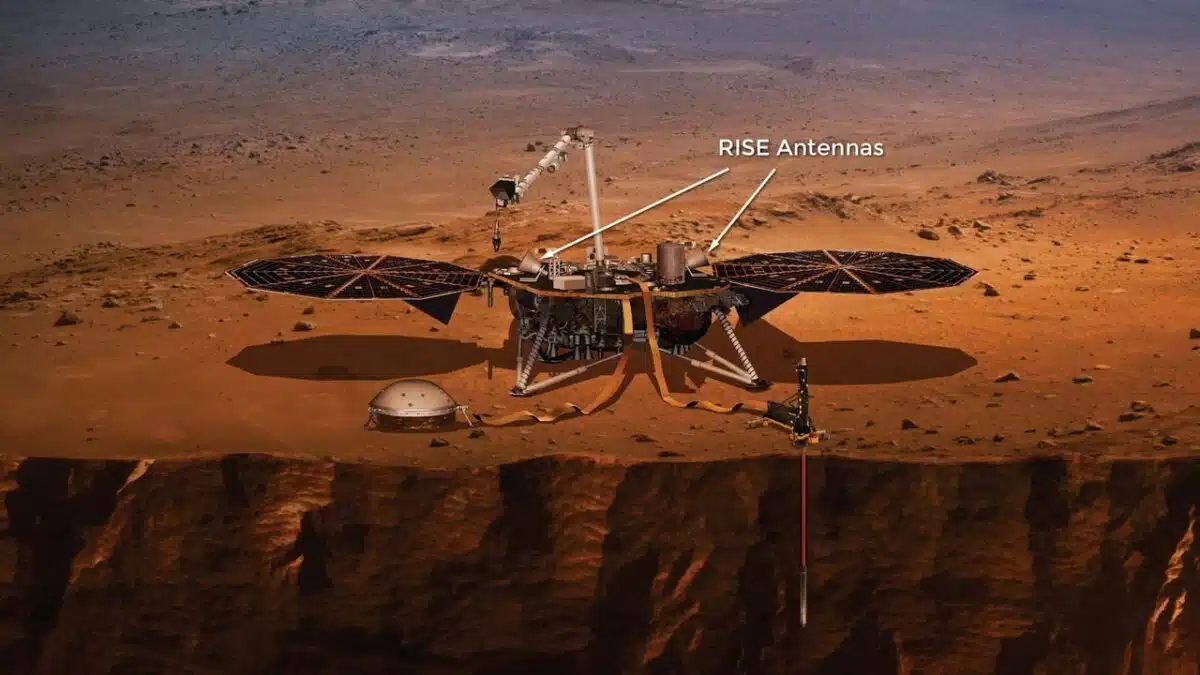
The idea comes from research published in the Journal of Geophysical Research: Planets, using data from NASA’s InSight lander. By comparing it with older observations from the Viking missions, scientists found that the length of a Martian day is slowly shrinking.
The Red Planet has often been seen as a mostly inactive world. These new results suggest something more dynamic may still be happening beneath its surface.
Mars Is Speeding Up?
Mars’ rotation is increasing by about 70 microseconds per year. According to data from InSight and Viking, this trend has been consistent over time, even if the change is extremely small. Researchers had no clear explanation for it. Because the effect involves the whole planet, they suspected the cause had to come from inside Mars rather than from surface processes.
“The Martian surface is so old and shows all these complex but largely not well understood process[es], which I think we can start to unravel by combining interior with surface,” noted Bart Root, lead author of the study and Assistant Professor at TU Delft.
Tharsis Hides a Massive Subsurface Anomaly
Scientists focused on Tharsis, a huge volcanic region about 6,000 kilometers wide. It hosts some of the biggest volcanoes in the solar system, formed without the plate tectonics seen on Earth. Using InSight data, a team from Delft University of Technology identified what they describe as a negative mass anomaly beneath this region. As explained by the researchers:
“The negative or light mass anomaly will move upwards and hit the lithosphere of Mars, introducing melt pockets that have the potential to penetrate the crust and erupt as volcanoes.”
As this material moves upward, it can create melt pockets under the crust. These pockets may help explain how such massive volcanic structures formed in the first place.
Something Deep Below Is Altering the Planet’s Spin
The same process could also explain why the Red Planet is spinning faster. As lighter material rises, heavier material shifts closer to the planet’s rotation axis.
“A negative mass flowing upwards means something heavier needs to go down, and because the mass anomaly is located on the equator of Mars, this means the heavier mass is going closer to [the] rotation axis, hence a speed up,” Root said.
As stated by the latest research, avaliable on JGR Planets, this works like a spinning person pulling weight inward, which makes the rotation speed up. The team found that even simple calculations match the scale of the observed change.
The result suggests Mars still holds more internal heat than expected. In the study, the authors said that this kind of deep movement means the planet may not be as inactive as once thought, even after billions of years.
First Appeared on
Source link






Leave feedback about this