

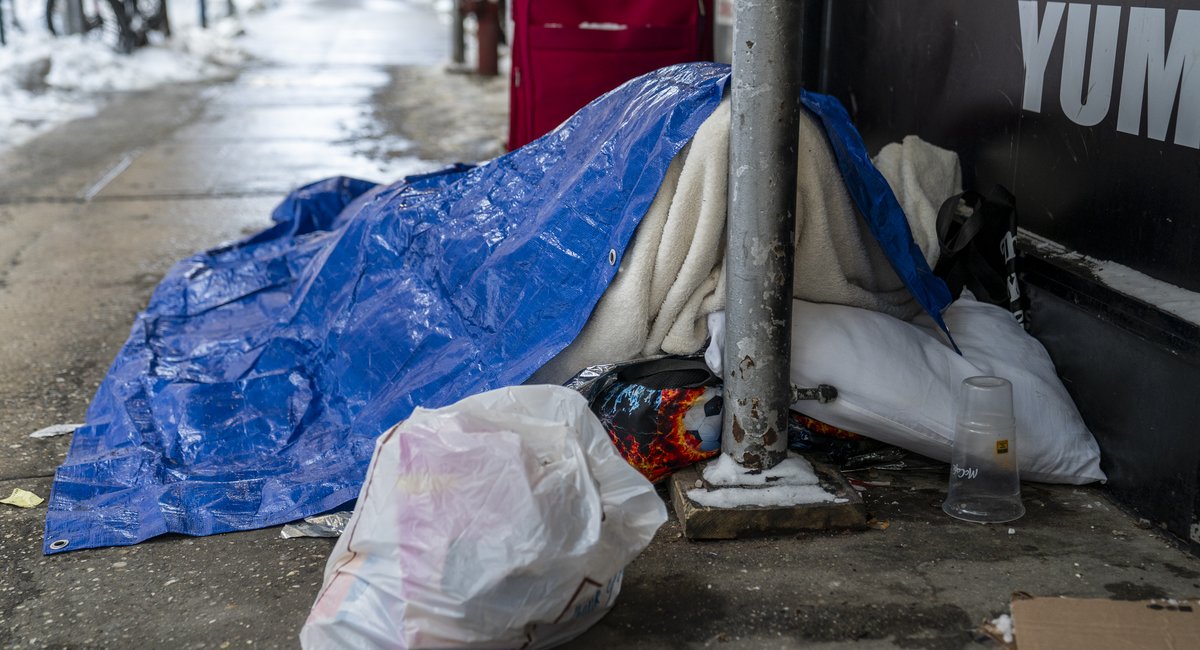
Mayor Zohran Mamdani is facing criticism and questions from advocates for homeless New Yorkers after abruptly reversing his policy pledge to end homeless encampment sweeps.
City Hall officials said outreach workers with the Department of Homeless Services would begin notifying street homeless New Yorkers this week of plans to clear them out of public spaces. During a sweep, city sanitation workers often trash tents, makeshift encampments and other belongings if people refuse to pack up and go to a shelter or another location.
Mamdani had called the encampment sweeps done by his predecessors Eric Adams and Bill de Blasio a “failure” because they rarely led to people being placed in permanent housing. He billed the new plan as a kinder, gentler approach to addressing street homelessness, saying the city would conduct daily outreach in the seven days before police and sanitation workers arrived to disperse encampments or makeshift shelters.
But advocates for homeless New Yorkers say Mamdani’s plan is more of the same, and will displace people while moving only a fraction of them into shelters or permanent housing.
“It’s a huge step backwards,” said Josh Goldfein, a staff attorney for the Legal Aid Society. “It seems like what’s happening now is the administration is caving to political pressure to say they have to push people out with force rather than approaching them with resources that they need and will accept.”
Mamdani has faced pressure to resume sweeps from business leaders, elected officials and media outlets since he halted the policy days after taking office. Those calls intensified after at least 19 people died outdoors during a recent stretch of cold weather — though it was unclear how many of the people were living in encampments. At least five had permanent housing.
Mamdani said the city’s new sweeps policy will look “far different” than it did under the Adams administration, starting from the day outreach workers begin notifying street homeless New Yorkers of a scheduled sweep.
“Every single day of that time period will be characterized by outreach, outreach from homeless services workers to homeless New Yorkers,” he said.
Mamdani said the new approach will help foster trust and lead to placements in shelters and apartments.
“Their first reaction might be that of skepticism,” Mamdani said. “But their third, their fourth, their fifth, their sixth reaction may be one of interest in the possibility of shelter services, programming, support, supportive housing.”
New York City has roughly 3,200 vacant supportive apartments for formerly homeless tenants, Gothamist reported earlier this month.
Mamdani also said the Department of Homeless Services will decide which public sites to target — a departure from the Adams administration, which put the NYPD back in control of those decisions, according to a 2022 policy memo.
A 2025 Gothamist analysis found that city officials conducted more than 4,100 sweeps between January 2024 and June 2025, but none of the people targeted in those operations moved into permanent housing. About 260 people agreed to move to a shelter.
Mamdani’s policy change, which was first reported by the New York Post, has received praise from business groups and some elected leaders. Some city councilmembers from Manhattan had voiced their discontent over the end of sweeps, even as they urged the city to offer more comprehensive services.
Steven Fulop, CEO of the Partnership for New York City, a business lobbying group, said it was a positive step that the mayor had reconsidered his pause on sweeps.
“There’s nothing positive that comes out of leaving homeless encampments for either the broader community or the people living in those homeless encampments. It’s not healthy. It’s not safe for anybody,” he said.
‘They’re traumatizing’
By noon Wednesday, officials from the Department of Homeless Services had not yet reached an encampment beneath a towering sidewalk shed along West 18th Street, people staying in small makeshift tents and structures there said.
Gothamist visited the site last month, just before dangerously low temperatures hit the city. At that time, four occupants were on their way to Safe Haven shelters designed for street homeless New Yorkers.
A sweeps notice dated Oct. 31, 2025 was still taped to the window of a nearby building.
Asia-Marie James, 29, said she had been living in public spaces for about three years, since she and her then-boyfriend were kicked out of a shelter unit for fighting. She said she would move indoors if she were offered a private room or apartment with her own kitchen and bathroom, and would then go back to school to study cosmetology.
“I need to be able to have an apartment with a stove, a bathroom, a shower, and be able to have a job,” James said.
James said she has lost valuable possessions, including a gold locket given to her by her grandmother, after police and sanitation workers tossed them in previous sweeps. Those did not compel her to move into a shelter or lead to permanent housing. Instead, she said, “It made me rebellious.”
For now, James said she would continue to stay in the enclosure she built using metal poles she salvaged from the trash and insulated with layers of tarps, mesh and foil blankets. She stored cereal boxes and other food packages on top of a floor lined with quilts and comforters.
City officials said NYPD officers will be present on the day of each sweep but will no longer lead operations. It’s not clear what threshold DHS will use to determine what sites to target.
City officials say they also plan to improve how people’s belongings are stored. People affected by past sweeps said they’ve often lost their belongings, identification documents and clothing after sanitation workers discard them. Gothamist previously reported that outreach workers stored people’s belongings just 13 times between January and the end of May in 2025.
“ They’re traumatizing, they threw away everything I owned,” said Andrew Chappotin, 41. “ I had a bicycle. I had my tent. I had blankets. I had my medication. I had my book bags. I had all my clothes. I even had clothes for my children. And this was right around the time for Christmas. So I also had like gifts for my kids.”
Chappotin is now living in a Safe Haven site where he has his own room.
Mamdani said he expects more people to move into shelters and apartments under his current plan.
“We will meet them looking to connect them with shelter, looking to connect them with services, looking to connect them with a city that wants them to be sheltered and indoors and warm and safe, and that is something that I believe will yield far better results,” he said.
Elizabeth Kim contributed reporting.
First Appeared on
Source link





Leave feedback about this