

The Emergence of Agriculture: A Global View (Routledge, 2007).
Pearsall, D. M. in The Handbook of South American Archaeology (eds Silverman, H. & Isbell, W. H.) 105–120 (Springer, 2008).
Lombardo, U. et al. Early Holocene crop cultivation and landscape modification in Amazonia. Nature 581, 190–193 (2020).
Fuller, D. Q., Denham, T. & Allaby, R. Plant domestication and agricultural ecologies. Curr. Biol. 33, R636–R649 (2023).
Lipson, M. et al. Parallel palaeogenomic transects reveal complex genetic history of early European farmers. Nature 551, 368–372 (2017).
Smith, B. D. Eastern North America as an independent center of plant domestication. Proc. Natl Acad. Sci. USA 103, 12223–12228 (2006).
Piperno, D. R., Ranere, A. J., Holst, I., Iriarte, J. & Dickau, R. Starch grain and phytolith evidence for early ninth millennium B.P. maize from the Central Balsas River Valley, Mexico. Proc. Natl Acad. Sci. USA 106, 5019–5024 (2009).
Yacobaccio, H. D. The domestication of South American camelids: a review. Animal Front. 11, 43–51 (2021).
Hastorf, C. A. Agriculture and the Onset of Political Inequality Before the Inka (Cambridge Univ. Press, 1993).
de Valdivia, L. Doctrina cristiana y catecismo en la lengua allentiac, que corre en la ciudad de San Juan de la frontera, con un confesionario, arte y vocabulario breves. An. Inst. Etnogr. Am. 1, 19–94 (1940).
Yáñez, B. et al. Pace and space in the practice of aDNA research: concerns from the periphery. Am. J. Biol. Anthropol. 180, 417–422 (2023).
de la Fuente Castro, C. & Figueiro, G. Human ancient DNA analysis in Latin America: current state and challenges. Archaeometry 67, S4–S26 (2025).
Novellino, P. S. et al. Sitios de entierro de la localidad arqueológica Barrancas, Maipú (Mendoza, Argentina). Intersec. Antropol. 14, 271–277 (2013).
Da Peña Aldao, G., Novellino, P. & Frigolé, C. Caracterización del Túmulo II (Uspallata, Mendoza): actualización del análisis del contexto funerario. Comechingonia 20, 21–49 (2016).
Guevara, D. et al. Estructura demográfica, dieta y migración en los Andes del sur: nuevos análisis del sitio Osario Potrero Las Colonias, Uspallata (Mendoza, Argentina). Intersec. Antropol. 23, 67–82 (2022).
Durán, V. et al. Barrio Ramos I. Funebria y modos de vida en el inicio del período de dominación inca del valle de Uspallata (Mendoza, Argentina). Relac. Soc. Arg. Antropol. XLIII, 55–86 (2018).
Barberena, R. et al. Scale of human mobility in the southern Andes (Argentina and Chile): a new framework based on strontium isotopes. Am. J. Phys. Anthropol. 164, 305–320 (2017).
Barberena, R. et al. Multi-isotopic and morphometric evidence for the migration of farmers leading up to the Inka conquest of the southern Andes. Sci. Rep. 10, 21171 (2020).
Jørkov, M. L. S., Heinemeier, J. & Lynnerup, N. The petrous bone—a new sampling site for identifying early dietary patterns in stable isotopic studies. Am. J. Phys. Anthropol. 138, 199–209 (2009).
Willerslev, E. & Meltzer, D. J. Peopling of the Americas as inferred from ancient genomics. Nature 594, 356–364 (2021).
Rohland, N. et al. Three assays for in-solution enrichment of ancient human DNA at more than a million SNPs. Genome Res 32, 2068–2078 (2022).
Nakatsuka, N. et al. ContamLD: estimation of ancient nuclear DNA contamination using breakdown of linkage disequilibrium. Genome Biol 21, 199 (2020).
García, A. et al. Ancient and modern mitogenomes from Central Argentina: new insights into population continuity, temporal depth and migration in South America. Human Mol. Genet. 30, 1200–1217 (2021).
Luisi, P. et al. Fine-scale genomic analyses of admixed individuals reveal unrecognized genetic ancestry components in Argentina. PLoS ONE 15, e0233808 (2020).
Arango-Isaza, E. et al. The genetic history of the Southern Andes from present-day Mapuche ancestry. Curr. Biol. 33, 2602–2615.e5 (2023).
Posth, C. et al. Reconstructing the deep population history of Central and South America. Cell https://doi.org/10.1016/j.cell.2018.10.027 (2018).
Pedersen, M. W. et al. Ancient Human genomes and environmental DNA from the cement attaching 2,000-year-old head lice nits. Mol. Biol. Evol. 39, 1–16 (2022).
De La Fuente Castro, C. et al. The genomic and cultural diversity of the Inka Qhapaq Hucha ceremony in Chile and Argentina. Genome Biol. Evol. 16, 1–15 (2024).
Alexander, D. H., Novembre, J. & Lange, K. Fast model-based estimation of ancestry in unrelated individuals. Genome Res. 19, 1655–1664 (2009).
Excoffier, L., Smouse, P. E. & Quattro, J. M. Analysis of molecular variance inferred from metric distances among DNA haplotypes: application to human mitochondrial DNA restriction data. Genetics 131, 479–491 (1992).
Patterson, N. et al. Ancient admixture in human history. Genetics 192, 1065–1093 (2012).
Peralta, E. A. et al. Past maize consumption correlates with population change in Central Western Argentina. J. Anthropol. Archaeol. 68, 101457 (2022).
Falabella, F., Planella, M. T. & Tykot, R. H. El Maíz (Zea mays) en el mundo prehispánico de Chile Central. Latin Am. Antiq. 19, 25–46 (2008).
Finucane, B. C. Maize and sociopolitical complexity in the Ayacucho Valley, Peru. Curr. Anthropol. 50, 535–545 (2009).
Pezo-Lanfranco, L. & Colonese, A. C. The role of farming and fishing in the rise of social complexity in the Central Andes: a stable isotope perspective. Sci. Rep. 14, 4582 (2024).
Knüsel, C. J. & Schotsmans, E. M. J. The Routledge Handbook of Archaeothanatology: Bioarchaeology of Mortuary Behaviour (Routledge, 2022).
Sedig, J. W., Olalde, I., Patterson, N., Harney, É & Reich, D. Combining ancient DNA and radiocarbon dating data to increase chronological accuracy. J. Archaeolog. Sci. 133, 105452 (2021).
Marsh, E. J., Kidd, R., Ogburn, D. & Durán, V. Dating the expansion of the Inca empire: Bayesian models from Ecuador and Argentina. Radiocarbon 59, 117–140 (2017).
Skoglund, P. et al. Genetic evidence for two founding populations of the Americas. Nature 525, 104–108 (2015).
Fournier, R., Tsangalidou, Z., Reich, D. & Palamara, P. F. Haplotype-based inference of recent effective population size in modern and ancient DNA samples. Nat. Commun. 14, 7945 (2023).
Suchard, M. A. et al. Bayesian phylogenetic and phylodynamic data integration using BEAST 1.10. Virus Evol. 4, vey016 (2018).
O’Donnell, L., Hill, E. C., Anderson, A. S. A. & Edgar, H. J. H. Cribra orbitalia and porotic hyperostosis are associated with respiratory infections in a contemporary mortality sample from New Mexico. Am. J. Phys. Anthropol. 173, 721–733 (2020).
Bos, K. I. et al. Pre-Columbian mycobacterial genomes reveal seals as a source of New World human tuberculosis. Nature 514, 494–497 (2014).
Vågene, ÅJ. et al. Geographically dispersed zoonotic tuberculosis in pre-contact South American human populations. Nat. Commun. 13, 1195 (2022).
Washburn, E. et al. A multi-isotope approach to reconstructing human residential mobility and diet during the Late Intermediate Period (1000–1450 CE) in highland Ancash, Peru. J. Archaeol. Sci. 41, 103291 (2022).
McCool, W. C. et al. Climate change–induced population pressure drives high rates of lethal violence in the Prehispanic central Andes. Proc. Natl Acad. Sci. USA 119, e2117556119 (2022).
Fort, J. Tendencies in the tempo of prehistoric agricultural expansions. J. Archaeol. Res. https://doi.org/10.1007/s10814-025-09212-1 (2025).
Fehren-Schmitz, L. et al. Climate change underlies global demographic, genetic, and cultural transitions in pre-Columbian southern Peru. Proc. Natl Acad. Sci. USA 111, 9443–9448 (2014).
Maravall-López, J. et al. Eight millennia of continuity of a previously unknown lineage in Argentina. Nature https://doi.org/10.1038/s41586-025-09731-3 (2025).
Mallick, S. et al. The Allen Ancient DNA Resource (AADR): a curated compendium of ancient human genomes. Sci. Data 11, 182 (2024).
Gil, A. F., Giardina, M. A., Neme, G. A. & Ugan, A. Demografía humana e incorporación de cultígenos en el centro occidente argentino: explorando tendencias en las fechas radiocarbónicas. Revis. Española Antropol. Am. 44, 523–553 (2014).
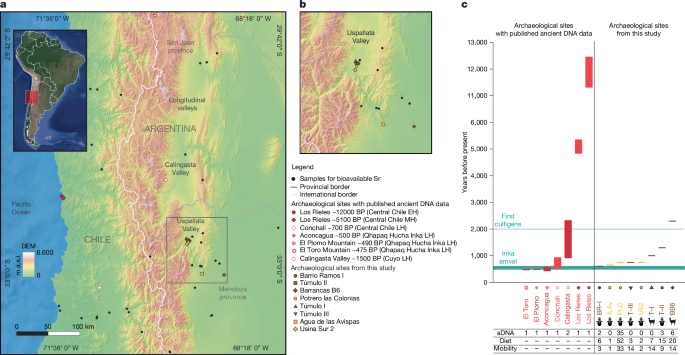
Dawson, N. qgis/QGIS: 3.44.7. Zenodo https://doi.org/10.5281/zenodo.6139224 (2026).
De La Fuente, C. et al. Genomic insights into the origin and diversification of late maritime hunter-gatherers from the Chilean Patagonia. Proc. Natl Acad. Sci. USA 115, E4006–E4012 (2018).
Homburger, J. R. et al. Genomic insights into the ancestry and demographic history of South America. PLoS Genet. 11, e1005602 (2015).
R Core Team. R: A Language and Environment For Statistical Computing (R Foundation for Statistical Computing, 2023).
South, A., Michael, S. & Massicotte, P. rnaturalearthdata: World Vector Map Data from Natural Earth Used in ‘rnaturalearth’. R v.1.0.0.9000 https://docs.ropensci.org/rnaturalearthdata/ (R project, 2026).
Rusconi, C. Poblaciones Pre y Posthispanicas de Mendoza Vol. 3, Arqueología (Mendoza, 1962).
Rusconi, C. Poblaciones Pre y Posthispanicas de Mendoza Vol. 1, Etnografía (Mendoza, 1961).
Suby, J. A., Novellino, P., Da Peña, G. & Pandiani, C. D. Elongated odontoid process in late Holocene skeletal remains from B6 archaeological site, Mendoza, Argentina. Intl J. Paleopathol. 22, 86–91 (2018).
Hansen, H. B. et al. Comparing ancient DNA preservation in petrous bone and tooth cementum. PLoS ONE 12, e0170940 (2017).
Damgaard, P. B. et al. Improving access to endogenous DNA in ancient bones and teeth. Sci. Rep. 5, 11184 (2015).
Pinhasi, R. et al. Optimal ancient DNA yields from the inner ear part of the human petrous bone. PLoS ONE 10, e0129102 (2015).
Dabney, J. & Meyer, M. Extraction of highly degraded DNA from ancient bones and teeth. Methods Mol. Biol. 1963, 25–29 (2019).
Rohland, N. & Hofreiter, M. Ancient DNA extraction from bones and teeth. Nat. Protoc. 2, 1756–1762 (2007).
Allentoft, M. E. et al. Population genomics of post-glacial western Eurasia. Nature 625, 301–311 (2024).
Rohland, N., Harney, E., Mallick, S., Nordenfelt, S. & Reich, D. Partial uracil-DNA-glycosylase treatment for screening of ancient DNA. Philos. Trans. R. Soc. B 370, 20130624 (2015).
Gamba, C. et al. Comparing the performance of three ancient DNA extraction methods for high-throughput sequencing. Mol. Ecol. Resour. 16, 459–469 (2016).
Kapp, J. D., Green, R. E. & Shapiro, B. A Fast and efficient single-stranded genomic library preparation method optimized for ancient DNA. J. Hered. 112, 241–249 (2021).
Fages, A. et al. Tracking five millennia of horse management with extensive ancient genome time series. Cell 177, 1419–1435.e31 (2019).
Yates, J. A. F. et al. Reproducible, portable, and efficient ancient genome reconstruction with nf-core/eager. PeerJ 9, e10947 (2021).
Schubert, M., Lindgreen, S. & Orlando, L. AdapterRemoval v2: rapid adapter trimming identification and read merging. BMC Res. Notes 9, 88 (2016).
Genovese, G., Handsaker, R. E., Li, H., Kenny, E. E. & McCarroll, S. A. Mapping the human reference genome’s missing sequence by three-way admixture in Latino genomes. Am. J. Hum. Genet. 93, 411–421 (2013).
Li, H. & Durbin, R. Fast and accurate short read alignment with Burrows–Wheeler transform. Bioinformatics 25, 1754–1760 (2009).
Peltzer, A. et al. EAGER: efficient ancient genome reconstruction. Genome Biol. 17, 60 (2016).
Andrews, R. M. et al. Reanalysis and revision of the Cambridge reference sequence for human mitochondrial DNA. Nat. Genet. 23, 147–147 (1999).
Li, H. et al. The sequence alignment/map format and SAMtools. Bioinformatics 25, 2078–2079 (2009).
McKenna, A. et al. The Genome Analysis Toolkit: a MapReduce framework for analyzing next-generation DNA sequencing data. Genome Res. 20, 1297–1303 (2010).
Neukamm, J., Peltzer, A. & Nieselt, K. DamageProfiler: fast damage pattern calculation for ancient DNA. Bioinformatics 37, 3652–3653 (2021).
Jun, G., Wing, M. K., Abecasis, G. R. & Kang, H. M. An efficient and scalable analysis framework for variant extraction and refinement from population-scale DNA sequence data. Genome Res. 25, 918–925 (2015).
Renaud, G., Slon, V., Duggan, A. T. & Kelso, J. Schmutzi: estimation of contamination and endogenous mitochondrial consensus calling for ancient DNA. Genome Biol. 16, 224 (2015).
Fu, Q. et al. A revised timescale for human evolution based on ancient mitochondrial genomes. Curr. Biol. 23, 553–559 (2013).
Weissensteiner, H. et al. Contamination detection in sequencing studies using the mitochondrial phylogeny. Genome Res 31, 309–316 (2021).
Korneliussen, T. S., Albrechtsen, A. & Nielsen, R. ANGSD: analysis of next generation sequencing data. BMC Bioinformatics 15, 356 (2014).
Alaçamlı, E. et al. READv2: advanced and user-friendly detection of biological relatedness in archaeogenomics. Genome Biol. 25, 216 (2024).
Popli, D., Peyrégne, S. & Peter, B. M. KIN: a method to infer relatedness from low-coverage ancient DNA. Genome Biol. 24, 10 (2023).
van Oven, M. & Kayser, M. Updated comprehensive phylogenetic tree of global human mitochondrial DNA variation. Hum. Mutat. 30, E386–E394 (2009).
Motti, J. M. B. et al. Ancient mitogenomes from the Southern Pampas of Argentina reflect local differentiation and limited extra-regional linkages after rapid initial colonization. Am. J. Biol. Anthropol. 181, 216–230 (2023).
Tamburrini, C. Diversidad genética de muestras arqueológicas humanas del nordeste de la provincia del Chubut (Patagonia Argentina) durante el Holoceno (6000–200AP). Arqueología 30, 14390–14390 (2024).
Drummond, A. J. & Rambaut, A. BEAST: Bayesian evolutionary analysis by sampling trees. BMC Evol. Biol. 7, 214 (2007).
Ralf, A., Montiel González, D., Zhong, K. & Kayser, M. Yleaf: software for human y-chromosomal haplogroup inference from next-generation sequencing data. Mol. Biol. Evol. 35, 1291–1294 (2018).
Moreno-Mayar, J. V. et al. Early human dispersals within the Americas. Science 362, eaav2621 (2018).
Campelo dos Santos, A. L. et al. Genomic evidence for ancient human migration routes along South America’s Atlantic coast. Proc. Biol. Sci. 289, 20221078 (2022).
Bongers, J. L. et al. Integration of ancient DNA with transdisciplinary dataset finds strong support for Inca resettlement in the south Peruvian coast. Proc. Natl Acad. Sci. USA 117, 18359–18368 (2020).
Capodiferro, M. R. et al. Archaeogenomic distinctiveness of the Isthmo-Colombian area. Cell 184, 1706–1723 (2021).
Ferraz, T. et al. Genomic history of coastal societies from eastern South America. Nat. Ecol. Evol. 7, 1315–1330 (2023).
Kennett, D. J. et al. South-to-north migration preceded the advent of intensive farming in the Maya region. Nat. Commun. 13, 1530 (2022).
Kennett, D. J. et al. Archaeogenomic evidence reveals prehistoric matrilineal dynasty. Nat. Commun. 8, 14115 (2017).
Lindo, J. et al. The genetic prehistory of the Andean highlands 7000 years BP though European contact. Sci. Adv. 4, eaau4921 (2018).
Lindo, J. et al. The genomic prehistory of the Indigenous peoples of Uruguay. PNAS Nexus 1, pgac047 (2022).
Nakatsuka, N. et al. Ancient genomes in South Patagonia reveal population movements associated with technological shifts and geography. Nat. Commun. 11, 3868 (2020).
Nakatsuka, N. et al. Genetic continuity and change among the Indigenous peoples of California. Nature 624, 122–129 (2023).
Nakatsuka, N. et al. A paleogenomic reconstruction of the deep population history of the Andes. Cell 181, 1131–1145 (2020).
Raghavan, M. et al. Genomic evidence for the Pleistocene and recent population history of Native Americans. Science 349, aab3884 (2015).
Rasmussen, M. et al. The genome of a Late Pleistocene human from a Clovis burial site in western Montana. Nature 506, 225–229 (2014).
Salazar, L. et al. Insights into the genetic histories and lifeways of Machu Picchu’s occupants. Sci. Adv. 9, eadg3377 (2023).
Villa-Islas, V. et al. Demographic history and genetic structure in pre-Hispanic Central Mexico. Science 380, eadd6142 (2023).
Harris, D. N. et al. Evolutionary genomic dynamics of Peruvians before, during, and after the Inca Empire. Proc. Natl Acad. Sci. USA 115, E6526–E6535 (2018).
Mallick, S. et al. The Simons Genome Diversity Project: 300 genomes from 142 diverse populations. Nature 538, 201–206 (2016).
Bergström, A. et al. Insights into human genetic variation and population history from 929 diverse genomes. Science 367, eaay5012 (2020).
Reich, D. et al. Reconstructing Native American population history. Nature 488, 370–374 (2012).
Paradis, E. & Schliep, K. ape 5.0: an environment for modern phylogenetics and evolutionary analyses in R. Bioinformatics 35, 526–528 (2019).
Maier, R. et al. On the limits of fitting complex models of population history to f-statistics. eLife 12, e85492 (2023).
Kamvar, Z. N., Tabima, J. F. & Grünwald, N. J. Poppr: an R package for genetic analysis of populations with clonal, partially clonal, and/or sexual reproduction. PeerJ 2, e281 (2014).
pontussk/popstats https://github.com/pontussk/popstats (GitHub, 2025).
Ringbauer, H., Novembre, J. & Steinrücken, M. Parental relatedness through time revealed by runs of homozygosity in ancient DNA. Nat. Commun. 12, 5425 (2021).
Buikstra, J. & Ubelaker, D. Standards for Data Collection from Human Skeletal Remains Vol. 44 (Archaeological Survey Research Series, 1994).
Chamberlain, A. T. Demography in Archaeology (Cambridge Univ. Press, 2006).
Gifford-Gonzalez, D. An Introduction to Zooarchaeology (Springer, 2018).
Adams, B. J. & Konigsberg, L. W. Estimation of the most likely number of individuals from commingled human skeletal remains. Am. J. Phys. Anthropol. 125, 138–151 (2004).
Gregoricka, L. A. et al. The impact of secondary mortuary practices on representation and distribution of commingled elements from Umm an-Nar human skeletons in communal tombs. Adv. archaeol. https://doi.org/10.1017/aap.2024.47 (2025).
Copeland, S. R. et al. Using strontium isotopes to study site accumulation processes. J. Taphon. 8, 115–127 (2010).
Bataille, C. P., Crowley, B. E., Wooller, M. J. & Bowen, G. J. Advances in global bioavailable strontium isoscapes. Palaeogeogr. Palaeoclimatol. Palaeoecol. 555, 109849 (2020).
Le Corre, M. et al. An ensemble machine learning bioavailable strontium isoscape for Eastern Canada. FACETS 10, 1–17 (2025).
Spies, M. J. et al. Strontium isoscapes for provenance, mobility and migration: the way forward. R. Soc. Open Sci. 12, 250283 (2025).
Barberena, R. et al. Bioavailable strontium, human paleogeography, and migrations in the Southern Andes: a machine learning and GIS approach. Front. Ecol. Evol. 9, 584325 (2021).
Breiman, L. Random Forests. Mach. Learn. 45, 5–32 (2001).
Scaffidi, B. K. & Knudson, K. J. An archaeological strontium isoscape for the prehistoric andes: Understanding population mobility through a geostatistical meta-analysis of archaeological 87Sr/86Sr values from humans, animals, and artifacts. J. Archaeolog. Sci. 117, 105121 (2020).
Barberena, R. et al. Bioavailable strontium in the Southern Andes (Argentina and Chile): a tool for tracking human and animal movement. Environ. Archaeol. 26, 323–335 (2021).
Wunder, M. B. Determining geographic patterns of migration and dispersal using stable isotopes in keratins. J. Mammal. 93, 360–367 (2012).
Ma, C., Vander Zanden, H. B., Wunder, M. B. & Bowen, G. J. assignR: an R package for isotope-based geographic assignment. Methods Ecol. Evol. 11, 996–1001 (2020).
Sealy, J. C. et al. Comparison of two methods of extracting bone collagen for stable carbon and nitrogen isotope analysis: Comparing whole bone demineralization with gelatinization and ultrafiltration. J. Archaeolog. Sci. 47, 64–69 (2014).
Hogg, A. G. et al. SHCal20 Southern Hemisphere calibration, 0–55,000 years cal BP. Radiocarbon 62, 759–778 (2020).
Bronk Ramsey, C. Bayesian analysis of radiocarbon dates. Radiocarbon 51, 337–360 (2009).
Martel-Cea, A. et al. A multiproxy approach to reconstruct the Late Holocene environmental dynamics of the semiarid Andes of central Chile (29°S). Front. Ecol. Evol. 11, 1227020 (2023).
Tiner, R. J., Negrini, R. M., Antinao, J. L., McDonald, E. & Maldonado, A. Geophysical and geochemical constraints on the age and paleoclimate implications of Holocene lacustrine cores from the Andes of central Chile. J. Quaternary Sci. 33, 150–165 (2018).
Martel-Cea, A. et al. Late Holocene environmental changes as recorded in the sediments of high Andean Laguna Chepical, Central Chile (32°S; 3050 m a.s.l.). Palaeogeogr. Palaeoclimatol. Palaeoecol. 461, 44–54 (2016).
Rein, B. et al. El Niño variability off Peru during the last 20,000 years. Paleoceanography 20, 2004PA001099 (2005).
Wickham, H. Ggplot2: Elegant Graphics for Data Analysis (Springer, 2016).
Pebesma, E. Simple features for R: standardized support for spatial vector data. R J. 10, 439 (2018).
First Appeared on
Source link




Leave feedback about this