

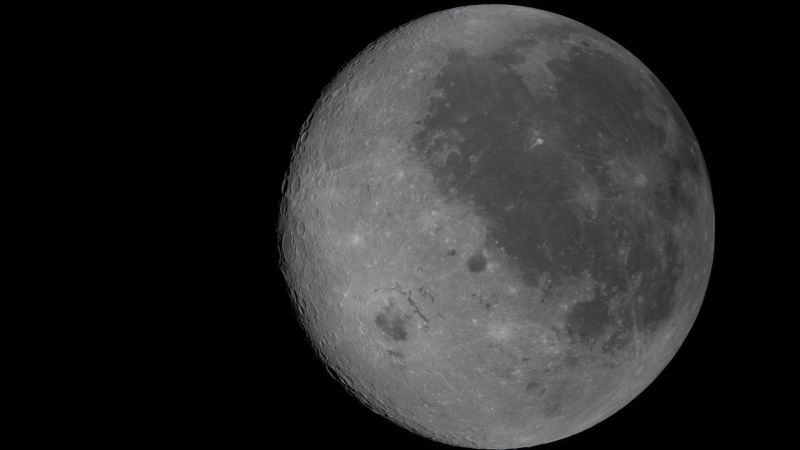
The moon and Earth are fundamentally made of the same material, said Dr. Lori Glaze, acting associate administrator for NASA’s Exploration Systems Development Mission Directorate.
Before the Apollo moon landings, scientists debated whether the satellite originated elsewhere in the solar system before our planet’s gravitational field captured it, or whether it formed alongside Earth or even spin off from the rapidly rotating Earth like a blob, said Carolyn Crow, assistant professor in the department of geological sciences at the University of Colorado Boulder.
But the Apollo samples pointed to a novel theory about how Earth acquired such a big moon, Crow said.
Within the samples was anorthosite, a type of igneous rock. Anorthosite is rarely uncovered on Earth in isolation, usually existing as a mineral component of other rocks. But the white rock was prevalent on the near side of the moon, suggesting that the right conditions existed for it to form, Crow said.
“What you need is a really big magma pond that slowly crystallizes and all of the anorthosite will float up to the top of the pond if it’s cooling slowly enough,” Crow said.

The presence of anorthosite on the moon suggested that the entire orb was once a magma ocean, or completely molten. Additionally, isotopes, essentially chemical fingerprints for planetary bodies, found in Apollo rock samples matched isotopes in Earth’s mantle, suggesting they formed at the same time.
Taken together, these insights helped scientists arrive at the current prevailing theory that a Mars-size object smashed into Earth, ejecting a blob of molten material from our planet that became the moon.
First Appeared on
Source link





Leave feedback about this