

Polymetallic nodules—lumpy, mottled, soot-colored chunks of rock, sized anywhere between a walnut and a potato—may appear unglamorous, but they are stunning examples of deep time in action. The misshapen orbs are found scattered across enormous swathes of the ocean floor, many miles deep; they form when elements precipitate out of seawater and accrue around tiny solid objects, like a piece of shell or a stray fish tooth, growing a few millimeters every million years. When today’s nodules began forming, between eight and 32 million years ago, the Alps were still rising, crocodiles prowled north of the Arctic Circle, and rhinoceroses roamed Europe: a vast sweep of geologic history compressed into a paperweight.
But not just any paperweight: These nuggets might also hold the key to a carbon-free future. They are rich in manganese, cobalt, nickel, and other so-called critical minerals essential to the production of renewable-energy technologies. Deep-sea mining companies say that they can be recovered from the seafloor with negligible environmental damage; geopolitical battles are being waged to secure the rights to the underwater treasure. But the science is still out on the companies’ investor-friendly claims. The long-term effects of nodule mining on deep-sea biodiversity are unknown—like so much of the deep ocean and its fertile benthic ecosystems, whose mysteries scientists are only beginning to unravel.
No score yet, be the first to add.
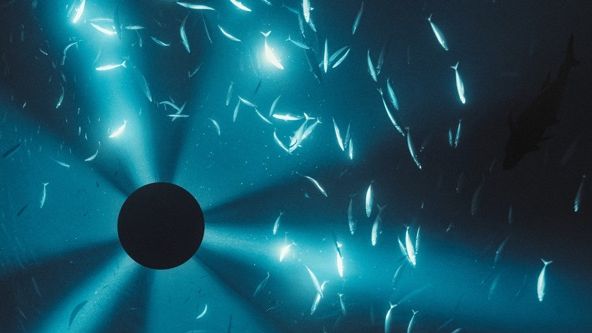
This contested terrain is the backdrop to Julian Charrière’s film Midnight Zone, in which the French-Swiss artist follows the path of an illuminated Fresnel lighthouse lens as it makes its hour-long descent through the blackness, shoals of fish exploding in front of his camera like slow-motion fireworks. Its destination is the bottom of the Clarion-Clipperton fracture zone, a patch of seafloor between Hawaii and Mexico that contains an estimated 20 billion tons of polymetallic nodules. With no dialog and no action, the film refracts a multiplicity of themes through its binary of vision and darkness: technology and nature, hubris and the sublime, knowledge and the unknowable. Laurel Halo’s soundtrack makes for a gripping and appropriately claustrophobic counterpart, capturing the velvety overwhelm of Charrière’s film in lightless, airless drones.
“Sunlight Zone,” the soundtrack’s 11-minute opener, begins with an indistinct hum, like a faraway boat engine. It is loosely harmonic, almost chordal, but it would be impossible to pinpoint the exact notes inside its smear. In the midrange, tones slide woozily up and down in pitch like dopplering sirens, or warped vinyl. The density is static but the sound is always in motion: The longer you listen, the more you begin to pick out discrete parts and pinprick details, like weird panning effects or, deep in the mix, what sounds like water trickling through a storm drain. The drone expands in frequency as it progresses: The bass rumbles louder, the highs shriek like subway brakes. The soundscape shifts, slowly and imperceptibly, from the kind of cozy murmur you might find in the run-out groove of a Sonic Youth record to an apocalyptic din that sounds like bells being forged in a fire of the damned.
First Appeared on
Source link





Leave feedback about this