

Our view of the cosmos changes completely based on how we observe it.
Now, astronomers have released the data from the largest-ever sky survey at radio wavelengths, revealing nearly 13.7 million celestial objects in light the human eye literally cannot see unaided.
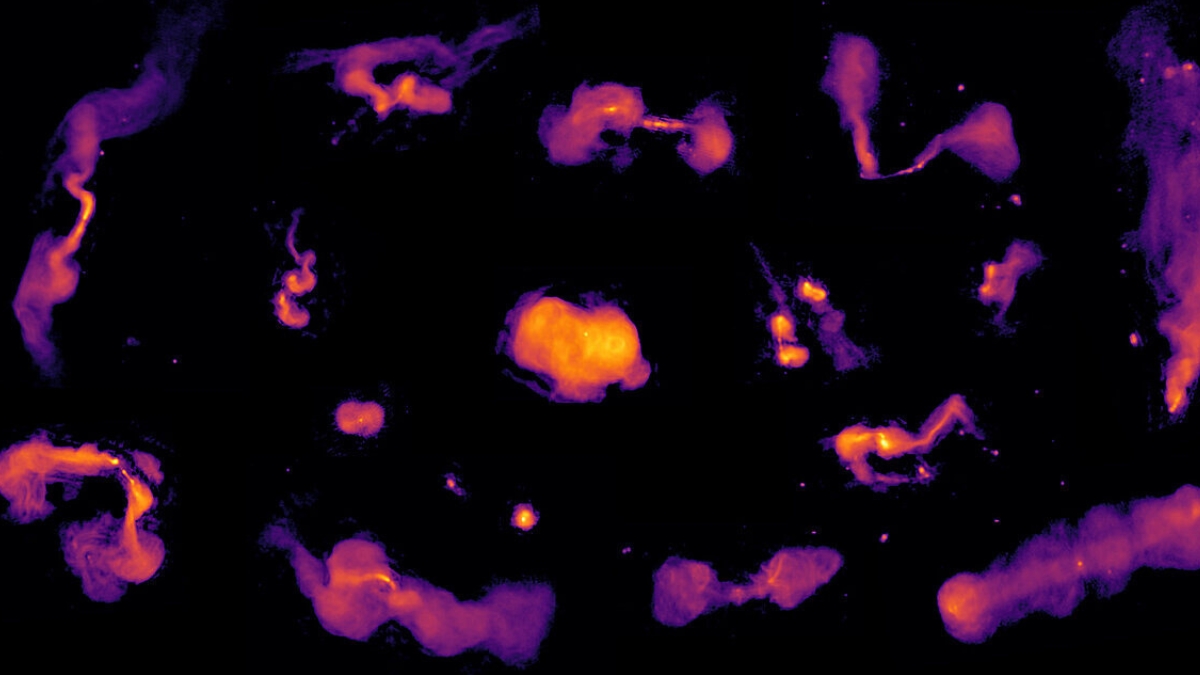
This is the third data release from the LOFAR Two-metre Sky Survey (LoTSS-DR3). It provides an unprecedented collection of cosmic objects that emit radio waves.
These include some of the most extreme phenomena in the Universe, including galaxies being whipped into weird shapes by Death-Star-like beams from supermassive black holes.
The survey covers 88 percent of the northern sky and comprises approximately 13,000 hours of data collected over years.
“This data release brings together more than a decade of observations, large-scale data processing and scientific analysis by an international research team,” says Timothy Shimwell, the study’s lead author and an astronomer at ASTRON and Leiden University in the Netherlands.
As detailed in a recent paper in the journal Astronomy & Astrophysics, an international team of researchers conducted this survey using the LOw Frequency ARray (LOFAR).
LOFAR itself is a technological wonder. It looks nothing like the large dish installations perfectly suited for climactic final battles between super-spies.
Instead, the telescope array is an interferometer composed of some 20,000 antennas spread between 52 individual stations – 38 in the Netherlands and 14 across other European countries. Spanning more than 1,000 kilometers (600 miles), they can act as a mass of individual sensors or work together as a single radio telescope the size of Europe.
“The volume of data we handled – 18.6 petabytes in total – was immense and required continuous processing and monitoring over many years, using more than 20 million core hours of computing time,” explains Alexander Drabent, an astronomer at Thuringian State Observatory and software developer for LOFAR as well as a study co-author.
The researchers employed one of Europe’s prominent supercomputers, at the Jülich Supercomputing Centre (JSC) in Germany, to analyze the treasure trove of data.
“For this sky survey, it was the first time that such large amounts of data had to be stored, processed, and made accessible as part of an astronomical observation project. LOFAR has thus also paved the way for future large-scale projects,” says Cristina Manzano, head of technical services at JSC and a study co-author.
The nature of the data may also be surprising, as LOFAR doesn’t simply ‘take pictures’ of the night sky. To create a single image, researchers must stitch together the input from 70,000 antennas, a task that requires digitizing, transporting, and combining 13 terabits (equivalent to more than 300 DVDs) of raw data per second.
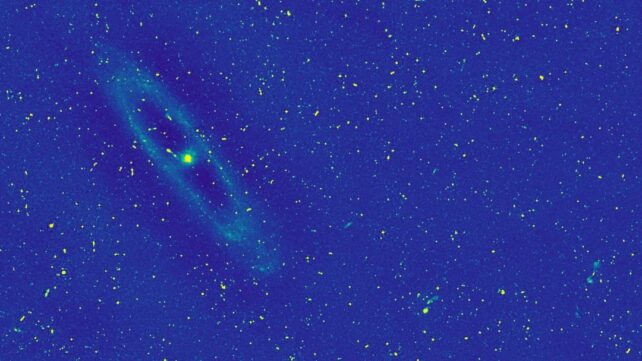
It’s worth the work because the resultant images offer an oddly unfamiliar view of the Universe. For example, LOFAR’s glimpse of the Andromeda Galaxy gives our biggest galactic neighbor the semblance of a ghostly cosmic eye, presumably staring down its future collision with the Milky Way.
Radio emissions can also reveal exoplanets, collisions between clusters of galaxies, and supernova-produced magnetic fields that accelerate particles with thousands of times more energy than Earthly supercolliders.
And thanks to low-frequency light’s Houdini-like escape skills, it reaches us through dense environments, like the dust-obscured hearts of the Milky Way and other galaxies.
As a result, astronomers can see how black holes shape cosmic evolution and how young stars explode into life.
Related: Most Energetic Ghost Particle Ever Seen May Have Come From Black Hole Jets
Now that the data release is publicly available, the floodgates are open for a glut of studies, as the past two LOFAR releases have demonstrated – A single image that contains 25,000 supermassive black holes, anybody?
Finally, LOFAR serves as an essential predecessor to its spiritual sibling: the next-generation Square Kilometre Array Observatory (SKAO), a global collaboration to build the two largest telescope arrays in the world in South Africa and Australia.
It’s an exciting time for science, and more so for us, who benefit from the cool discoveries without much of the hard work, other than some finger-intensive clicking and scrolling.
This study was published in Astronomy & Astrophysics.
First Appeared on
Source link





Leave feedback about this