

Sign up for the Slatest to get the most insightful analysis, criticism, and advice out there, delivered to your inbox daily.
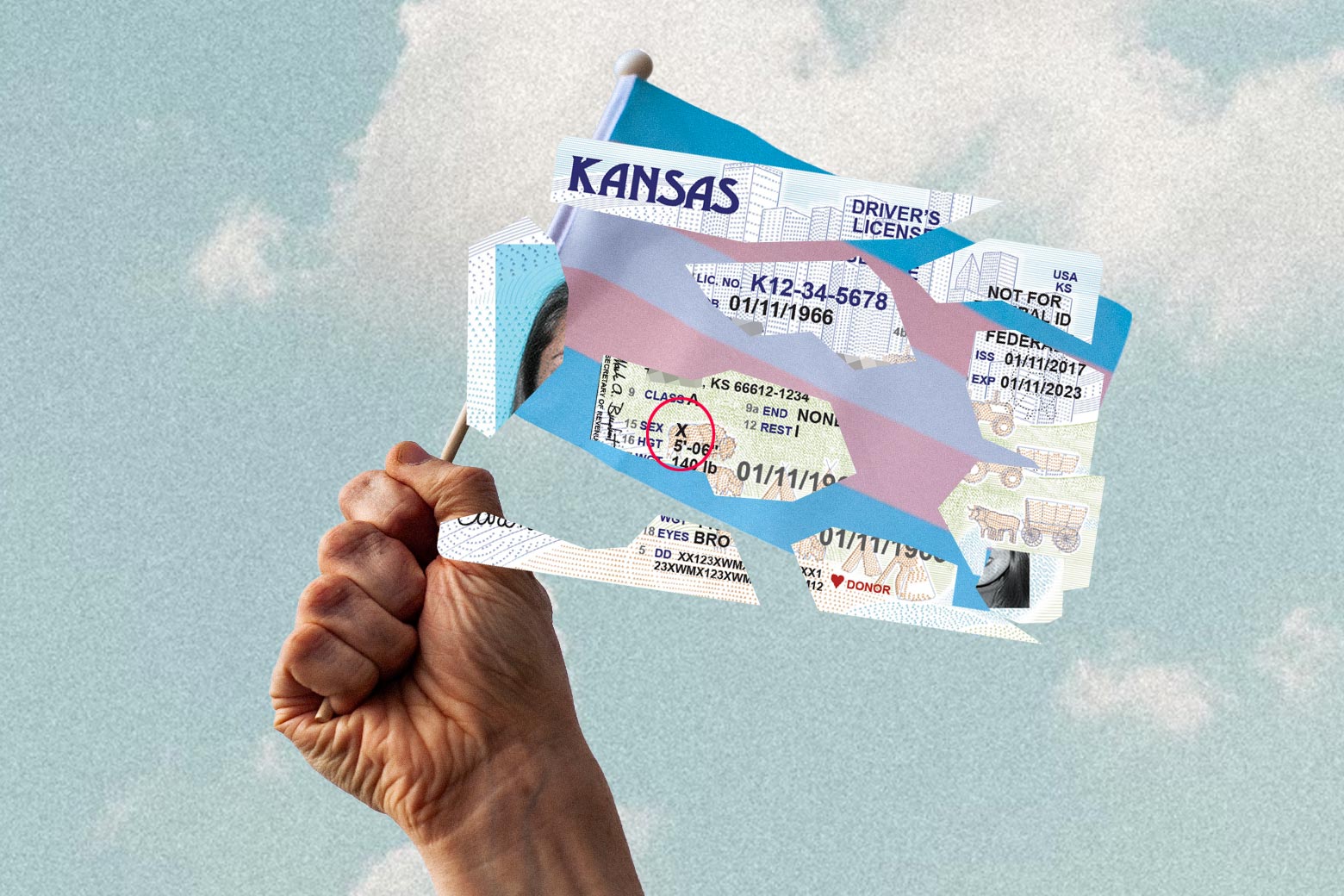
On Thursday morning, the state of Kansas invalidated the personal identification documents of more than 1,000 residents. A new law that went into effect requires state-issued IDs to reflect each person’s gender assigned at birth, instantly nullifying all driver’s licenses held by trans Kansans who’d gone through the process of changing the gender marker to reflect their identities.
Affected Kansans were informed that their licenses would become meaningless pieces of plastic with letters that went out from the Kansas Division of Vehicles this week. “Please note that the legislature did not include a grace period for updating credentials,” it read. “This means that once the law is officially enacted, your current credential will be invalid immediately.”
It’s hard to overemphasize the chaos an abrupt revocation of identity documents can inflict on a person’s life. Trans people who may have gotten their gender markers switched up to two decades ago, when Kansas first began allowing such changes, are suddenly unable to legally drive to work, school, medical appointments, or the grocery store. They cannot drive their kids where they need to go. Depending on what other identity documents they have and how strict ID takers decide to be, they may not be able to get into a bar, board an airplane, purchase alcohol, get a job, or apply for financial assistance until they get a new license.
This new law, S.B. 244, is one piece of a broader anti-transgender agenda that is consuming the Republican Party. Determined to enforce a draconian gender hierarchy, the right seeks to punish people who expose the fragility and malleability of gender itself. GOP legislators are also well-aware that whipping up public outrage against a tiny minority is a tried-and-true political strategy for their party. As a result, trans people who are just trying to live in peace have found themselves in the crosshairs, with the full force of the state deployed to upend their lives.
The swiftness of the law’s rollout adds an additional layer of cruelty to a measure that was already set to destabilize trans people’s lives. With credentials that do not match their gender identities, many trans people will be outed when their IDs contradict the gender a cashier, bouncer, police officer, or other ID taker expects based on their appearance. In the best-case scenarios, this will be merely time-consuming or annoying. In other cases, it will cause public humiliation. In still others, it could put a trans person’s safety at risk.
Trans Kansans had little time to prepare for this new reality. The law was passed less than a month ago, and Democratic Gov. Laura Kelly vetoed it just last week. The Republican supermajority state Legislature overrode the veto with a two-thirds vote a couple of days later, leaving trans people one week to change their IDs—if they were even aware that the law had passed. By giving Kansans barely any window to obtain a new driver’s license, Republicans ensured the law would cause maximum stress for those impacted and maximum financial penalties for those left without a way to get to work.
The letters that went out this week instructed recipients to “surrender” their current IDs to the Kansas Division of Vehicles, warning that drivers will be “subject to additional penalties” if they are caught operating a vehicle with their current ID. Individuals will need to go in person to a government office and pay up to $48 for a new license. The Kansas Division of Vehicles did not respond to a request for information on the replacement process, but according to the division’s website, it can take 45 days to receive a new credential, meaning that affected trans people may be prohibited from driving—and doing anything else that requires a valid ID—until April.
The new law also invalidates birth certificates that bear a gender marker other than the one assigned at birth. This presents a potential challenge for trans Kansans who might have otherwise used their birth certificates as one of the two pieces of identification required to replace a driver’s license. (Only 41 percent of Kansans have a passport.) The department responsible for issuing Kansas birth certificates estimated that more than 1,800 such documents were nullified this week.
And IDs make up just one part of the law, which poses sweeping restrictions on trans Kansans’ access to public spaces. As of Thursday, any “multiple-occupancy private space” must be segregated by gender assigned at birth, including restrooms, hospital rooms, dormitories, locker rooms, and more. The law will be enforced by bounty-hunter lawsuits: Anyone who believes they were in a bathroom with someone who was given a different gender at birth can sue for damages of at least $1,000. If a trans person runs afoul of the law multiple times, they may be criminally charged with a misdemeanor.
In a statement explaining her veto, Kelly criticized the broad and vague way the law was written, noting that a husband would not be allowed to visit his wife in a shared room at a hospital, and a brother would be barred from entering his sister’s dorm room. When the Legislature overrode her veto, Kelly wrote that it was “nothing short of ridiculous” to force “the entire state, every city and town, every school district, every public university to spend taxpayer money on a manufactured problem.”
Rep. Abi Boatman, the only transgender member of the Kansas Legislature, told me on Thursday that she has not yet received her own letter demanding the surrender of her ID, and the delay has her worried that trans people may be risking penalties for driving without a license without ever being notified that their IDs are void. The Democrat from Wichita tried to stop the bill last month, when it was brought up for debate on her 20th day in office. “I have sat here for five and a half hours and listened to this entire room debate my humanity and my ability to participate in the most basic functions of society,” she said on the floor of the House. “From the bottom of my heart, I hope none of you have to ever sit through something like that.”
In an email, Boatman wrote me that she believes the law is unconstitutional and pointed out that Kansan taxpayers will be on the hook for all the money it will take for the state to defend this law in court. The ACLU is still in the midst of challenging a similar law that went into effect in 2023, but was paused in fall 2025, which stood to prevent Kansans from changing the gender markers on their IDs.
It’s not easy showing up to a workplace with a supermajority of co-workers bent on undermining the lives of trans Kansans, Boatman told me. But “I would much rather participate in the process than be left helplessly ranting about it on social media,” she wrote. “I think it’s important for folks to actually see the Kansans whose lives they are making so difficult.”

First Appeared on
Source link






Leave feedback about this