

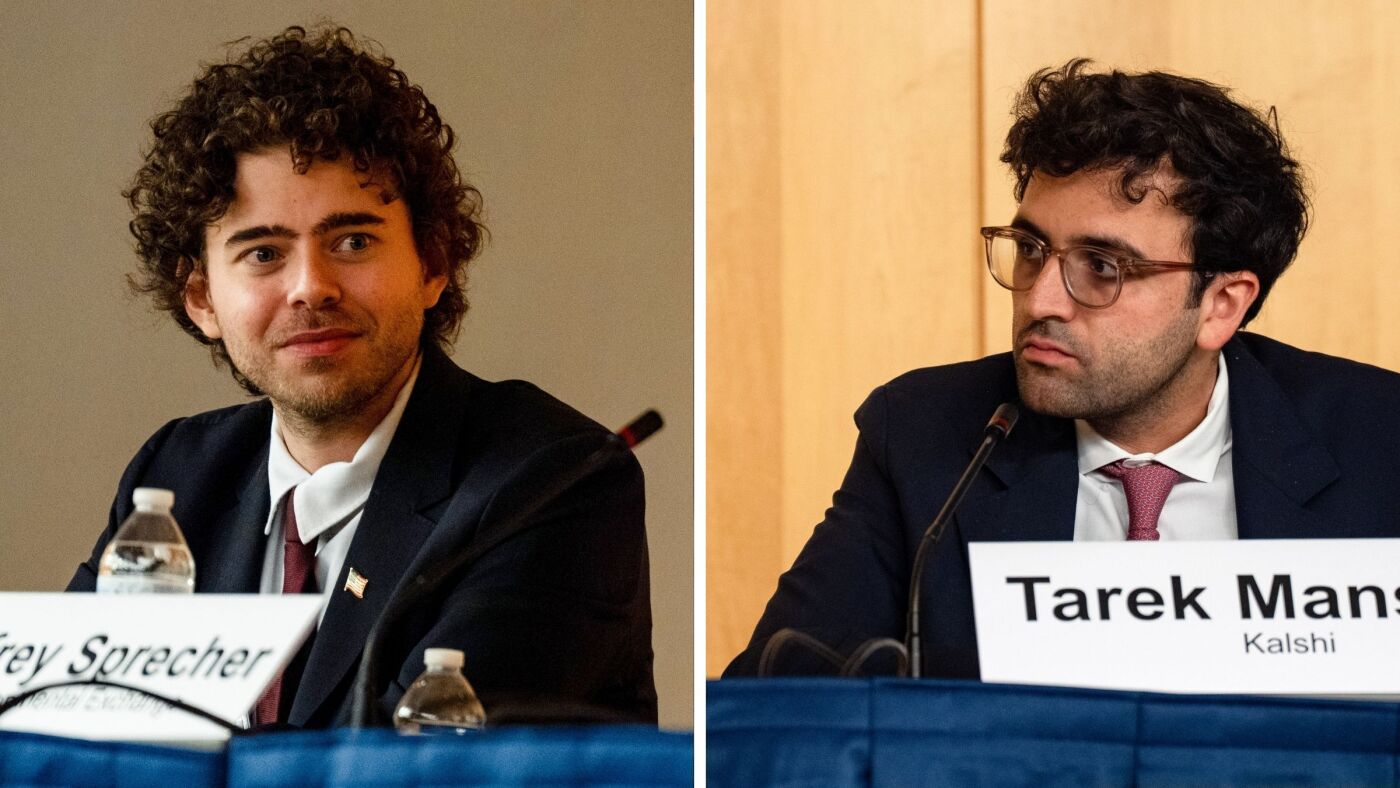
Polymarket’s Shayne Coplan (left) and Kalshi’s Tarek Mansour are two 20-something billionaires who run the biggest prediction market sites. They have had a long-running rivalry.
hide caption
toggle caption
There’s one word Kalshi CEO Tarek Mansour is loath to say: Polymarket.
Like a politician swiping his never-to-be-spoken-of challenger on the campaign trail, Mansour will drag the enemy but never name the enemy.
Yes, there’s an “unregulated, offshore prediction market,” which is not like Kalshi. Too many people, Mansour says, confuse Kalshi for that “non-American, unregulated platform.”
For Mansour, distinguishing Kalshi from that other site is a form of combat. If there’s a chance to land a blow, he will.
After the FBI raided Polymarket CEO Shayne Coplan’s home in November 2024, Kalshi staffers teamed up with influencers to promote memes mocking Coplan, Mansour admitted the following month. “Some of our team got pretty heated,” he said at the time.
Mansour, in a December podcast interview, likened his beef with Coplan with one of the most rousing rivalries in NFL history, the face-off between Tom Brady and Eli Manning over football quarterback supremacy.
“When Tom Brady kind of reflected on that back in the day, he’s like, ‘You know, we were like the most ferocious on the field, and we fought each other,'” said Mansour, adding that the vying ultimately led Brady to greatness.
Coplan has been cagier in public about his prediction market foe, even as he rages quietly to his inner circle about Mansour, who keeps ratcheting up his antagonism.
Even the typically stodgy U.S. Patent and Trademark Office is witnessing some of the action. Both Kalshi and Polymarket have pending trademark applications for “the world’s largest prediction market,” federal records show. (Kalshi is the bigger one by trading volume, but Polymarket has long called itself the largest.)
The feud could shape the future of the industry, with each executive offering competing visions for how prediction markets should grow, either by fighting in court for the legal right to exist or — like the cryptocurrency industry before them — by trying to skirt U.S. regulations for as long as possible.
“Kalshi hates getting lumped in with Polymarket,” said Dustin Gouker, who writes a prediction markets newsletter and is also a consultant. “They’re trying to draw this line in the sand that they’re this CFTC-regulated prediction market and Polymarket is not,” he said, referring to the Commodity Futures Trading Commission. “I’m not sure that message is getting through, but it’s furthering the animosity between the two companies.”
A former Kalshi employee with direct knowledge of Mansour, who spoke to NPR on the condition of anonymity for fear of retaliation, said the culture inside the company is “die-hard,” with Mansour pushing his staff relentlessly to hit goals for new users and other metrics. The person said Polymarket’s popularity has only exacerbated Mansour’s intensity.
“Tarek is being so aggressive because the size of the bag is generational if they get it right,” the person said. “For them, it’s existential.”
The two fintech execs being at loggerheads comes against the backdrop of a boom in the prediction market industry.
The sites have seen exponential growth in recent months, logging billions of dollars in bets every week on everything from Oscar winners to what words President Trump will utter at a press conference to when exactly bombs will drop on Iran — there was even a market on Polymarket that was taking wagers over when a civil war in the U.S. could break out.
Tens of millions of people are turning to the sites to try to cash in, just as ethical and legal questions haunt the industry. Dozens of new entrants — like Coinbase, Robinhood and even Trump’s social media site, Truth Social — are trying to get in on the gold rush, but the world of prediction markets remains dominated for now by two firms: Kalshi and Polymarket.
Media partnership and grocery store wars
Mansour and Coplan, who both wouldn’t comment for this story, are both 20-something billionaires with a shared belief that prediction markets’ “wisdom of the crowd” ethos can illuminate truths faster and more accurately than media, polls and other traditional institutions.
Getting there has meant embarking on opposite journeys.
Mansour, 29, a Massachusetts Institute of Technology graduate, formerly worked at Wall Street firms like Goldman Sachs and Citadel. He likes to say that his time on prestigious trading floors made him realize that mass adoption of prediction markets requires playing nice with the federal government, a tack that Kalshi’s co-founder, Luana Lopes Lara, who keeps a much lower profile, has endorsed.

“We will literally go to the federal government and subject ourselves and say, ‘We want to get regulated, and we’ll bang our head against the wall until you regulate us,'” Mansour said at last year’s TechCrunch Disrupt conference. “I didn’t want to build a company that had the curse of scale,” he said, referencing the idea that problems for a tech startup could get worse the bigger the company gets.
The curse of scale is hardly a fear of Coplan, a 27-year-old New York University dropout who traded cryptocurrencies as a teenager and launched Polymarket without the blessing of any regulators. He drove the company in more of a shoot-first, aim-later style. Scale it fast, the feds be damned. That approach didn’t always work out. The FBI raided his Manhattan apartment as part of a Biden-era money-laundering investigation. Trump has since dropped the probe.
“We’re just market nerds who think prediction markets provide the public with a much needed alternative data source,” Coplan wrote on X in October 2024, a month before the FBI raid. The Trump administration just months ago cleared the way for Polymarket to open a U.S.-based exchange.
“It’s naturally a fit in a world where there are infinite opinions being served to you algorithmically based on what you already think, designed only to keep you engaged and push you further into an echo chamber,” Coplan said in the post.
Polymarket’s most popular exchange is overseas and accessible in the U.S. only through a virtual private network. Traders landing six-figure payouts associated with the capture of Venezuelan leader Nicolás Maduro and the death of Iran’s supreme leader drew criticism from lawmakers in Washington and critics of the apps. Until recently, Polymarket allowed bettors to wager money over when a nuclear bomb would detonate. It quietly removed it after an online uproar.
“Polymarket is so much more willing to push the envelope,” said the former Kalshi staffer. “Kalshi does hate getting confused for Polymarket, but when Polymarket is confused with Kalshi, it’s good for them.”
And that’s because Kalshi negotiated with regulators for years before launching, and it is now under the watch of the CFTC. During the Biden years, the vast majority of Kalshi’s offerings were considered illegal. Now, the CFTC’s chairman, Michael Selig, has affirmed that prediction markets should flourish and largely police themselves.
Selig has even vowed to defend Kalshi in court in the face of states suing the company for violating state gambling laws.
Kalshi has the Trump administration on its side, but so does Polymarket. Donald Trump Jr., the president son, advises both companies. And his venture capital firm, 1789 Capital, has invested millions of dollars into Polymarket.
The president’s son advising may be a commonality, but Mansour is quick to argue that Polymarket is the law-breaking, shady foreign exchange, with Kalshi’s X account often attacking those who get confused. Don’t conflate us, Mansour pleas, even as many users, politicians and commentators mix them up regularly.
As such, the companies have been looking for opportunities to one up each other.
In early December, Kalshi bragged about its new partnership with CNN. Weeks later, Polymarket unveiled a deal with Wall Street Journal publisher Dow Jones.
When Kalshi last month pulled a stunt of giving out $50 of free groceries per shopper in New York City’s East Village, Polymarket’s Coplan had a response: “New York City, we’re open,” Polymarket’s X account announced, revealing a temporary free grocery store in Manhattan that the company now intends to keep open permanently.
But perhaps nothing crystallizes the feud more than an announcement that Kalshi made late last year about the formation of a trade group, called the Coalition for Prediction Markets, to promote the development of the industry. It describes itself as a “unified industry voice working with policymakers, regulators, and the public to establish clear, fair rules that make prediction markets accessible and trustworthy for everyone.”
Missing from the coalition? One of the other biggest prediction markets in the world: Polymarket.
First Appeared on
Source link




Leave feedback about this