

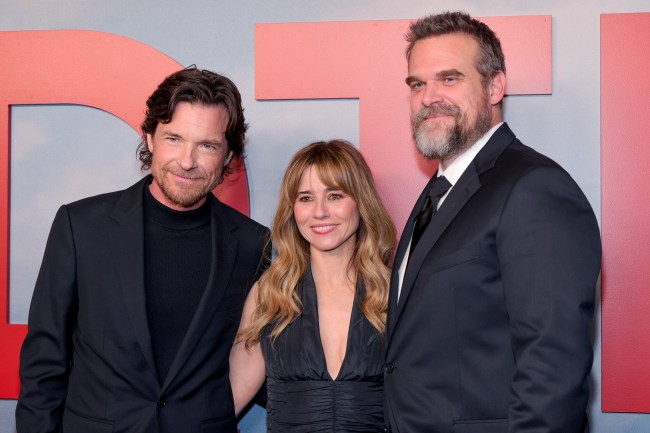
As I was eavesdropping on him (this will be explained), Jason Bateman astutely pointed out something key: “DTF St. Louis” is tough to pigeonhole, genre-wise. “Dark comedy” seems to be used a lot in these situations, which kinda, sorta works? But some pretty tragic events happen for a “comedy,” even a dark one.
In the new HBO limited series, Bateman plays Clark Forrest, a St. Louis weatherman who meets and is instantly attracted to Carol (Linda Cardellini) at a cornhole party thrown by his coworker, Floyd, played by David Harbour. (If you don’t know what cornhole is, it’s basically a horseshoe-type game involving beanbags that actually is very popular in the St. Louis area; I do speak from experience here.)
The problem is that Clark is married. And Carol is married to Floyd. Floyd is a sweet man who has kind of stumbled through life professionally, though he’s finally found his niche as a sign language specialist at a local television station. Though not hearing impaired himself, he does have his own ailment that involves an unexplained (at least through four episodes) accident involving his penis. And, as a former Playgirl model, this has affected his confidence.
Well, that and he’s sexually repulsed by Carol’s new side hustle as a baseball umpire. Clark soon introduces Floyd to the DTF (which stands for “down to fuck”) St. Louis app, for selfish reasons, but this recommendation has terrible consequences for everyone.
When I joined the three on Zoom, they were mid-conversation, and I didn’t want to interrupt. Usually in these situations, the person being interviewed is staring stoically into the camera so, to be fair, this did seem more natural. But I’m also open to the fact this could have been one of those moments on television when a character looks at the screen and says, “Oh, it’s you! I didn’t see you there!”
The following interview has been edited and condensed for clarity and length.
Jason Bateman: …because it’s exciting to them, they’re so used to… oh …
IndieWire: No, I’ll just listen, someone is excited about something.
Bateman: No, we were just talking about, what is this show? Steven Conrad did such a great job of creating something that can’t really be categorized in any particular genre. It does subvert all the different genres it pretends to be, almost immediately. For me, as a viewer, that’s an exciting element to the show.
A lot of twists and turns happen, pretty early.
Bateman: That’s correct, yeah. They keep coming.
It doesn’t fit into the cornhole, if you will.
Bateman: Nice work.
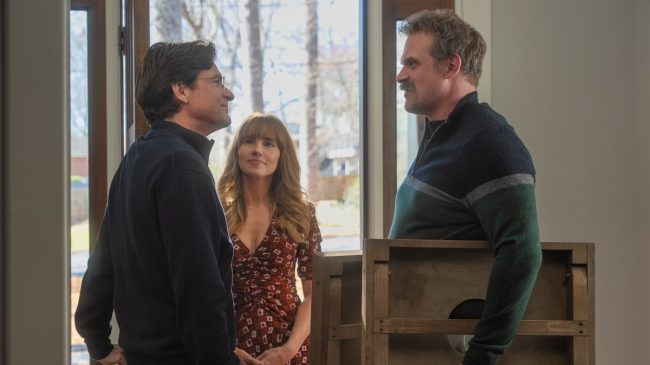
I have been wondering this, when you first became attached, was there ever a time you asked, “Can this just be set in a different state?”
Bateman: [Laughs] Right, because of St. Louis and the Ozarks?
Look, I was born in St. Louis and went to elementary school near Lake Ozark, so personally I’m thrilled. But I could see you thinking, maybe I don’t need to do another show set in Missouri.
Bateman: Well, ironically, or coincidentally, I shot both of those shows in Atlanta. But I was just so thrilled to get the call from David. This is David’s baby. Fortunately for me, this part opened up and I got invited in. And Steve Conrad is somebody I’ve been a fan of for 20-plus years and I could just not be happier with the way it turned out and the process of making it. It’s very unique and I was really happy to play this character.
Also there aren’t many shows set in St. Louis. It’s basically this and “The John Larroquette Show,” and that was over 30 years ago.
Bateman: That’s true!
Originally this was based on a New Yorker article about a dentist, I believe? Which I’ve read, and this show is now completely different. When did that all change?
David Harbour: Yeah, there was a lot of different stuff that went into it, the components that Steven and I talked about early on. Pedro Pascal was involved and we were working on it. But about two years ago, we redeveloped it around this new story with the weather man and the ASL interpreter and a murder and this app. And then it took on a new life.
Steven is so creative, that when you let him go, you’re better off. There are some writers that it’s nicer when they are hemmed in, but for him, in particular, when you give him space, he makes it more colorful and more exciting and more twists and more turns. And then we were lucky enough to have Jason want to do this. And the last component, really, of the core group was Linda. It’s just a coming together, a perfect storm of talent. It’s been this iteration with HBO the last two years.
It’s not just the twists and turns, it’s also little plot details like Linda’s character being a baseball umpire, which is a turn-off for Floyd.
Linda Cardellini: I met with a real umpire! Where he taught me how to do the signs and everything.
A major league umpire?
Cardellini: He was saying it was good money! Oh no, not major league. But it was good money and you could make it in cash. So that part makes so much more sense for me, it’s truly about this trying to do that accounting at home like she does at Purina, trying to get their books in order. [Laughs] And it just so happens to be the biggest turn-off in the world for him.
Harbour: Well, you’ve got the big bag with the balls. You’ve got to put the balls in the thing. All the pads!
Cardellini: There were three people helping me get it all on and off!
Harbour: There’s that great scene in the hallway where I see her go out in these enormous boxy blue pads.
Bateman: Yeah, that’s a big turn-on.
Cardellini: And she waters the plants.
Bateman: It’s sweet that she’s doing this to help the bottom line of the house. That earns it back. It’s this absurd, sort of farcical thing. Yet it’s super-grounded because of how lovely her character is. Steve is constantly making this balance.
When the umpiring aspect is first mentioned, there’s a great shot of Linda by herself on the field in a kind of montage of making strike calls.
Cardellini: And they did that on Super 8. Where they’d put that footage in different spots. It’s really beautiful how they crafted all these little moments that are in and out of the show that are stream of consciousness.
It feels like all three of you get to play characters you haven’t really played before. And, for David, this has to be perfect timing, coming right after “Stranger Things” ending.
Harbour: I love it. He’s such a different guy, He’s so vulnerable and so sweet. And such a schlub in a certain way. He’s not capable like Hopper. He’s not like a big superhero at all. He’s battling middle age! [That’s] his biggest monster. I really love him and he has a sweetness. He really allowed me a vulnerability.
There’s something in that last season of “Stranger Things,” those characters, we were going through so much. It’s the characters tying the whole thing up — there’s a certain speed and pace to the whole thing. In this, there really was all the freedom to slow down and to be, truly, kind of lost and vulnerable. And I love that as an actor. It allowed me so much freedom. And to work with these guys was a dream as well. You just show up and you’re playing tennis with two of the greats.
I’ll disagree, because when Floyd is on stage at the concert, dancing and signing the concert, he looks like a superhero.
Harbour: [Laughs] I’m glad you think that.
Those were superhero maneuvers.
Harbour: You’re one of the only people who probably thinks that, but I’m glad you think that.
I just got Springsteen tickets, he should hire you to sign the show.
Harbour: Ha, OK right. OK, that’s funny.
Jason, if you were actually a weatherman, I would trust your forecast.
Bateman: Yeah…
I think you’re convincing.
Bateman: Yeah, well, this Clark guy is certainly affable and decent. He’s got the glasses and the hair and the smile and the “aw shucks.”
Harbour: And you were good with the weather board too, weren’t you?
Bateman: Yeah, that was very cool. I love the way they shot all that stuff, too. Using the green screen and the TV monitor and the onboard camera thing, it was so well-shot. I like playing people who seem like one thing on the surface and then, kind of underneath, there’s other stuff ticking. The audience starts to get little flashes of it. And you’re clocking that and you’re tracking that. Sometimes, the audience is ahead of the other characters in the show and sometimes the opposite is true.
I had a friend who ran into a local St. Louis weatherman at a bar and was excited to meet him, then said he was a dick.
Cardellini: Oh, haaaaa.
Bateman: Well, maybe that was after a few beers, I guess.
I’ve thought about this, if you’re the weatherman in St. Louis, you’re famous and are the local celebrity. So maybe it gets old.
Bateman: Yeah, there’s a version of Clark that could have been played much more alpha, much more aggressive, and use all of these things that he went through as a way, a path, to softening. As opposed to, I just thought it was a more interesting route to do the opposite. That he’s a really vulnerable, meek kind of guy who was looking to get a little more backbone in his life.
But you do perform an opening credits big kick.
Cardellini: Beware!
Why?
Bateman: You’ll figure out what that is.
Oh, that has deeper meaning?
Bateman: Yeah, there’s a whole sort of payoff for that. Eventually. I think it’s in [Episode] 6 or 7.
I see. They only sent the first four.
Cardellini: You have some treats coming.
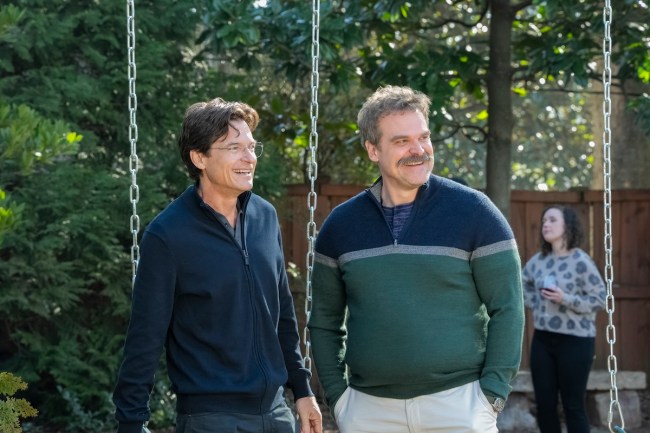
I have to wait like everyone else.
Cardellini: It’s all twists and turns.
What are everyone’s opinions on this DTF St. Louis app? People upload their picture, it seems like a good way to get caught? Also, from my experience in St. Louis, everyone seems to know each other.
Bateman: Yeah, do apps like this exist?
I actually don’t know, but I assume so? I remember there was that Ashley Madison website for married people that was a big story because it got hacked. So I assume this app is maybe based on that a bit? But in real life it got hacked and everyone’s information was released.
Bateman: Oh, boy. That’s messy.
Cardellini: I feel like that’s the danger of doing anything online, too. It’s just like what is privacy anymore for anybody? That’s terrifying. And not even with trying to cheat on anybody, but even with your credit card online.
Harbour: I feel like the app is just kind of a conduit. It’s funny, it functions in the show in a very specific way. We don’t get into any of those ideas of people getting caught. It functions more as an outlet for some deeper meaning, in a weird way. The only guy who really goes on dates is Floyd, a couple times. They aren’t even that significant.
It functions in a very specific way on our story — it sort of seems like one thing. Again, it’s a genre-bending thing. It seems like we’re going to show you a show about an app and kinky sex and all that. But what we’re really showing you is a show about a lot of really intimate, longing vulnerability among people.
Cardellini: What you see from me and Jason, we don’t meet on DTF.
Right, you meet at cornhole and then the big Jamba Juice scene.
Harbour: The Go Getter!
I’d argue that the date Floyd goes on with Peter Sarsgaard is significant. It really establishes how sweet Floyd is, that Floyd “french kisses” with him just to avoid any chance of making him feel bad.
Harbour: I know! He’s a very unique character. Again, there’s a version of that scene where Floyd says, “Oh, I thought you were a girl, I’m out of here.” Instead it becomes a whole breakfast and a whole thing afterwords he’s roped into. But it speaks a little bit into Floyd’s longing for some kind of effect on people. Or some kind of former potency the Playgirl spread had for him. There are a lot of layers to what Floyd is looking for — but he also wants to take care of people.
That also sums up Floyd, the avatar being used on the profile was a picture of David Bowie and he thought the photo of Bowie was a pretty lady.
Harbour: [Laughs] Right, the nice lady!
“DTF St. Louis” premieres Sunday, March 1 at 9 p.m. ET on HBO. New episodes will be released weekly through April 12.
First Appeared on
Source link



Leave feedback about this