

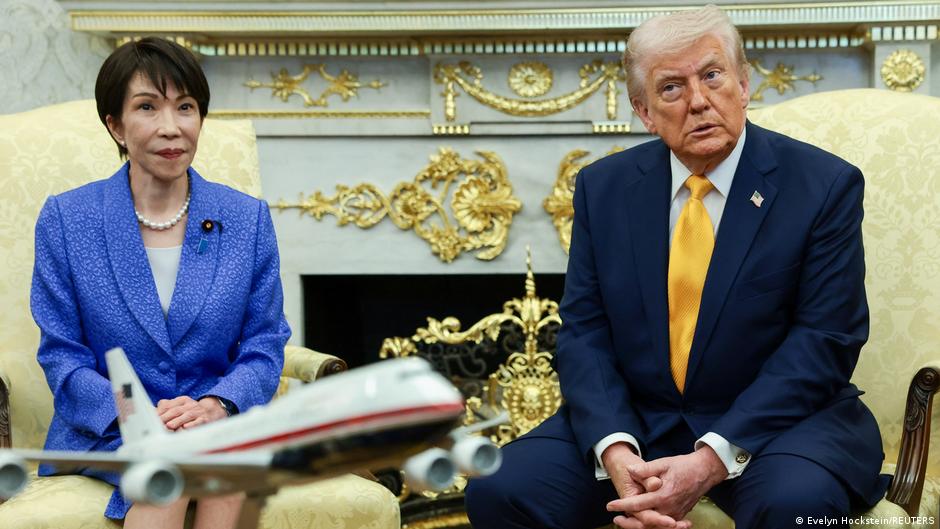
The delicate summit between US President Donald Trump and Japanese Prime Minister Sanae Takaichi went off largely smoothly on Thursday.
Takaichi arrived in Washington bearing trade and energy deals, and Trump reciprocated by reiterating the importance of the relationship while refraining from asking Tokyo to send warships to the Strait of Hormuz to support the US-Israel war with Iran.
The meeting was arranged long before the US and Israel launched their attacks on Iran late last month, with Trump last week calling on US allies, specifically naming Japan, to commit military forces to the region.
Japan would be unable to make any such commitment under the terms of its strict pacifist constitution. The Iran war in general is deeply unpopular with the Japanese people, analysts point out, effectively making it impossible for Takaichi to accede to any such request.
They added that Trump never directly broached the subject in front of the media, a request that would have put his guest on the spot, which indicated that Tokyo’s top aides responsible for ensuring the summit ran smoothly did their jobs.
Smooth Japan visit despite Trump’s Pearl Harbor aside
There was a brief awkward moment when Trump made what was assumed to be a joke about Japan’s 1941 surprise attack on Pearl Harbor, with Takaichi visibly stiffening at the comment. Even so, experts say the Japanese side will have breathed a sigh of relief that the visit went off so smoothly.
“Takaichi would have been nervous when they were speaking in front of the media as it would have been very difficult if Trump had suddenly asked her to send the Self-Defense Forces,” Toshimitsu Shigemura, a professor of international relations at Tokyo’s Waseda University, told DW.
“The Japanese side would have explained to the US why that is just not possible under the constitution, but there was always a possibility that he would raise it.
“Still, I think it is quite clear that the outcome of the visit was a victory for Trump as he got everything else that he has been asking for since he came to power, and Takaichi got promises on security.”
The Japanese PM called for de-escalation of the US-Israel war with Iran, condemned Iran’s attacks in the Strait of Hormuz and said the nation’s theocratic regime must never be allowed to obtain a nuclear weapon.
She also showered praise on Trump, saying, “I firmly believe that it is only you, Donald, who can achieve peace across the world.”
Deals on rare earths, shipbuilding and technology
During Takaichi’s visit, the two governments announced expanded cooperation, including Japanese investment of up to $73 billion (€63 billion) in US business projects as part of the broader $550 billion investment commitment announced last year.
The new projects include the development of small modular reactors in Tennessee and Alabama and an action plan to develop alternatives to China for critical minerals and rare earth elements.
Agreements have also been reached to reinvigorate both nations’ shipbuilding industries in order to wrest control of the sector back from China and further development of artificial intelligence and cutting-edge technology.
And in yet another sweetener, Japan committed to purchasing more crude oil from Alaska while investing in production and refining infrastructure.
As well as pleasing Trump, the move aims to shift Japan’s energy reliance away from the volatile Middle East, which currently supplies around 90% of Japan’s crude oil.
Fuel prices in Japan have risen sharply since the start of the war with Iran.
Japanese role in Golden Dome defense
With the security challenges posed by an increasingly aggressive China and the deeply unpredictable regime in North Korea also at the forefront of Tokyo’s mind, Takaichi also arrived in the US with a request to participate in the development of Trump’s proposed Golden Dome missile defense system.
Based on a network of satellites that provide early warning of a launch linked to interceptor missiles, Takaichi wants the system to also cover Japan.
“Japan’s greatest concern is, of course, China, and everything that Takaichi went to the US for can be linked back to greater safeguards for Japan from China,” Shigemura said.
Japanese support after a ceasefire?
And while Trump had been briefed not to mention Japan committing military capabilities to the Middle East while hostilities are ongoing, Shigemura believes that Takaichi will agree to provide logistical support and minesweeping vessels once a ceasefire has been agreed in the region.
“When this meeting was first announced, after Takaichi’s election victory in early February, Tokyo did not expect a war in the Middle East,” said Robert Dujarric, co-director of the Institute of Contemporary Asian Studies at the Tokyo campus of Temple University.
“I think the Japanese diplomats who laid the groundwork for the visit have done an excellent job in keeping the focus on trade deals, security, greater bilateral collaboration and progress on the Golden Dome project, all of which are priorities for Japan,” he said.
“She was never going to be able to send troops, that has been made clear, but Japan has not angered Trump like Europe, and Washington’s NATO allies have clearly enraged him,” Dujarric said.
“The trans-Pacific alliance is still in place and my sense is that Takaichi will be very relieved.”
Edited by: Keith Walker
First Appeared on
Source link

Leave feedback about this