

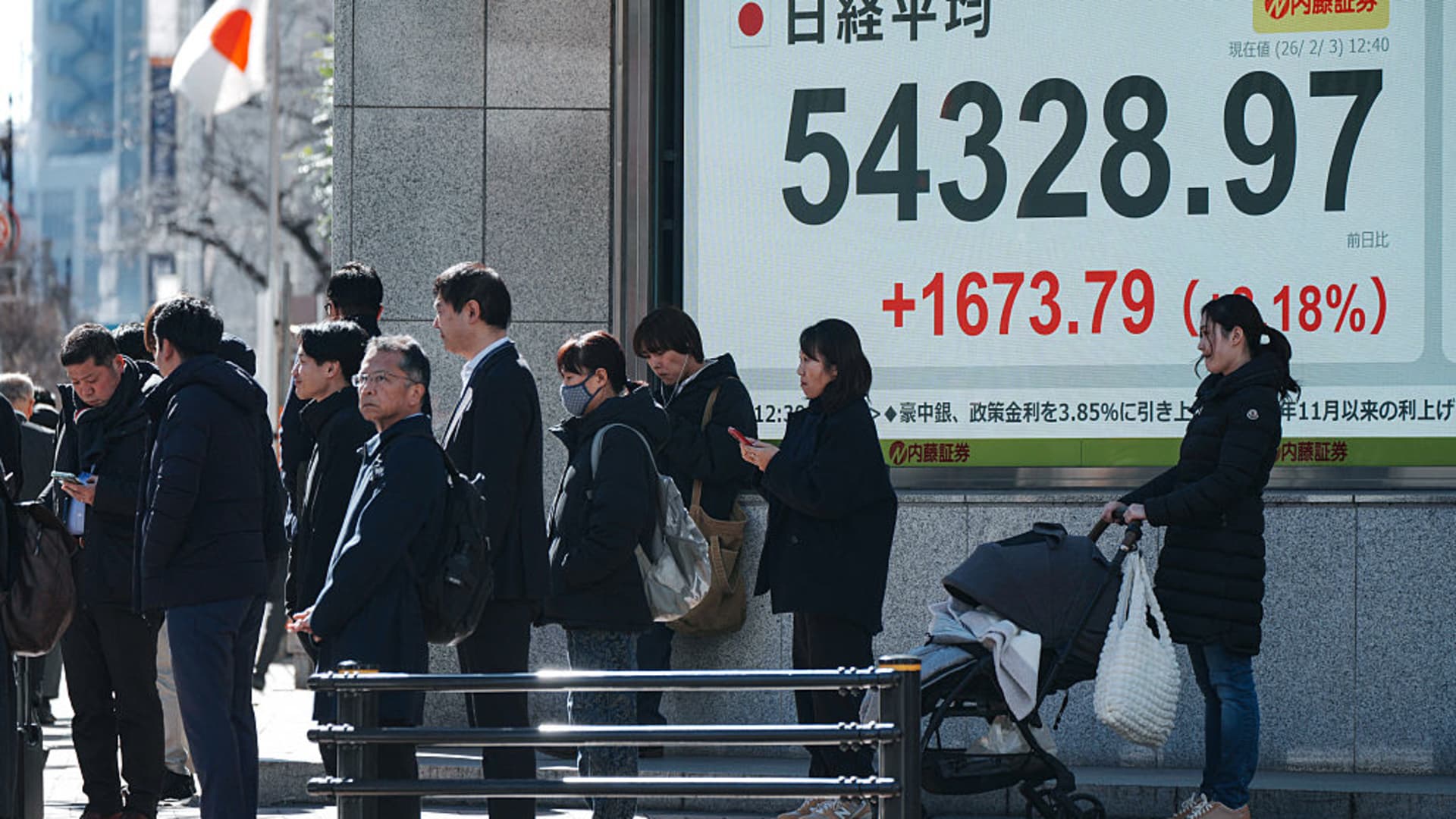
Pedestrians stand in front of an electronic quotation board displaying the numbers of the Nikkei Stock Average on the Tokyo Stock Exchange in Tokyo on Feb. 3, 2026.
Kazuhiro Nogi | Afp | Getty Images
Japan’s economy grew 0.1% in the fourth quarter of 2025 compared with the previous three months, narrowly avoiding a technical recession.
While it was a reversal of the 0.7% contraction in the third quarter, the gross domestic product missed expectations of a 0.4% expansion by economists polled by Reuters.
A technical recession is commonly defined as two consecutive quarters of contraction.
On an annualized basis, output rose 0.2%, compared with forecasts of 1.6%, following a 2.3% decline in the previous quarter.
Compared with a year earlier, fourth-quarter GDP expanded 0.1%, slowing from 0.6% in the third quarter. Private consumption drove the modest expansion, offsetting weakness in exports and public spending, according to data from Japan’s Cabinet Office.
Following the data release, the Nikkei 225 opened up 0.12%, but the yen weakened 0.25% to 153.06 against the dollar.
The Bank of Japan in January raised its economic growth forecast for the fiscal year ending March 2026 to 0.9% from 0.7%. It also lifted its fiscal 2026 outlook to 1% from 0.7%.
The central bank said it expects moderate expansion as other countries return to growth. The BOJ also said it sees a virtuous cycle of rising prices and wages, supported by the government’s economic measures and accommodative financial conditions.
The data also comes as Japan works with the U.S., its second-largest trading partner, on a $550 billion investment pledge under its trade deal with Washington.
Public broadcaster NHK reported last Friday that Tokyo and Washington have yet to agree on the first projects tied to the pledge.
Japan Economy Minister Ryosei Akazawa was quoted as saying he hoped the initial projects would be finalized before Prime Minister Sanae Takaichi meets U.S. President Donald Trump.
Trump had announced the meeting with Takaichi just before the Feb. 8 Lower House election, which saw Takaichi lead the ruling Liberal Democratic Party to a landslide victory.
After her victory, Takaichi said last Monday that she would support economic growth by boosting investment through “proactive” fiscal policy, although she did not elaborate.
She had earlier pledged to suspend food taxes for two years and boost defence spending to 2% of the country’s GDP.
Defense will be the next major catalyst driving Japanese equities higher, said Bruce Kirk, Chief Japan Equity Strategist and managing director at Goldman Sachs.
Speaking to CNBC’s “Squawk Box Asia,” Kirk pointed to Takaichi’s upcoming meeting with Trump, saying he expects a “flurry of announcements” involving Japanese and U.S. companies across areas such as industrialization, factory automation, and shipbuilding.
Kirk also highlighted a document released by the Trump administration over the weekend that called for the restoration of U.S. maritime dominance and touted cooperation with Japan and South Korea in revitalizing shipbuilding.
Before the election, Takaichi had announced a record 122 trillion yen budget for the fiscal year starting April 1, marking a second straight year of record spending and vowing to support households with cost-of-living pressures.
Japan’s inflation had slowed sharply to 2.1% in January, its lowest level since March 2022. Still, prices have remained above the Bank of Japan’s 2% target for 45 consecutive months.
— CNBC’s Martin Soong contributed to this report.
First Appeared on
Source link






Leave feedback about this