

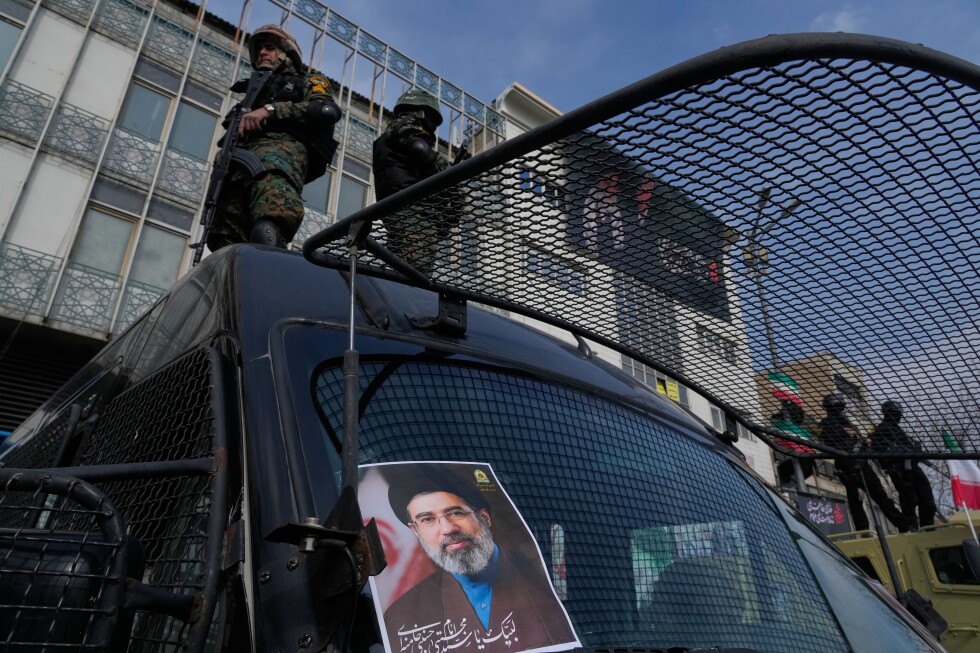
BEIRUT (AP) — Hours after Israel killed the top commander of Iran’s Basij this week, it struck again — this time at the rank and file of the feared force that helped crush widespread protests this year. A drone blasted one of the Basij’s many temporary roadblocks erected around the capital, Tehran.
Israel and the U.S. say they aim to break the Islamic Republic’s tools of domestic control in their campaign of bombardment, now nearly three weeks old. Since the war began, monitors estimate that up to a third of strikes have targeted the top echelons and major bases of the paramilitary Revolutionary Guard and its Basij volunteers tasked with enforcing loyalty to Iran’s theocratic rulers.
Last week, Israel began striking Basij checkpoints, extending the threat to low-ranking members. But the Basij, police and Revolutionary Guard have maintained their grip, and there has been no sign yet of Iranians heeding U.S. and Israeli calls to rise up, as many seek refuge from the airstrikes and uncertainty.
Security agents are still out in force
Residents say security forces still have an intimidating presence in Tehran. War monitors say an intensified crackdown that began with the crushing of January’s nationwide protests continues, often targeting those who take videos of strikes or try to get around a weekslong internet blackout to contact the outside world.
Israel’s campaign may aim to undermine the morale of Basijis and prompt defections or refusals to serve. It could also encourage the many Iranians who remain furious over the thousands killed in January’s crackdown. In early March, Israel’s military issued a Farsi-language message urging the mothers of Basijis to “save their children” by encouraging them put down their arms.
But the Basijis are highly ideological and “the most decentralized force within an already highly decentralized system,” said Hamidreza Azizi, an expert on Iran’s security and foreign policy.
Israel’s killing of its top commander, Gen. Gholam Reza Soleimani, early Tuesday, is unlikely to disrupt it, Azizi said. The Basij chief is chosen not for expertise but for “ideological rigidity and demonstrated loyalty to the supreme leader,” playing a more symbolic role.
“In most cases, Basij units operate autonomously or semiautonomously, particularly in operational matters,’” Azizi said.
Basij checkpoints have proliferated across Tehran, often just a line of traffic cones and a few vehicles. One resident said there were five or six new checkpoints in his upscale neighborhood alone. They search vehicles for weapons, examine documents and sometimes demand to look at people’s phones, he said, speaking on condition of anonymity for his safety.
Israel says it is striking the Basij in the streets
The strikes on checkpoints began on March 11, with at least 15 incidents on a single day documented by Armed Conflict Location and Event Data, a U.S.-based monitoring group.
“We are landing crushing blows on the Revolutionary Guards and the Basij, both in the streets and at checkpoints,” Israeli Prime Minister Benjamin Netanyahu said the next day, adding that the aim was to create the conditions for Iranians to overthrow their government.
On Tuesday, the Israeli military said it struck more than 10 Basij positions across the capital. A video posted online and verified by the AP showed two vehicles burning near traffic cones on a multilane boulevard in central Tehran. The location matched that shown in aerial footage released by the Israeli military of a Tuesday strike hitting a checkpoint as a bus and cars passed.
Iranians have been spreading videos and posts on social media showing locations of checkpoints, often tagging the Farsi account of the Israeli military and urging it to strike, sometimes in the name of protesters who were killed in the area. Others trade news about checkpoints to alert commuters to traffic. Several videos show checkpoints set up under bridges, apparently as cover from strikes.
Volunteers work to instill loyalty
The Basij, Farsi for “mobilization,” has tens of thousands of volunteers under the command of the Revolutionary Guard. Most are unarmed, engaged in “ideological and political activities,” said Azizi, a visiting fellow at the German Institute for International and Security Affairs.
They function like the Communist Party did in the Soviet Union, with branches in schools, universities, government institutions and other organizations, he said. Volunteers, both men and women, work to ensure loyalty to the Islamic Republic. That might mean holding religious lectures or harassing those who flout social restrictions. They can also be mobilized for state-organized events, including counterprotests, Azizi said.
District-level paramilitary units deploy in times of domestic unrest — like the January protests — armed with everything from batons and electroshock devices to live ammunition.
Since those protests and into the current war, the Basij’s role has been to provide manpower, said Azizi.
“The state’s security apparatus has been continuously engaged, leaving many of its core forces both deeply entrenched and likely fatigued,” he said. By manning checkpoints, the Basij helps security agencies to focus on information gathering and arrests.
The crackdown continues
Iranians describe mass text messages warning against protests and aggressive Basij patrols in Tehran. On Thursday, Iran announced the execution of three men detained in the January protests, the first such sentences known to have been carried out.
In the last week, semiofficial news outlets have reported the arrest of more than 100 people across Iran, most accused of conspiring with enemy states or sharing media reports with foreign entities. At least 14 were accused of possessing Starlink internet dishes or planning to sell them or virtual private network cards. Starlink has been one of the only ways to access the global internet since the unprecedented blackout began on Jan. 8.
The government also reportedly has also shut down parts of Iran’s internal internet and revoked some VPN cards given to people with specialized jobs.
The Iran Human Rights Documentation Center, a U.S.-based group, said people have been rounded up for taking pictures identifying the location of checkpoints, bases and military installations. Authorities are also still detaining people linked to the January protests, former political prisoners or members of minorities.
The rights group said it had reports of security forces opening fire at checkpoints. In one incident, two teenage brothers were shot and killed after honking their car horn in celebration of the killing of Supreme Leader Ayatollah Ali Khamenei in the war’s opening salvo.
___
Associated Press writers Amir-Hussein Radjy and Lee Keath in Cairo contributed.
First Appeared on
Source link



Leave feedback about this