

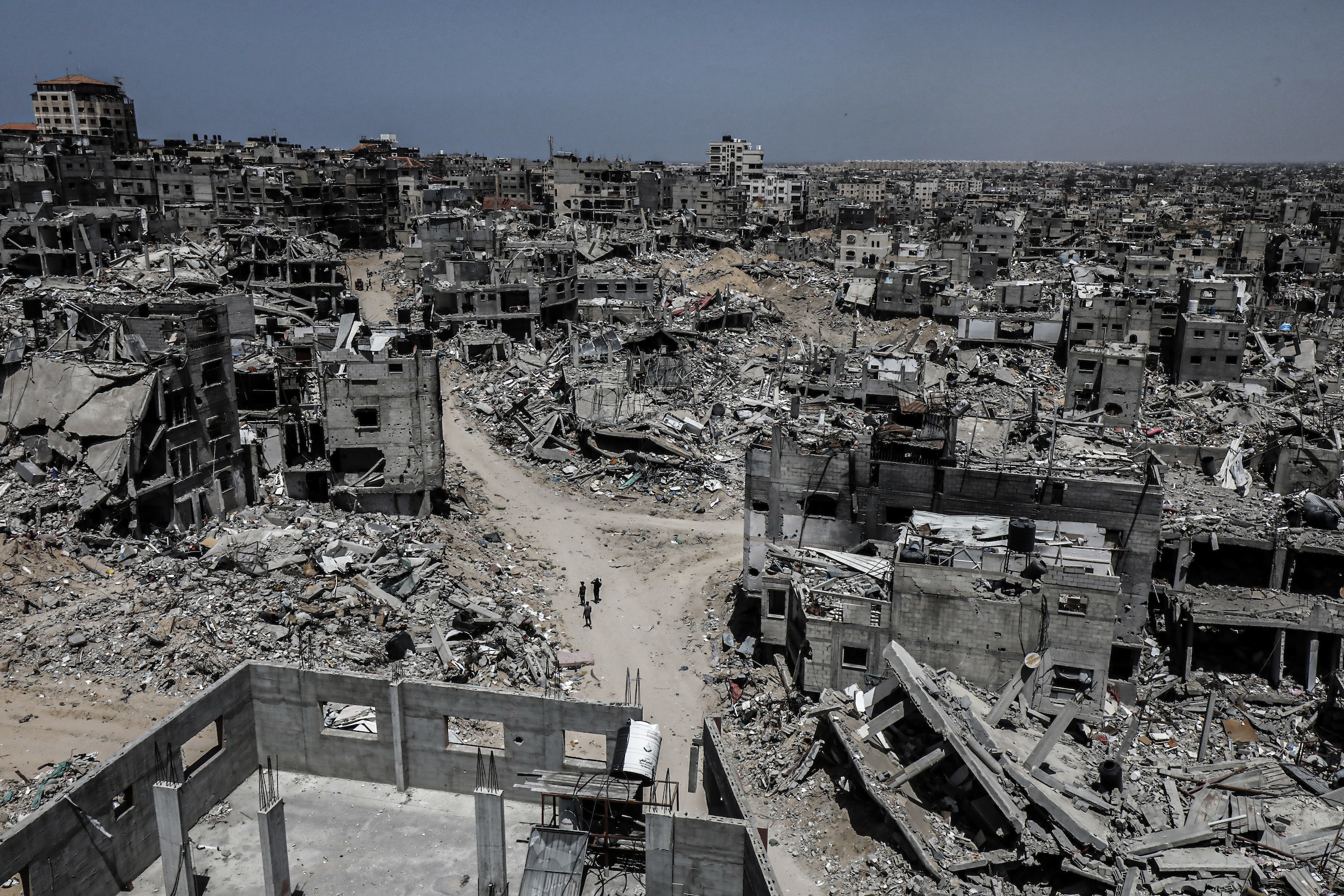
Early on Thursday, Israeli Finance Minister Bezalel Smotrich toured the border with Lebanon and vowed that “very soon, Dahiya will look like Khan Younis.” With that, he gave voice to a historic shift that has been unfolding over the last two years in how Israel relates to the peoples of this region.
The Israeli army has issued a blanket evacuation order for Beirut’s entire southern Dahiya district, home to well over half a million people, as widespread panic grips the city. Similar broad evacuation orders have been given to southern Lebanon, which, alongside Dahiya, is predominantly made up of the population from which Hezbollah draws its base of social support. Comparisons to Gaza were not far from people’s minds, fearing that Beirut would suffer the same fate of total annihilation, as pointed out by commentators.
More commentary identifies a similar pattern in the “apocalyptic” scenes unfolding in Tehran. Israeli Defense Minister Israel Katz has called this a “tornado plan” to “destroy Tehran,” describing a strategy to level targets with “high visibility in a civilian environment” in the city. Two more schools were targeted only yesterday in southwest Tehran amid this campaign.
As the U.S.-Israeli war on Iran enters its seventh day and Hezbollah opens a second front in Lebanon, Gaza has become the new model for how asymmetric wars are waged. This marks a qualitative shift away from how Israel used to pursue military action, even though it continues to follow a similar logic.
Israel’s old doctrine
In previous decades, Israel’s military strategy was shaped by a policy requiring the use of disproportionate force against its enemies. Military action didn’t just aim to target guerrilla groups, but to punish the communities from which they arose. The first time an army official explicitly spelled out the strategy was in 2008, when then Chief of Northern Command, Gadi Eisenkot, said that Israel’s levelling of entire neighborhoods in the Dahiya district during the 2006 Lebanon war would continue to be applied everywhere.
The Israeli army’s rationale was simple: the society that formed Hezbollah’s popular base must also be punished. Targeting civilians in Dahiya wasn’t “collateral damage,” because the collateral damage was the point.
Eisenkot made sure to drive home this message, declaring that “what happened in the Dahiya quarter of Beirut in 2006 will happen in every village from which Israel is fired upon,” and that “we will apply disproportionate force upon [that village] and cause great damage and destruction. From our standpoint, these are not civilian villages. They are military bases.”
The policy became known as the “Dahiya doctrine,” but it was not limited to Lebanon. Israel applied the same model in Gaza from 2008 to 2023, launching periodic massacres meant to inflict damage on both Hamas and its social base. Another name for this policy was “mowing the lawn,” as it was meant to keep the capabilities for resistance below a certain arbitrary threshold.
Central to this disproportionate use of force — and what makes it stand out from how Israel conducts war today — was its limited time horizon and intermittent application. With the exception of the war of the Nakba in 1948, all of Israel’s wars before 2023 were relatively brief affairs despite being so destructive. Their short duration was the result of the assumption that Israel could not tolerate a protracted war of attrition against its enemies, and perhaps secondarily, because the constraints of the post-WWII order could not justify normalizing such overwhelming devastation indefinitely.
October 7 changed this equation. “Mowing the lawn” was no longer enough, and neither was keeping the population blockaded in an open-air prison. The new stage of the Dahiya doctrine became the Gaza genocide. After two years of catastrophic civilian punishment, sustained by American financial and military largesse, Israel is now seeking to apply elements of its conduct in Gaza outside of Palestine’s borders. We now see this new doctrine, characterized by protracted wholesale annihilation, playing out in Lebanon and Iran.
The new doctrine
For all the ugliness that Smotrich’s comment exposes, it underscores a basic truth about the nature of this war: it isn’t a conflict between states and political groups, but a war of societies.
These societies aren’t divided along racial, ethnic, religious, or national lines. The real fault lines lie between societies that resist foreign domination, those that accept it, and those that seek to dominate.
This is the underlying logic of the Gaza doctrine: to wage war against a society not only to subjugate it, but to destroy it and prevent its conditions for life.
The contours for Israel’s new posture toward the societies of the enemy took shape soon after October 7. “It is an entire nation out there that is responsible,” said Israeli President Isaac Herzog on October 12, 2023.
“What we are doing in Gaza, we know how to do in Beirut,” said Defense Minister Yoav Gallant a month later. “The ones who will pay the price are, first of all, the citizens of Lebanon.”
Influential retired Israeli general Giora Eiland outlined this policy more comprehensively in a November 2023 article advocating for starving Palestinians in Gaza. “Who are the ‘poor’ women of Gaza? They are all the mothers, sisters, or wives of Hamas murderers,” Eiland wrote. “They are part of the infrastructure that supports the organization.” For him, causing a “severe epidemic” in Gaza would “bring victory closer,” since “Hamas fighters and more junior commanders will begin to understand that the war is futile and it is better to prevent irreversible harm to their families.”
Eiland regarded “humanitarian pressure” as “legitimate,” because Israel didn’t only seek to fight Hamas fighters, but “the entire opposing system” with the objective of bringing about “civil collapse.” And he went even further:
When senior Israeli figures tell the media, “It’s either us or them,” we should clarify the question of who is “them.” “They” are not only Hamas fighters with weapons but also all the “civilian” officials, including hospital administrators and school administrators, and also the entire Gaza population that enthusiastically supported Hamas.
Eiland was not a fringe figure. The article he wrote became the blueprint for a plan a year into the genocide, put forward by a group of Israeli generals to depopulate northern Gaza. The so-called “Generals’ Plan,” beginning in October 2024 and continuing until the first ceasefire signed in January 2025, saw wholesale extermination campaigns in the north and the destruction of most civilian infrastructure necessary for supporting life.
This is the underlying logic of the Gaza doctrine: to wage war against a society not only to subjugate it, but to destroy and prevent its conditions for life. In Lebanon and Iran, this policy is tinged with the revived Zionist ambition of conquering “Greater Israel,” enshrined in a new era of Israeli expansionism across the vast geography of this part of the world.
Israel will not stop until it is the uncontested master in an era of fading American unipolarity. While the U.S. gambit in Iran represents the death knell of the Pax Americana, for Israel, it is its final assault on the tapestries of resistance woven through the societies of this region.
Faris Giacaman
Faris Giacaman is Mondoweiss’ Palestine Editorial Director.
First Appeared on
Source link






Leave feedback about this