

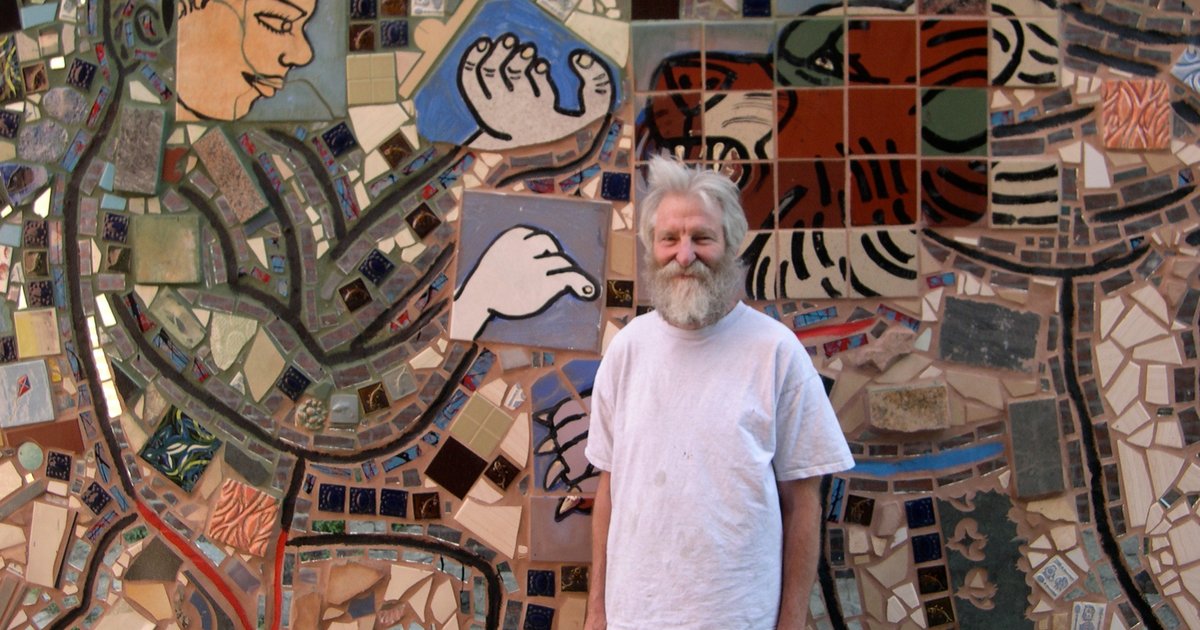
Famed mosaic artist and Philadelphia’s Magic Gardens founder Isaiah Zagar has passed away at the age of 86.
Zagar, who created over 200 mixed-media pieces on public walls in his lifetime, died Thursday due to complications from congestive heart failure and Parkinson’s disease. Known for his swirling and colorful mosaics dotted with mirrors and hand-painted tiles, he helped revitalize South Street through his work. The commercial corridor is home to many of his pieces, including his largest, the Magic Gardens museum. He and his wife Julia also opened Eye’s Gallery on the street in 1968.
MORE: Bird-watching backpacks are now available at every Free Library branch
In the decades that followed, Zagar plastered his work on over 50,000 square feet of public space in Philadelphia. In addition to murals, he strove to create art environments, large-scale and immersive pieces crafted with unorthodox materials. Magic Gardens and his studio at Watkins Street, which opened to the public in 2024, were his most notable examples.
Zagar saw art as a means for coping with life’s challenges, and spoke openly about the mental health crisis that led him to his mosaics. He was heavily influenced by Latin American folk art traditions, collaborating with numerous artists that he met while traveling to Mexico, Peru, Ecuador and Guatemala.
“Isaiah was more than our founder; he was our close friend, teacher, collaborator, and creative inspiration,” Emily Smith, executive director of Philadelphia’s Magic Gardens, said in a statement. “He was unlike anyone we have ever met and will ever meet. Above all things, he was an artist. In his lifetime, he created a body of work that is unique and remarkable, and one that has left an everlasting mark on our city.”
Remaking South Street
Zagar was born in Philadelphia in 1939, but grew up in Brooklyn and graduated from the Pratt Institute. He met and quickly married Julia Papiroff, a fellow art student and lifelong New Yorker, in 1963.
The couple enlisted in the Peace Corps as conscientious objectors to the Vietnam War, landing in Peru in 1965. Their proximity to folk artists in the Puno region proved foundational to the art and community they built in Philadelphia, where they settled three years later.
Zagar’s mental health initially deteriorated in his hometown. After a suicide attempt and hospitalization, he taught himself to mosaic as a form of therapy. He began covering the walls of Eye’s Gallery – and the home he shared with Julia on South Street – with broken bottles and other salvaged supplies.
His pieces spread across the city, reaching as far north as Chestnut Hill and as far west as Cobbs Creek. The majority of his work, however, was and remains concentrated in South Philadelphia. He and Julia participated in the so-called South Street Renaissance, a 1970s movement to revitalize the depressed area. Vacancy rates had soared after the city announced its intention to raze South and Bainbridge streets to construct an eight-lane expressway. Residents protested the project, which was ultimately scraped, and rebuilt the corridor by renovating abandoned buildings and opening new businesses. Zagar’s mosaics and the Eye’s Gallery aided in this second act.
 Kristin Hunt/PhillyVoice
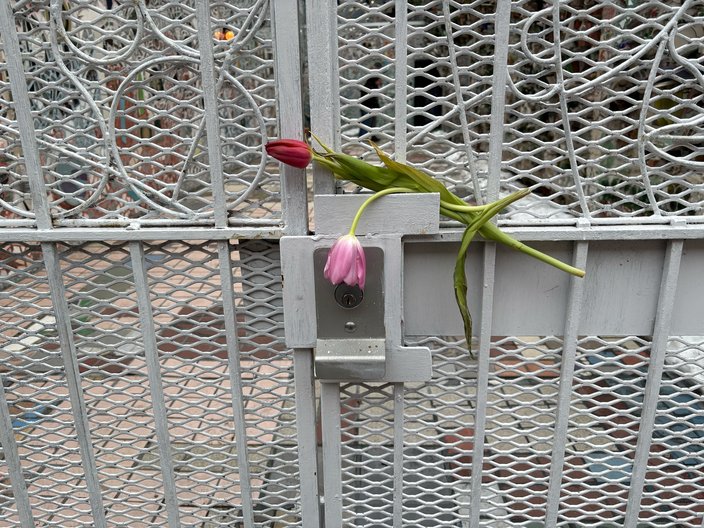
Flowers were left on the gates of Philadelphia’s Magic Gardens, at 1020 South Street, in memory of Isaiah Zagar.
Magic gardens and painted brides
He began work on what would become the Magic Gardens in the 1990s, striving to create an art environment that would rival the “house of mirrors” he toured in Woodstock as an art student. As he excavated tunnels and erected walls, the work crept past the buildings he actually owned and onto the vacant lots next door. The nonprofit Philadelphia’s Magic Gardens formed in 2004 to purchase the land, preserving Zagar’s work and creating a new museum in the process.
Other pieces weren’t so lucky. “The Skin of the Bride,” Zagar’s sprawling 7,000-square-foot mosaic that covered the former Painted Bride Art Center in Old City, sparked a dramatic development battle after the site fell into the hands of developers. An application for historic preservation failed and, after several starts and stops, the building’s new owners proceeded with demolition.
Tourists searching for a cheesesteak will find Zagar’s mosaics in the dining room of Jim’s Steaks, which bought the Eye’s Gallery building after a 2022 fire closed both businesses down. (The gallery reopened a block away.) His pieces are also in the permanent collections of the Philadelphia Museum of Art and Pennsylvania Academy of the Fine Arts. While he is most associated with Philadelphia, Zagar has also spackled mosaics onto the public walls of California, New York, Hawaii, Florida, Mexico and Chile.
The artist shared much of his story in the 2008 documentary “In A Dream.” It was directed by his son Jeremiah, who has since carved out a creative career of his own. He most recently worked on the Delco drama “Task.”
Zagar is survived by his wife Julia and sons Zeke and Jeremiah. A public memorial will be announced at a later date.
Follow Kristin & PhillyVoice on Twitter: @kristin_hunt
| @thePhillyVoice
Like us on Facebook: PhillyVoice
Have a news tip? Let us know.
First Appeared on
Source link






Leave feedback about this