


Whatever you may have heard about the Target boycott ending, here’s the truth: The boycott is not over for many Black women. It probably never will be.
A year ago, Black women started the movement to boycott the retail giant after it made a U-turn on its numerous commitments to racial equity — and particularly the Black community. That movement took various forms: Ohio state Sen. Nina Turner called for a national boycott, as did grassroots activists in Minneapolis, where Target is based. Rev. Jamal Harrison Bryant of Atlanta’s New Birth Missionary Baptist Church also launched a 40-day “Target fast” that stretched into nearly 400.
The boycott played a key role in a year of declining sales and profits that forced CEO Brian Cornell to step down. Target’s stock price dropped about 30 percent in 2025.
But this week, just as the Target fast passed the one-year mark, Bryant announced it was over, citing “productive” conversations with the company’s new CEO Michael Fiddelke.
“We have not been able to get all that we have desired, but I am grateful for the strides that we have made. For the Target fast, that really reflects the faith-based component of this, we are claiming victory,” he said at a press conference Wednesday.
His announcement confused many Black women who, for more than a year, have held steady in their conviction to not set foot inside a Target store until the company reversed its retreat on diversity, equity and inclusion, or DEI.
That still has not happened: The company confirmed to USA Today that it’s making no new commitments or reversals on its DEI policy. Target said in a statement to The 19th that it is “more committed than ever to creating growth and opportunity for all. We’re pleased to be moving forward, and we will continue showing up as trusted neighbors while delivering results for our team members, guests, and the more than 2,000 communities in which we serve.”


Now, organizers in Minnesota are pushing forward with a boycott until that key demand is met, and Black women across the country are reminding people that they started the boycott — and they’ll decide when it ends.
Laverne Mickens, a fourth grade teacher and scholarship coach in Springfield, Massachusetts, was one of the many who took to social media Wednesday.
“It was Black women that started the Target boycott, not Jamal Bryant,” Mickens said in a video on Instagram. “[Black women] will say if and when it’s over. And I can tell you right now: That will be the 15th of never ever.”
She told The 19th that the response she’s heard since is that many Black women are “lockstep on the same page” about continuing the Target boycott. “People have taken advantage of Black people and our dollars. They don’t respect us, they don’t respect our money,” she said.
For years, Target, or “Tarjay” to many, has been a favorite among Black women. But the company gained more respect in the wake of the 2020 killing of George Floyd, when the retailer, whose offices sit a mere three miles from where Floyd was murdered, said it would work to raise the number of Black employees by 20 percent over three years, establish a racial equity committee and spend more than $2 billion on partnerships with Black-owned businesses, which included adding products from 500 Black-owned vendors.
In that time, Target rolled out popular Black History Month displays and showcased vendors like the Black-owned makeup company the Lip Bar and creator Tabitha Brown’s food, appliance and hair care lines. It had installations at Essence Fest, the massive annual event celebrating Black culture.
Shoppers like Whitney Roberts, a content creator in Philadelphia, would rush to get new merchandise whenever the Black History Month drops hit the shelves, only to find most of it sold out. Most of her registry for her daughter, who was born in late 2020, was made up of Target items.
“It felt like they saw us. It felt like they cared about our community,” she said.
Which is why what happened in January 2025 hit Black women so hard.
Days after President Donald Trump took office and issued an executive order dismantling federal diversity, equity and inclusion programs, Target joined other major corporations in completely undoing its commitments to DEI. It announced a new program called “Belonging at the Bullseye,” which was positioned as an effort to recruit and retain staff “who represent the communities we serve and fuel a culture where everyone has access to opportunity and growth” while also offering an assortment of products and services that “help all guests feel seen and celebrated.”
For Roberts and numerous other Black women, it felt like a betrayal. She’s since had to explain to her daughter, who is now 5, why they could no longer walk the aisles or scour the dollar section for toys.
“At 5 years old, I shouldn’t have to tell her that a company that pretended to rock with us and feigned like they were supporting us broke a promise to us,” Roberts said. “Black folks have constantly had to explain to the new generation that promises keep getting broken to us.”
Soon after Target’s announcement, a group of organizers in Minneapolis led by civil rights lawyer and activist Nekima Levy Armstrong formulated a plan to stage a national boycott with one primary objective: bring back Target’s DEI policies.
At the same time, Turner, the former Ohio state senator, also started calling for a nationwide boycott of the retailer with her organization, We Are Somebody. She called activist Tamika Mallory to help her organize the boycott, and then Bryant joined in, offering to start a 40-day “Target fast” through his church, Mallory told The 19th.
Both efforts moved concurrently, though Armstrong believes Bryant, Mallory and Turner tried to co-opt the efforts of local leaders as their own, claiming they started the boycott, Levy Armstrong told The 19th. Turner has maintained that she started the national boycott.
“Women, period, are the ones who have been the main sustainers of this boycott because we are the ones in control of our family’s discretionary income,” Levy Armstrong said. “To have a man come out of nowhere and try to call for an end to it also is a slap in the face.”
She called her own press conference in response to Bryant’s announcement outside Target’s Minneapolis headquarters Wednesday afternoon.
“We are asking people: Continue to stand with grassroots leadership in the state of Minnesota, where Target is actually headquartered, and not clout-chasers, not fake pastors, not fake activists trying to co-opt our work,” she said at the press conference. “We are asking people: Continue to double down and hold Target accountable. The boycott continues.”
Mallory denied claims that she, Bryant and Turner co-opted Levy Armstrong’s efforts. “I think the work everybody is doing is important and the leaders in Minnesota have been through a lot and they should be respected and honored for their contributions,” she said.
“No one group of people has the authority to call off a grassroots-led movement,” Mallory said.
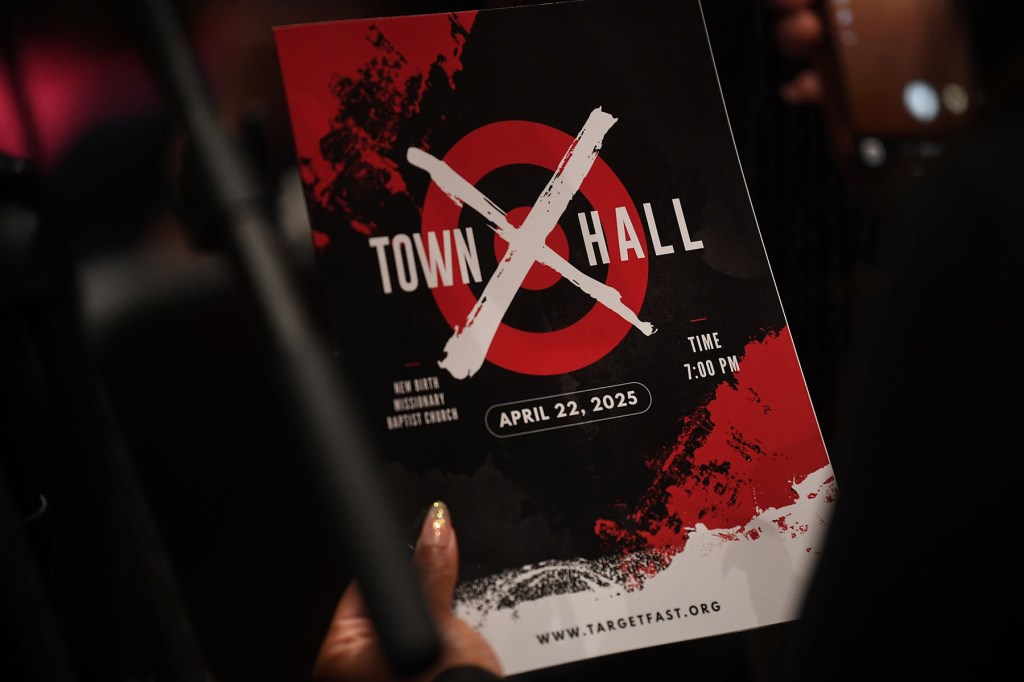
Part of what prompted the end of the fast, Bryant said at his press conference Wednesday, was a meeting he and Mallory had with Fiddelke, Target’s CEO, who updated them on commitments the company has made to the Black community. Among them: Target committed $100 million in grants and scholarships to Black-led community organizations and partnered with Historically Black Colleges and Universities — announcements the company actually made back in 2021, so it’s unclear what are new commitments. Fiddelke also said Target was on track to hit its $2 billion commitment set in 2020 by Easter in April. Bryant said during the press conference that he was also encouraged by Target’s “Belonging” program and how it’s opening opportunities for people of color and women within the company.
For Bryant, those steps signaled it was time to end the fast “because we have other fights that we’ve got to see, and other things that we’ve got to tackle,” he said.
But both Turner and Mallory told The 19th their battle is not done.
Mallory said that in her meeting with Fiddelke, Target did acknowledge the company is responsible for the breakdown of trust that happened with the Black community. But Target continues to refuse to issue that apology publicly.
“I also asked, ‘Why are you unable to apologize, to acknowledge the harm that has been done … stand by the work that you are so proud of, and speak about it publicly?’” Mallory recounted to The 19th. “They have not done so after my request and so therefore there’s no reason for me to believe that it’s time to return to Target. I probably will never go back.”
Turner and her organization will also continue boycotting. She told The 19th she was particularly disheartened by news that Target allegedly said DEI is “divisive” during a recent meeting with a Washington, D.C., coalition of leaders who have been protesting in front of a store every Saturday for the past year.
“That doesn’t seem to me a corporation that has learned its lesson,” said Turner, who emphasized that Target is just one of a number of corporations she and others have their eyes on due to their retreat from racial and social justice.
Now, instead of dying down, it feels like the boycott is again ramping up, Levy Armstrong said.
“There is so much momentum and actually some people are doubling down as a result,” she said.
None of it is happening in a vacuum. Over the past year, Black women have lost jobs at record rates, hitting the highest unemployment rates they’ve experienced since the pandemic. The unemployment rate for Black women was 7.1 percent in February, the highest rate among every group of women and men. A big part of the reason? The retreat from DEI efforts across corporate America.
Karla Lee, a pharmacist in Orlando, viewed her decision on Target “as a breakup, not a boycott” because her trust had been broken. She said Black women feel sidelined economically and “sidelined because of betrayal.”
Lee has grieved the loss of shopping there, a place that offered a reprieve for her, where she got joy from wandering the aisles and picking out Easter basket knickknacks for her kids or stocking stuffers when the Christmas decorations went up. Once she realized so much of it for her was about the experience, and not the merchandise, she was able to move on. She knew the betrayal she felt meant she’d never be able to experience Target the same way again.
“The trick was that there was really nothing that we needed at Target that we couldn’t get anywhere else,” Lee said. “Now that we lost out on the magic, we see it for what it is, and it doesn’t sparkle.”
Errin Haines contributed to this report.
First Appeared on
Source link





Leave feedback about this