

Unlock the Editor’s Digest for free
Roula Khalaf, Editor of the FT, selects her favourite stories in this weekly newsletter.
The writer is a senior research fellow at the Royal United Services Institute
Since Saturday, US and Israeli air strikes have eliminated many of Iran’s top leaders, jolting the power centre in Tehran. But the next shock may come from the country’s border provinces, home to diverse and historically restive ethnic groups.
Iran is a Persian majority nation. But it is also a multi-ethnic country comprised of sizeable Azeri and Kurdish populations, along with Lurs, Arabs, Baluchis and Turkmen in borderlands that sit astride trade routes, smuggling corridors and energy infrastructure. The regime has long exploited fears of Iran breaking apart to mobilise loyalty, suppress dissent and resist external meddling. It will try again, but this time the centre’s ability to hold its peripheries may be significantly weakened. Reports that the CIA is aiding Kurdish armed groups to drum up resistance against the Iranian regime have sharpened Tehran’s fears. Kurdish fighters lack the numbers to overthrow the regime, but backing them could be a pretext for creating an enclave that serves as a US and Israeli staging ground against Tehran.
What comes next will depend on the regime’s military capabilities, its capacity to reconstitute itself and whether US and Israeli strikes open a security vacuum that armed groups can exploit. If so, a patchwork republic could emerge.
The Kurdish region in Iran’s north-west has long represented a major internal challenge to the regime, which treats Kurdish political activity through a securitised lens. In late February, five Iranian Kurdish groups proclaimed the formation of an alliance with the stated objective of advancing the Kurdish political movement in Iran.
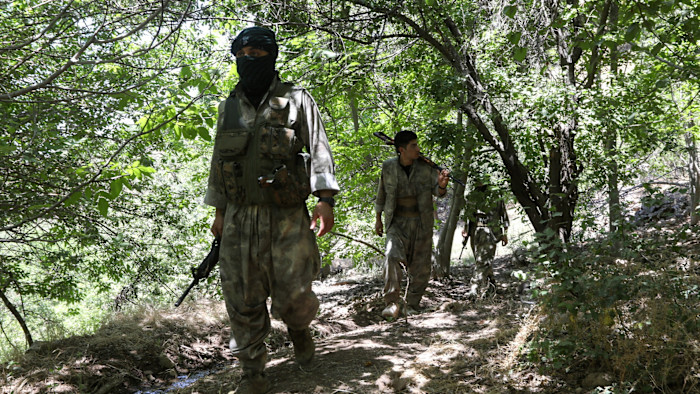
Part of this nascent alliance is the Kurdistan Free Life Party (PJAK), an armed Kurdish militia that is the Iranian affiliate of the Kurdistan Workers’ Party, or PKK. Turkey is currently involved in a historic peace process with the PKK, which declared the end of its armed struggle last year. But the opening of the Iranian front presents new challenges. Last month, an estimated 100 PKK members left north-eastern Syria as part of a deal with the interim government in Damascus. Battle-hardened commanders, facing diminishing room for manoeuvre in Syria and Iraq, could pivot towards Iran.
Turkey is not the only regional actor watching the Kurds. Israeli strategists have long viewed Kurdish partners as a potential hedge, which has heightened Ankara’s threat perceptions as Israel-Turkey frictions rise. Despite their rivalry, Tehran and Ankara have historically aligned to deter Kurdish bids for self-determination within their borders, and there is no reason to think Ankara’s calculus will shift now.
Tehran may move to contain rebellions elsewhere, too. Sistan and Baluchestan province, along the border with Pakistan, presents a different problem. It is a strategically pivotal but chronically under-developed region. Last December, several Sunni Baluchi militant factions, including Jaish ul-Adl, announced they had merged in Iran’s south-east. With Tehran stretched, Baluchi armed actors may see an opportunity to escalate, expand recruitment or deepen cross-border attacks. Islamabad now faces escalation along its restive western border with Iran, and is wary of a defanged Islamic Revolutionary Guard Corps, which has thus far contained the Baluchi insurgency.
Finally, there are Azeris — often described as Iran’s “loyal” minority. Predominantly Shia, they are deeply embedded in the state’s security apparatus and elite networks. Amid chaos, they could seek to shape Iran’s future. But in Azeri areas along the borders with Turkey, Armenia and Azerbaijan, Tehran will be vigilant about any revival of identity politics.
In a post-Khamenei Iran, all of these groups will assess their leverage. Even an air campaign the US regards as successful could produce strategic aftershocks. If military strikes induce elite fragmentation, it could lead to insurgent pockets, criminalised economies and fragmented sovereignty. If the regime is unable to retain its monopoly on the use of violence, its control over Iran’s full territory may not hold.
First Appeared on
Source link


Leave feedback about this