

Dobzhansky, T. Nothing in biology makes sense except in the light of evolution. Am. Biol. Teach. 35, 125–129 (1973).
Barrett, R. D. H. & Hoekstra, H. E. Molecular spandrels: tests of adaptation at the genetic level. Nat. Rev. Genet. 12, 767–780 (2011).
Dobzhansky, T. Genetics and the Origin of Species (Columbia University Press, 1982).
Loewe, L. & Hill, W. G. The population genetics of mutations: good, bad and indifferent. Phil. Trans. R Soc. Lond. B Biol. Sci. 365, 1153–1167 (2010).
Lu, Y.-F., Goldstein, D. B., Angrist, M. & Cavalleri, G. Personalized medicine and human genetic diversity. Cold Spring Harb. Perspect. Med. 4, a008581 (2014).
Schluter, D. The Ecology of Adaptive Radiation (OUP Oxford, 2000).
Benton, M. L. et al. The influence of evolutionary history on human health and disease. Nat. Rev. Genet. 22, 269–283 (2021).
Altshuler, D. & Donnelly, P. The International HapMap Consortium. A haplotype map of the human genome. Nature 437, 1299–1320 (2005).
Auton, A. et al. A global reference for human genetic variation. Nature 526, 68–74 (2015).
Akey, J. M. Constructing genomic maps of positive selection in humans: where do we go from here? Genome Res. 19, 711–722 (2009).
Nielsen, R. et al. Genomic scans for selective sweeps using SNP data. Genome Res. 15, 1566–1575 (2005).
Sabeti, P. C. et al. Detecting recent positive selection in the human genome from haplotype structure. Nature 419, 832–837 (2002).
Bersaglieri, T. et al. Genetic signatures of strong recent positive selection at the lactase gene. Am. J. Hum. Genet.74, 1111–1120 (2004).
Lamason, R. L. et al. SLC24A5, a putative cation exchanger, affects pigmentation in zebrafish and humans. Science 310, 1782–1786 (2005).
Sabeti, P. C. et al. Genome-wide detection and characterization of positive selection in human populations. Nature 449, 913 (2007).
Green, R. E. et al. A draft sequence of the Neandertal genome. Science 328, 710–722 (2010).
Meyer, M. et al. A high-coverage genome sequence from an archaic Denisovan Individual. Science 338, 222–226 (2012).
Haak, W. et al. Massive migration from the steppe was a source for Indo-European languages in Europe. Nature 522, 207–211 (2015).
Lazaridis, I. et al. Ancient human genomes suggest three ancestral populations for present-day Europeans. Nature 513, 409–413 (2014).
Allentoft, M. E. et al. Population genomics of post-glacial western Eurasia. Nature 625, 301–311 (2024).
Antonio, M. L. et al. Stable population structure in Europe since the Iron Age, despite high mobility. eLife 13, e79714 (2024).
Lazaridis, I. et al. The genetic history of the Southern Arc: a bridge between West Asia and Europe. Science 377, eabm4247 (2022).
McColl, H. et al. Tracing the spread of Celtic languages using ancient genomics. Preprint at bioRxiv https://doi.org/10.1101/2025.02.28.640770 (2025).
Barrie, W. et al. Elevated genetic risk for multiple sclerosis emerged in steppe pastoralist populations. Nature 625, 321–328 (2024).
Bolognini, D. et al. Recurrent evolution and selection shape structural diversity at the amylase locus. Nature 634, 617–625 (2024).
Childebayeva, A. et al. Population genetics and signatures of selection in Early Neolithic European farmers. Mol. Biol. Evol. 39, msac108 (2022).
Davy, T., Ju, D., Mathieson, I. & Skoglund, P. Hunter-gatherer admixture facilitated natural selection in Neolithic European farmers. Curr. Biol. 33, 1365–1371 (2023).
Evershed, R. P. et al. Dairying, diseases and the evolution of lactase persistence in Europe. Nature 608, 336–345 (2022).
Iasi, L. N. M. et al. Neanderthal ancestry through time: insights from genomes of ancient and present-day humans. Science 386, eadq3010 (2024).
Irving-Pease, E. K. et al. The selection landscape and genetic legacy of ancient Eurasians. Nature 625, 312–320 (2024).
Kerner, G. et al. Genetic adaptation to pathogens and increased risk of inflammatory disorders in post-Neolithic Europe. Cell Genom. 3, 100248 (2023).
Klunk, J. et al. Evolution of immune genes is associated with the Black Death. Nature 611, 312–319 (2022).
Le, M. K. et al. 1,000 ancient genomes uncover 10,000 years of natural selection in Europe. Preprint at bioRxiv https://doi.org/10.1101/2022.08.24.505188 (2022).
Mathieson, I. & Terhorst, J. Direct detection of natural selection in Bronze Age Britain. Genome Res. 32, 2057–2067 (2022).
Pandey, D., Harris, M., Garud, N. R. & Narasimhan, V. M. Leveraging ancient DNA to uncover signals of natural selection in Europe lost due to admixture or drift. Nat. Commun. 15, 9772 (2024).
Souilmi, Y. et al. Admixture has obscured signals of historical hard sweeps in humans. Nat. Ecol. Evol. 6, 2003–2015 (2022).
Barquera, R. & Krause, J. An ancient view on host pathogen interaction across time and space. Curr. Opin. Immunol. 65, 65–69 (2020).
Knapp, M. & Hofreiter, M. Next generation sequencing of ancient DNA: requirements, strategies and perspectives. Genes 1, 227–243 (2010).
Orlando, L., Gilbert, M. T. P. & Willerslev, E. Reconstructing ancient genomes and epigenomes. Nat. Rev. Genet. 16, 395–408 (2015).
Rizzi, E., Lari, M., Gigli, E., De Bellis, G. & Caramelli, D. Ancient DNA studies: new perspectives on old samples. Genet. Select. Evol. 44, 21 (2012).
Rohland, N. et al. Three assays for in-solution enrichment of ancient human DNA at more than a million SNPs. Genome Res. 32, 2068–2078 (2022).
Gilardet, A. et al. A high-throughput ancient DNA extraction method for large-scale sample screening. Mol. Ecol. Resour. 25, e14077 (2025).
Maricic, T., Whitten, M. & Pääbo, S. Multiplexed DNA sequence capture of mitochondrial genomes using PCR products. PLoS One 5, e14004 (2010).
Skoglund, P. et al. Separating endogenous ancient DNA from modern day contamination in a Siberian Neandertal. Proc. Natl Acad. Sci. USA 111, 2229–2234 (2014).
Zavala, E. I. et al. Quantifying and reducing cross-contamination in single- and multiplex hybridization capture of ancient DNA. Mol. Ecol. Resour. 22, 2196–2207 (2022).
Borry, M., Hübner, A., Rohrlach, A. B. & Warinner, C. PyDamage: automated ancient damage identification and estimation for contigs in ancient DNA de novo assembly. PeerJ 9, e11845 (2021).
Cooper, A. & Poinar, H. N. Ancient DNA: do it right or not at all. Science 289, 1139 (2000).
Everett, R. & Cribdon, B. MetaDamage tool: examining post-mortem damage in sedaDNA on a metagenomic scale. Front. Ecol. Evol. 10, 888421 (2023).
Peyrégne, S. & Peter, B. M. AuthentiCT: a model of ancient DNA damage to estimate the proportion of present-day DNA contamination. Genome Biol. 21, 246 (2020).
Mallick, S. et al. The Allen Ancient DNA Resource (AADR): a curated compendium of ancient human genomes. Sci. Data 11, 182 (2024).
Cheng, J. Y., Stern, A. J., Racimo, F. & Nielsen, R. Detecting selection in multiple populations by modeling ancestral admixture components. Mol. Biol. Evol. 39, msab294 (2021).
Mathieson, I. et al. Genome-wide patterns of selection in 230 ancient Eurasians. Nature 528, 499–503 (2015).
Bollback, J. P., York, T. L. & Nielsen, R. Estimation of 2Nes from temporal allele frequency data. Genetics 179, 497–502 (2008).
Malaspinas, A.-S., Malaspinas, O., Evans, S. N. & Slatkin, M. Estimating allele age and selection coefficient from time-serial data. Genetics 192, 599–607 (2012).
Mathieson, I. & McVean, G. Estimating selection coefficients in spatially structured populations from time series data of allele frequencies. Genetics 193, 973–984 (2013).
Steinrücken, M., Bhaskar, A. & Song, Y. S. A novel spectral method for inferring general diploid selection from time series genetic data. Ann. Appl. Stat. 8, 2203–2222 (2014).
Terhorst, J., Schlötterer, C. & Song, Y. S. Multi-locus analysis of genomic time series data from experimental evolution. PLoS Genet. 11, e1005069 (2015).
Akbari, A. et al. Pervasive findings of directional selection realize the promise of ancient DNA to elucidate human adaptation. Preprint at bioRxiv https://doi.org/10.1101/2024.09.14.613021 (2024).
Dehasque, M. et al. Inference of natural selection from ancient DNA. Evol Lett 4, 94–108 (2020).
Simon, A. & Coop, G. The contribution of gene flow, selection, and genetic drift to five thousand years of human allele frequency change. Proc. Natl Acad. Sci. USA 121, e2312377121 (2024).
Voight, B. F., Kudaravalli, S., Wen, X. & Pritchard, J. K. A map of recent positive selection in the human genome. PLoS Biol. 4, e72 (2006).
Smith, J. M. & Haigh, J. The hitch-hiking effect of a favourable gene. Genetics Research 23, 23–35 (1974).
Braverman, J. M., Hudson, R. R., Kaplan, N. L., Langley, C. H. & Stephan, W. The hitchhiking effect on the site frequency spectrum of DNA polymorphisms. Genetics 140, 783–796 (1995).
Kim, Y. & Nielsen, R. Linkage disequilibrium as a signature of selective sweeps. Genetics 167, 1513–1524 (2004).
Hermisson, J. & Pennings, P. S. Soft sweeps and beyond: understanding the patterns and probabilities of selection footprints under rapid adaptation. Methods Ecol. Evol. 8, 700–716 (2017).
McPherron, S. P. et al. Evidence for stone-tool-assisted consumption of animal tissues before 3.39 million years ago at Dikika, Ethiopia. Nature 466, 857–860 (2010).
Reich, D. et al. Denisova admixture and the first modern human dispersals into Southeast Asia and Oceania. Am. J. Hum. Genet. 89, 516–528 (2011).
Semaw, S. et al. 2.5-million-year-old stone tools from Gona, Ethiopia. Nature 385, 333–336 (1997).
Stringer, C. B. & Andrews, P. Genetic and fossil evidence for the origin of modern humans. Science 239, 1263–1268 (1988).
Duke, H., Feibel, C. & Harmand, S. Before the Acheulean: the emergence of bifacial shaping at Kokiselei 6 (1.8 Ma), West Turkana, Kenya. J. Hum. Evol. 159, 103061 (2021).
Harmand, S. et al. 3.3-million-year-old stone tools from Lomekwi 3, West Turkana, Kenya. Nature 521, 310–315 (2015).
Semaw, S. et al. 2.6-Million-year-old stone tools and associated bones from OGS-6 and OGS-7, Gona, Afar, Ethiopia. J. Hum. Evol. 45, 169–177 (2003).
Berna, F. et al. Microstratigraphic evidence of in situ fire in the Acheulean strata of Wonderwerk Cave, Northern Cape province, South Africa. Proc. Natl Acad. Sci. USA 109, E1215–E1220 (2012).
Boëda, E. The definition and interpretation of Levallois technology. Monographs in World Archaeology No. 23 (Prehistory Press, 1995).
Henshilwood, C. S. et al. Emergence of modern human behavior: Middle Stone Age engravings from South Africa. Science 295, 1278–1280 (2002).
Higham, T. et al. The timing and spatiotemporal patterning of Neanderthal disappearance. Nature 512, 306–309 (2014).
Hublin, J.-J. et al. New fossils from Jebel Irhoud, Morocco and the pan-African origin of Homo sapiens. Nature 546, 289–292 (2017).
Soffer, O. The Upper Paleolithic of the Central Russian Plain (Academic Press, 1985).
Soffer, O., Adovasio, J. M. & Hyland, D. C. The “Venus” Figurines: textiles, basketry, gender, and status in the Upper Paleolithic. Curr. Anthropol. 41, 511–537 (2000).
White, R. Upper Paleolithic Land Use in the Périgord: A Topographic Approach to Subsistence and Settlement (B.A.R., 1985).
Pettitt, P. The Palaeolithic Origins of Human Burial (Routledge, 2010).
Trinkaus, E. & Svoboda, J. (eds). Early Modern Human Evolution in Central Europe: The People of Dolní Věstonice and Pavlov (Oxford University Press, 2006).
Delporte, H. L’image de la Femme dans l’Art Préhistorique (Picard, 1993).
Conard, N. J. A female figurine from the basal Aurignacian of Hohle Fels Cave in southwestern Germany. Nature 459, 248–252 (2009).
Mithen, S. J. After the Ice: A Global Human History, 20,000-5000 BC (Phoenix, London, 2004).
Zvelebil, M. (ed.). Hunters in Transition: Mesolithic Societies of Temperate Eurasia and Their Transition to Farming (Cambridge University Press, Cambridge, 1986).
Tobler, R. et al. The role of genetic selection and climatic factors in the dispersal of anatomically modern humans out of Africa. Proc. Natl Acad. Sci. USA 120, e2213061120 (2023).
Wilde, S. et al. Direct evidence for positive selection of skin, hair, and eye pigmentation in Europeans during the last 5,000 y. Proc. Natl Acad. Sci. USA 111, 4832–4837 (2014).
Childe V. Gordon. Man Makes Himself (Watts and Co., 1936).
Vigne, J.-D. The origins of animal domestication and husbandry: a major change in the history of humanity and the biosphere. C.R. Biol. 334, 171–181 (2011).
Fuller, D. Q., Willcox, G. & Allaby, R. G. Cultivation and domestication had multiple origins: arguments against the core area hypothesis for the origins of agriculture in the Near East. World Archaeol. 43, 628–652 (2011).
Weninger, B. et al. Climate forcing due to the 8200 cal yr BP event observed at Early Neolithic sites in the eastern Mediterranean. Quat. Res. 66, 401–420 (2006).
Willcox, G. The roots of cultivation in Southwestern Asia. Science 341, 39–40 (2013).
Zeder, M. A. Domestication and early agriculture in the Mediterranean Basin: origins, diffusion, and impact. Proc. Natl Acad. Sci. USA 105, 11597–11604 (2008).
Belfer-Cohen, A. & Goring-Morris, A. N. Becoming farmers: the inside story. Curr. Anthropol. 52, S209–S220 (2011).
Bocquet-Appel, J. Paleoanthropological traces of a Neolithic demographic transition. Curr. Anthropol. 43, 637–650 (2002).
Bocquet-Appel, J.-P. The Neolithic demographic transition, population pressure and cultural change. Comp. Civiliz. Rev. 58, 6 (2008).
Gebel, H. G. K. Lithic economic systems and early sedentism. In From Handaxe to Khan. Essays Presented to Peder Mortensen 55–65 (Aarhus University Press, Aarhus, 2004).
Larsen, C. S. The agricultural revolution as environmental catastrophe: implications for health and lifestyle in the Holocene. Quat. Int. 150, 12–20 (2006).
Pearce-Duvet, J. M. C. The origin of human pathogens: evaluating the role of agriculture and domestic animals in the evolution of human disease. Biological Reviews 81, 369–382 (2006).
Richards, M. P., Schulting, R. J. & Hedges, R. E. M. Sharp shift in diet at onset of Neolithic. Nature 425, 366 (2003).
Hockett, B. & Haws, J. Nutritional ecology and diachronic trends in Paleolithic diet and health. Evolutionary Anthropology: Issues, News, and Reviews 12, 211–216 (2003).
Luca, F., Perry, G. H. & Rienzo, A. D. Evolutionary adaptations to dietary changes. Annu. Rev. Nutr. 30, 291–314 (2010).
Ye, K., Gao, F., Wang, D., Bar-Yosef, O. & Keinan, A. Dietary adaptation of FADS genes in Europe varied across time and geography. Nat. Ecol. Evol. 1, 0167 (2017).
Mathieson, S. & Mathieson, I. FADS1 and the timing of human adaptation to agriculture. Mol. Biol. Evol 35, 2957–2970 (2018).
Deng, L. & Xu, S. Adaptation of human skin color in various populations. Hereditas 155, 1 (2017).
Fu, Q. et al. The genetic history of Ice Age Europe. Nature 534, 200–205 (2016).
Hofmanová, Z. et al. Early farmers from across Europe directly descended from Neolithic Aegeans. Proc. Natl Acad. Sci. USA 113, 6886–6891 (2016).
Skoglund, P. et al. Genomic diversity and admixture differs for Stone-Age Scandinavian foragers and farmers. Science 344, 747–750 (2014).
Chaplin, G. & Jablonski, N. The human environment and the vitamin D compromise: Scotland as a case study in human biocultural adaptation and disease susceptibility. Hum. Biol. 85, 529–552 (2013).
Seersholm, F. V. et al. Repeated plague infections across six generations of Neolithic farmers. Nature 632, 114–121 (2024).
Key, F. M. et al. Emergence of human-adapted Salmonella enterica is linked to the Neolithization process. Nat. Ecol. Evol. 4, 324–333 (2020).
Sikora, M. et al. The spatiotemporal distribution of human pathogens in ancient Eurasia. Nature 643, 1011–1019 (2025).
LaPolice, T. M., Williams, M. P. & Huber, C. D. Modeling the European Neolithic expansion suggests predominant within-group mating and limited cultural transmission. Nat. Commun. 16, 7905 (2025).
Kenoyer, J. M. Trade and technology of the Indus Valley: new insights from Harappa, Pakistan. World Archaeol. 29, 262–280 (1997).
Kristiansen, K. & Suchowska-Ducke, P. Connected histories: the dynamics of Bronze Age interaction and trade 1500–1100 BC. Proc. Prehist. Soc. 81, 361–392 (2015).
Shirkey, Z. C. State formation, warfare, and the Bronze Age state system. Secur. Stud. 34, 197–227 (2025).
Sołtysiak, A. Early urbanization and mobility at Tell Brak, NE Syria: the evidence from femoral and tibial external shaft shape. HOMO 66, 101–117 (2015).
Yener, K. A. et al. Stable lead isotope studies of central taurus ore sources and related artifacts from Eastern Mediterranean Chalcolithic and Bronze Age sites. J. Archaeolog. Sci. 18, 541–577 (1991).
Balke, T. E. & Tsouparopoulou, C. Materiality of Writing in Early Mesopotamia (Walter de Gruyter GmbH & Co KG, 2016).
Kelley, K., Cartolano, M. & Ferrara, S. Seals and signs: tracing the origins of writing in ancient South-west Asia. Antiquity 99, 64–82 (2025).
Petrie, C. A. Ancient Iran and Its Neighbours: Local Developments and Long-range Interactions in the 4th Millennium B (Oxbow Books, 2013).
Ju, D. & Mathieson, I. The evolution of skin pigmentation-associated variation in West Eurasia. Proc. Natl Acad. Sci. USA 118, e2009227118 (2021).
Spyrou, M. A. et al. Analysis of 3800-year-old Yersinia pestis genomes suggests Bronze Age origin for bubonic plague. Nat. Commun. 9, 2234 (2018).
Collis, J. The European Iron Age (B.T. Batsford, 1984).
Erb-Satullo, N. L. The innovation and adoption of iron in the ancient Near East. J. Archaeol. Res. 27, 557–607 (2019).
The Oxford Handbook of the European Iron Age (Oxford University Press, 2023). https://doi.org/10.1093/oxfordhb/9780199696826.001.0001.
Mathieson, I. et al. Genome-wide analysis identifies genetic effects on reproductive success and ongoing natural selection at the FADS locus. Nat. Hum. Behav. 7, 790–801 (2023).
Segurel, L. et al. Why and when was lactase persistence selected for? Insights from Central Asian herders and ancient DNA. PLoS Biol. 18, e3000742 (2020).
Gretzinger, J. Ancient DNA connects large-scale migration with the spread of Slavs. Nature 646, 384–393 (2025).
Pickrell, J. K. et al. Ancient west Eurasian ancestry in southern and eastern Africa. Proc. Natl Acad. Sci. USA 111, 2632–2637 (2014).
Spyrou, M. A., Bos, K. I., Herbig, A. & Krause, J. Ancient pathogen genomics as an emerging tool for infectious disease research. Nat. Rev. Genet. 20, 323–340 (2019).
Vicente, M. & Schlebusch, C. M. African population history: an ancient DNA perspective. Curr. Opin. Genet. Dev. 62, 8–15 (2020).
Ávila-Arcos, M. C., Raghavan, M. & Schlebusch, C. Going local with ancient DNA: A review of human histories from regional perspectives. Science 382, 53–58 (2023).
Krettek, K.-L. et al. A 6000-year-long genomic transect from the Bogotá Altiplano reveals multiple genetic shifts in the demographic history of Colombia. Sci. Adv. 11, eads6284 (2025).
Nakatsuka, N. et al. Ancient genomes in South Patagonia reveal population movements associated with technological shifts and geography. Nat. Commun. 11, 3868 (2020).
Quinto-Cortés, C. D. et al. The genomic landscape of Oceania. Preprint at arXiv https://doi.org/10.48550/arXiv.2405.09216 (2024).
Sawchuk, E. A. et al. Charting a landmark-driven path forward for population genetics and ancient DNA research in Africa. Am. J. Hum. Genet. 111, 1243–1251 (2024).
Patin, E. & Quintana-Murci, L. Tracing the evolution of human immunity through ancient DNA. Annu. Rev. Immunol. 43, 57–82 (2025).
Lohmueller, K. E. et al. Natural selection affects multiple aspects of genetic variation at putatively neutral sites across the human genome. PLoS Genet. 7, e1002326 (2011).
Pouyet, F., Aeschbacher, S., Thiéry, A. & Excoffier, L. Background selection and biased gene conversion affect more than 95% of the human genome and bias demographic inferences. eLife 7, e36317 (2018).
Torres, R., Szpiech, Z. A. & Hernandez, R. D. Human demographic history has amplified the effects of background selection across the genome. PLoS Genet. 14, e1007387 (2018).
Barton, A. R. et al. Insufficient evidence for natural selection associated with the Black Death. Nature 638, E19–E22 (2025).
Vilgalys, T. P. et al. Reply to: Insufficient evidence for natural selection associated with the Black Death. Nature 638, E23–E29 (2025).
Poyraz, L., Colbran, L. L. & Mathieson, I. Predicting functional consequences of recent natural selection in Britain. Mol. Biol. Evol. 41, msae053 (2024).
Visscher, P. M. et al. 10 Years of GWAS discovery: biology, function, and translation. Am. J. Hum. Genet. 101, 5–22 (2017).
Pritchard, J. K., Pickrell, J. K. & Coop, G. The genetics of human adaptation: hard sweeps, soft sweeps, and polygenic adaptation. Curr. Biol. 20, R208–R215 (2010).
Choi, S. W., Mak, T. S.-H. & O’Reilly, P. F. Tutorial: a guide to performing polygenic risk score analyses. Nat. Protoc. 15, 2759–2772 (2020).
Ding, Y. et al. Polygenic scoring accuracy varies across the genetic ancestry continuum. Nature 618, 774–781 (2023).
Martin, A. R. et al. Clinical use of current polygenic risk scores may exacerbate health disparities. Nat. Genet. 51, 584–591 (2019).
Mostafavi, H. et al. Variable prediction accuracy of polygenic scores within an ancestry group. eLife 9, e48376 (2020).
Günther, T. & Nettelblad, C. The presence and impact of reference bias on population genomic studies of prehistoric human populations. PLoS Genet. 15, e1008302 (2019).
Sousa da Mota, B. et al. Imputation of ancient human genomes. Nat. Commun. 14, 3660 (2023).
Sohail, M. et al. Polygenic adaptation on height is overestimated due to uncorrected stratification in genome-wide association studies. eLife 8, e39702 (2019).
Buffalo, V. & Coop, G. Estimating the genome-wide contribution of selection to temporal allele frequency change. Proc. Natl Acad. Sci. USA 117, 20672–20680 (2020).
Marciniak, S. et al. An integrative skeletal and paleogenomic analysis of stature variation suggests relatively reduced health for early European farmers. Proc. Natl Acad. Sci. USA 119, e2106743119 (2022).
Cox, S. L. et al. Socio-cultural practices may have affected sex differences in stature in Early Neolithic Europe. Nat. Hum. Behav. 8, 243–255 (2024).
Cox, S. L. et al. Effects of ancestry, agriculture, and lactase persistence on the stature of prehistoric Europeans. Curr. Biol. 35, 5654–5665 (2025).
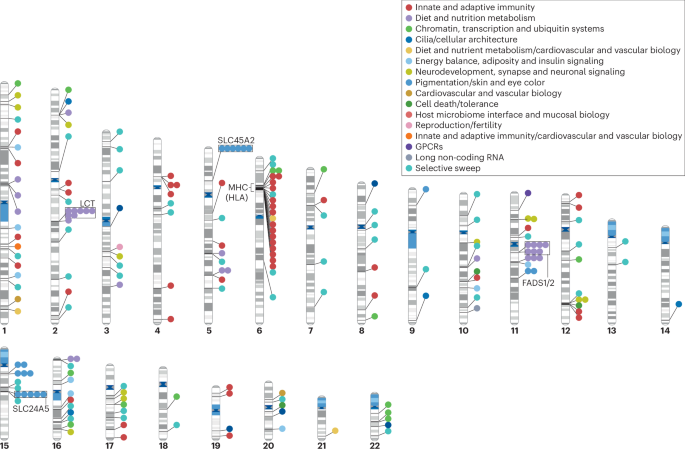
Wolfe, D., Dudek, S., Ritchie, M. D. & Pendergrass, S. A. Visualizing genomic information across chromosomes with PhenoGram. BioData Mining 6, 18 (2013).
Roberts, P. & Stewart, B. A. Defining the ‘generalist specialist’ niche for Pleistocene Homo sapiens. Nat. Hum. Behav. 2, 542–550 (2018).
Ségurel, L. & Bon, C. On the evolution of lactase persistence in humans. Annu. Rev. Genom. Hum. Genet. 18, 297–319 (2017).
Charlesworth, B., Morgan, M. T. & Charlesworth, D. The effect of deleterious mutations on neutral molecular variation. Genetics 134, 1289–1303 (1993).
Nielsen, R., Hellmann, I., Hubisz, M., Bustamante, C. & Clark, A. G. Recent and ongoing selection in the human genome. Nat. Rev. Genet. 8, 857–868 (2007).
Johri, P. et al. The Impact of Purifying and background selection on the inference of population history: problems and prospects. Mol. Biol. Evol. 38, 2986–3003 (2021).
Prugnolle, F. et al. Pathogen-driven selection and worldwide HLA class I diversity. Curr. Biol. 15, 1022–1027 (2005).
Johnson, O. L., Tobler, R., Schmidt, J. M. & Huber, C. D. Fluctuating selection and the determinants of genetic variation. Trends Genet. 39, 491–504 (2023).
Vaughn, A. H. & Nielsen, R. Fast and accurate estimation of selection coefficients and allele histories from ancient and modern DNA. Mol. Biol. Evol. 41, msae156 (2024).
Prüfer, K. et al. The complete genome sequence of a Neanderthal from the Altai Mountains. Nature 505, 43–49 (2014).
Sankararaman, S. et al. The genomic landscape of Neanderthal ancestry in present-day humans. Nature 507, 354–357 (2014).
Vernot, B. & Akey, J. M. Resurrecting surviving Neandertal lineages from modern human genomes. Science 343, 1017–1021 (2014).
Zeberg, H. & Pääbo, S. The major genetic risk factor for severe COVID-19 is inherited from Neanderthals. Nature 587, 610–612 (2020).
Dannemann, M., Andrés, A. M. & Kelso, J. Introgression of Neandertal- and Denisovan-like haplotypes contributes to adaptive variation in human Toll-like receptors. Am. J. Hum. Genet. 98, 22–33 (2016).
Immel, A. et al. Genome-wide study of a Neolithic Wartberg grave community reveals distinct HLA variation and hunter-gatherer ancestry. Commun. Biol. 4, 1–10 (2021).
Schlebusch, C. M. et al. Southern African ancient genomes estimate modern human divergence to 350,000 to 260,000 years ago. Science 358, 652–655 (2017).
Skoglund, P. et al. Reconstructing prehistoric African population structure. Cell 171, 59–71 (2017).
Perry, G. H. et al. Adaptive, convergent origins of the pygmy phenotype in African rainforest hunter-gatherers. Proc. Natl Acad. Sci. USA 111, E3596–E3603 (2014).
Ranciaro, A. et al. Genetic origins of lactase persistence and the spread of pastoralism in Africa. Am. J. Hum. Genet. 94, 496–510 (2014).
Prendergast, M. E. et al. Ancient DNA reveals a multistep spread of the first herders into sub-Saharan Africa. Science 365, eaaw6275 (2019).
Bigham, A. et al. Identifying signatures of natural selection in Tibetan and Andean populations using dense genome scan data. PLoS Genet. 6, e1001116 (2010).
Lindo, J. et al. The genetic prehistory of the Andean highlands 7000 years BP though European contact. Sci. Adv. 4, eaau4921 (2018).
Lindo, J. et al. A time transect of exomes from a Native American population before and after European contact. Nat. Commun. 7, 13175 (2016).
Colbran, L. L., Terhorst, J. & Mathieson, I. Global patterns of natural selection inferred using ancient DNA. Preprint at bioRxiv https://doi.org/10.64898/2026.01.07.697984 (2026).
Mathieson, I. Human adaptation over the past 40,000 years. Curr. Opin. Genet. Dev. 62, 97–104 (2020).
First Appeared on
Source link






Leave feedback about this