

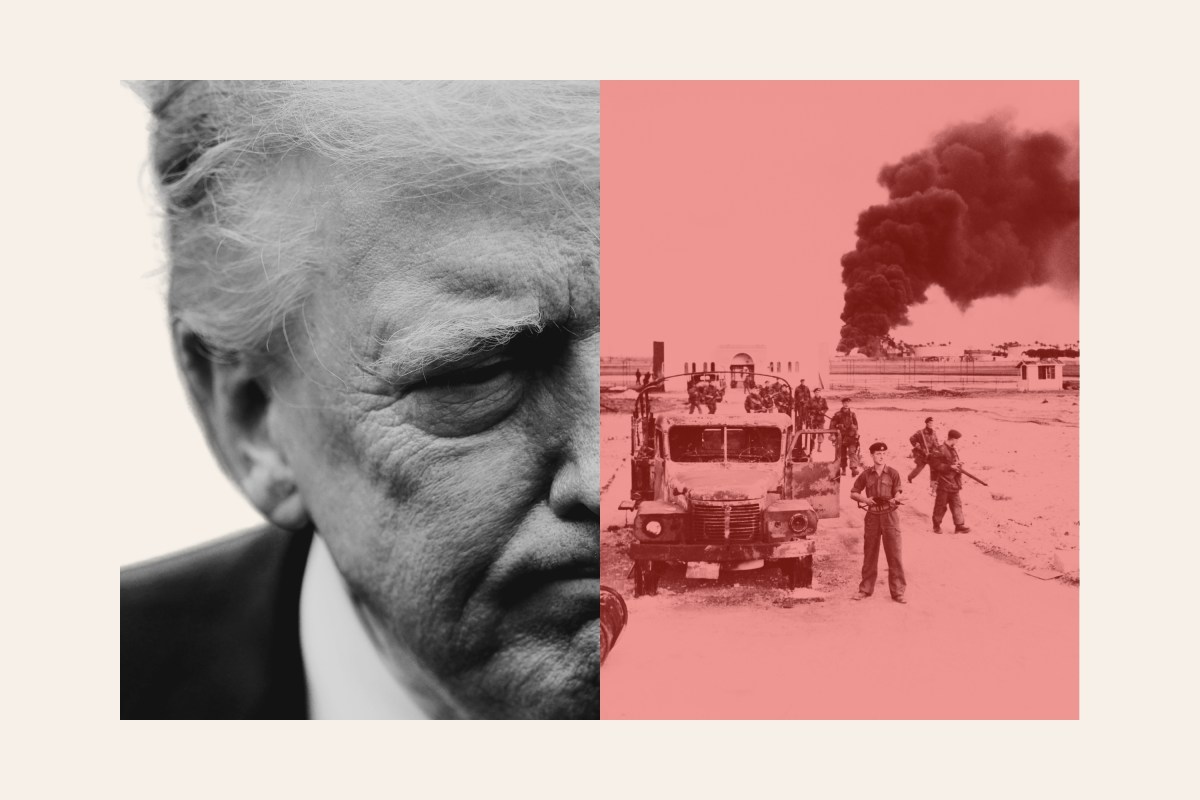
President Donald Trump’s frustration with Europe over Iran has a familiar historical echo. Only this time, the roles are reversed.
In the 1956 Suez Crisis, Britain and France expected U.S. backing for a dramatic show of force. Instead, they found Washington publicly distancing itself, pressing for a ceasefire, and supporting U.N. resolutions condemning the invasion.
Today, amid a widening confrontation involving the U.S., Israel, and Iran—and renewed disruption in the Strait of Hormuz—Trump has urged NATO allies to help secure the vital shipping lane and help its bigger campaign to bring the Iranian regime to its knees.
But he has encountered hesitation and even refusal from London, Paris, and others.
Where Suez exposed the limits of European power without American support, the current crisis is testing the limits of U.S. leadership without European buy-in.
In that sense, Iran is reviving the Suez lesson in reverse. Seventy years later, the British and French are getting even.
Transatlantic Tensions Over Iran’s Nuclear Question
The transatlantic argument over Iran did not begin with the current crisis.
It has been a persistent source of friction since the Obama-era Joint Comprehensive Plan of Action (JCPOA) was signed in July 2015 by the U.S., U.K., France, Germany, the European Union (EU), and other parties.
The agreement aimed to constrain Iran’s nuclear program through limits and inspections in exchange for sanctions relief.
When Trump withdrew the U.S. from the deal in 2018, he argued it was too permissive, rewarding Iran economically while and failing to address its ballistic missile program and destabilizing regional influence.
European leaders largely took the opposite view: that the JCPOA, while imperfect, imposed meaningful constraints and reduced the immediate risk of nuclear escalation.
That divergence hardened into a pattern. European governments consistently emphasized de-escalation, inspections, and negotiated limits. Trump emphasized maximum pressure, hard-power deterrence, and a broader, decisive bargain.
Iran’s nuclear advances accelerated after the U.S. withdrawal, and it enriched uranium to a higher purity as well as abandoning the limits set on its program, complicating claims that leaving the deal constrained Tehran’s program.
Crucially, the JCPOA split conditioned European capitals to treat U.S. appeals for military alignment on Iran with deep skepticism. European officials have often viewed Washington as prone to abrupt escalation. U.S. officials, in turn, have seen Europe as reluctant to confront long-term strategic risks due to endemic weakness.
Against that backdrop, Trump’s latest plea for allied support was always likely not to land easily.
The Suez Crisis
Suez remains the archetype of allied expectations shattering under U.S. opposition.
After Egyptian President Gamal Abdel Nasser nationalized the Suez Canal Company in July 1956, Britain and France, whose joint enterprise had controlled the canal, saw the move as both a strategic threat and a political humiliation.
In coordination with Israel, they devised a military plan. Israel invaded Egypt’s Sinai Peninsula on October 29, followed by British and French ultimatums and airstrikes under the stated aim of separating the combatants and securing the canal.
The Eisenhower administration refused to support the intervention.
U.S. officials feared it would inflame anti-Western nationalism, strengthen Soviet influence in the Middle East, and associate Washington with European colonial ambitions, particularly as the U.S. was simultaneously condemning the Soviet crackdown in Hungary.
Washington instead pushed for a U.N.-backed ceasefire, supported resolutions condemning the invasion, and helped establish the first U.N. peacekeeping force.
It also refused to provide financial backing as Britain faced mounting pressure on sterling—while signaling it would oppose IMF assistance—compounding the economic strain that accelerated London’s decision to withdraw.
The episode strained relations with key allies, who felt betrayed, especially after WWII, and contributed to the resignation of British Prime Minister Anthony Eden.
The U.S. in 2026 Is Not Britain in 1956
While the comparison to Suez is instructive, it is not exact.
In 1956, Britain and France, societies battered by two brutal world wars, lacked the economic and geopolitical independence to sustain military action without U.S. support.
American leverage, political and financial, quickly made their position untenable and forced a withdrawal despite initial battlefield success. Their failure was not primarily military. It was structural.
The U.S. today is operating from a different position as a hegemonic superpower. It retains the world’s most powerful navy and the ability to project force into the Persian Gulf without allied participation.
In purely military terms, Washington can strike Iranian targets and attempt to protect shipping lanes on its own, even if it would prefer to do so in partnership with allied militaries.
But capability is not the same as control. Securing the Strait of Hormuz, through which roughly a fifth of global oil consumption passes, demands more than defeating conventional forces.
Iran’s asymmetric toolkit—including mines, missiles, drones, and fast attack craft—can disrupt shipping even after major strikes, creating a persistent threat environment rather than a clean endpoint.
Restoring stable transit could take weeks or longer, even with sustained U.S. operations. That gap between overwhelming force and lasting stability helps explain why Washington still wants allies involved.
European participation would share the operational burden, broaden the coalition’s credibility, and signal the mission is about protecting global commerce rather than simply extending a U.S.-led war.
This is where the Suez lesson diverges. In 1956, Britain and France needed American backing to act at all. In 2026, the U.S. can act without Europe, even if achieving its broader goals becomes more complicated.
Europe’s Reluctance on Iran
Fast-forward to 2026, and Trump is now the leader pressing allies for support.
As tensions with Iran have escalated and threats to commercial shipping in the Strait of Hormuz have intensified, the administration has called on NATO partners to help secure the narrow waterway through which a significant share of global oil supplies passes.
U.S. officials have framed the effort as essential to protecting freedom of navigation and stabilizing energy markets.
European responses, however, have been cautious, even explicitly so.
British officials have emphasized maritime security and protecting regional allies from Iranian retaliation while making clear they will not be drawn by the U.S. into a wider conflict.
French leaders have raised questions about the legal basis for military action in the current circumstances and indicated a preference for a more limited, defensive maritime mission rather than joining operations amid active hostilities.
German officials have stressed that the crisis was not initiated by Europe and have urged restraint.
Trump has responded with visible frustration, criticizing NATO allies for what he has described as a failure to share the burden.
At the same time, he has alternated between demanding greater allied involvement and downplaying the need for it, a contradiction that underscores the political bind facing Washington.
“NATO NATIONS HAVE DONE ABSOLUTELY NOTHING TO HELP WITH THE LUNATIC NATION, NOW MILITARILY DECIMATED, OF IRAN,” Trump rages in an all-caps post on Truth Social early Thursday morning.
“THE U.S.A. NEEDS NOTHING FROM NATO, BUT ‘NEVER FORGET’ THIS VERY IMPORTANT POINT IN TIME!”
The U.S. is seeking both legitimacy and burden-sharing. European governments remain wary of escalation, legal ambiguity, and the domestic political risks of joining a U.S.-led military effort without a clear international mandate
Those concerns are shaped, in part, by the shadow of past interventions, especially Iraq, where the U.K. and other allies followed the U.S. into a quagmire that cause lasting damage.
Strained Alliances
The Suez lesson is remembered as a turning point that exposed the limits of British and French power, and demonstrated Washington’s willingness to override its closest allies when interests diverged.
In the Iran standoff, that lesson appears to be playing out in reverse.
It is now the U.S. pressing London and Paris to act, and Europe declining, citing legal concerns, escalation risks, and the belief that Washington has chosen a path they did not endorse.
The deeper point is that alliances strain when leaders assume solidarity is automatic.
Suez taught Europe that American support is conditional. The current Iran crisis is a reminder that power without allies can still be formidable. But it is often less decisive, and more brittle, than it appears.
Hey gang, Carlo Versano here. I hope you enjoyed this article. As Newsweek‘s Director of Politics and Culture and editor of the 1600 newsletter, I’m keen to hear what you think. Now, Newsweek is offering a new service to allow you to communicate directly with me in the form of a text message chat. You can sign up and get a direct line to me, as well as the reporters who work for me. You can shape our coverage.
As a Newsweek member, we’re offering this service to you for free. You can sign up below, or read more about how it works here. Let’s talk!
First Appeared on
Source link




Leave feedback about this