

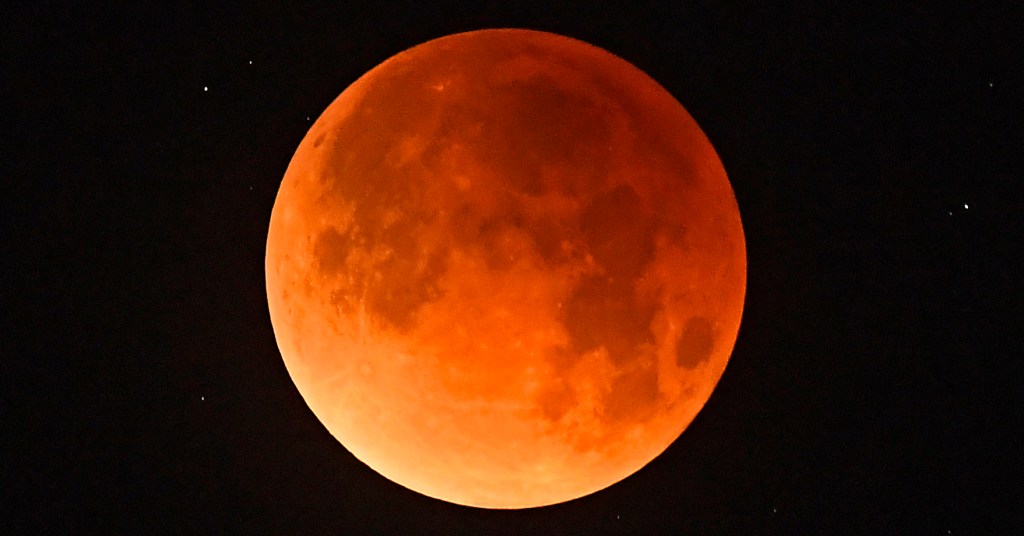
Normally, the only reason most people get up at 3 a.m. on a Tuesday morning is if the neighbor’s dog is barking or the person next to them is snoring. But now there’s another, more exciting reason: A total lunar eclipse.
Early Tuesday, at 3:05 a.m. Pacific time, the moon will turn dark red as a total lunar eclipse unfolds, lasting for about 1 hour. Lunar eclipses happen when the Earth passes directly between the sun and moon, casting a gigantic shadow that creeps across the moon’s surface. The event gives the moon a deep reddish-orange glow, which some people call “a blood moon.”
The eclipse will be visible across California. Another like it won’t be visible again in the Golden State until Oct. 8, 2033. As a result, Bay Area astronomers are excited.
“It takes a special kind of person to give up a good night’s sleep for an astronomical event, but it’s rare enough and beautiful enough that most people regard it as worth it,” said Andrew Fraknoi, a professor of astronomy at the Fromm Institute at the University of San Francisco.
To watch, viewers don’t need any special equipment. And they don’t need to travel to remote, dark places, like deserts or mountains, though that does increase clarity.
“Every total lunar eclipse I have seen has been spectacular,” said Ben Burress, staff astronomer at the Chabot Space and Science Center in the Oakland Hills. “It’s an experience that everyone should have at least once in a lifetime.”
The event begins at 1:50 a.m. Tuesday with a partial eclipse. First, the curved shadow of the Earth will appear on the moon and slowly move across it. By 3:05 a.m., the total eclipse begins and will last until 4:03 a.m. After that, the partial eclipse will resume and end at 5:17 a.m.
For people who don’t want to stay up more than 3 hours on a weeknight, the best time to wake up would be around 2:45 a.m., Burress said. That way, they can see the shadow moving on the lunar surface, and then the total eclipse occurring.
The Chabot Space and Science Center is holding a public event on its observation deck with telescopes and staff members explaining the science from 1 a.m. to 5 am. Tickets can be purchased on the Chabot website, and are $15 for adults, $7 for kids, and free for members.
Unlike a solar eclipse, which occurs when the moon passes between the sun and the Earth, people watching Tuesday morning’s lunar eclipse don’t have to worry about damaging their eyes. Binoculars will help make the moon look larger, but aren’t required.
“It’s extremely democratic,” Fraknoi said. “You don’t need fancy, expensive equipment. You can just go outside in your backyard and look up. If you have binoculars, it’s nice to look at it, but they are not required.”
To take a good photo, NASA recommends using a camera on a tripod with exposures of at least several seconds.
The curved shadow of the Earth that creeps across the moon during lunar eclipses is key to humankind’s understanding of our planet. More than 2,000 years ago, it provided evidence for ancient Greeks to posit that the Earth was round, even though the telescope hadn’t been invented yet, Fraknoi noted.
What makes the moon turn dark red during total lunar eclipses?
In short, Earth’s atmosphere.
The moon doesn’t generate its own light. It simply reflects light from the sun.
During a lunar eclipse, our planet blocks most of the sun’s light from reaching the moon for a few hours. But the light that does reach the lunar surface shines through the Earth’s atmosphere.
The exact color of the glow and darkness depends in part on the “sootiness” of our atmosphere, Fraknoi said, including how recently volcanoes have erupted, how much cloud cover, storm activity, smoke from wildfires and human pollution there is around the globe. Once the moon is totally eclipsed, stars in the sky should become easier to see, he noted.
Put another way, it’s as if all of the world’s sunrises and sunsets are projected onto the moon.
Since 2019, there have been three total lunar eclipses visible in the Bay Area. The weather forecast for Monday night into Tuesday morning calls for dry conditions with partly cloudy weather across the region.
“Partly cloudy is not a death knell,” Burress said. “Partly cloudy means partly not cloudy. You should still be able to see it.”
When lunar eclipses occur, New Age practitioners and others who believe in astrology — the pseudoscientific claim that stars, the moon, and planets affect the character and health of people’s lives — make many claims.
Fraknoi cautioned against drawing any such conclusion, saying it has no scientific basis.
“There have been dozens and dozens of experiments to see if the predictions of astrology are valid or hold up. And they don’t,” he said. “The predictions tend to be so vague that you might as well throw darts.”
Millenia ago, before telescopes, satellites, the moon landing, computers and modern medicine, astrology made sense, he said.
“Astrology was a brilliant idea thousands of years ago when humans felt like we had no control over our health or environment and everything was determined by the gods,” Fraknoi noted. “Somebody came up with a notion that you could read the minds of the gods by looking at the sky, and figure out your fate. It made us feel like we had some control over our lives. But when we began the scientific method, it got left behind.”
First Appeared on
Source link



Leave feedback about this