

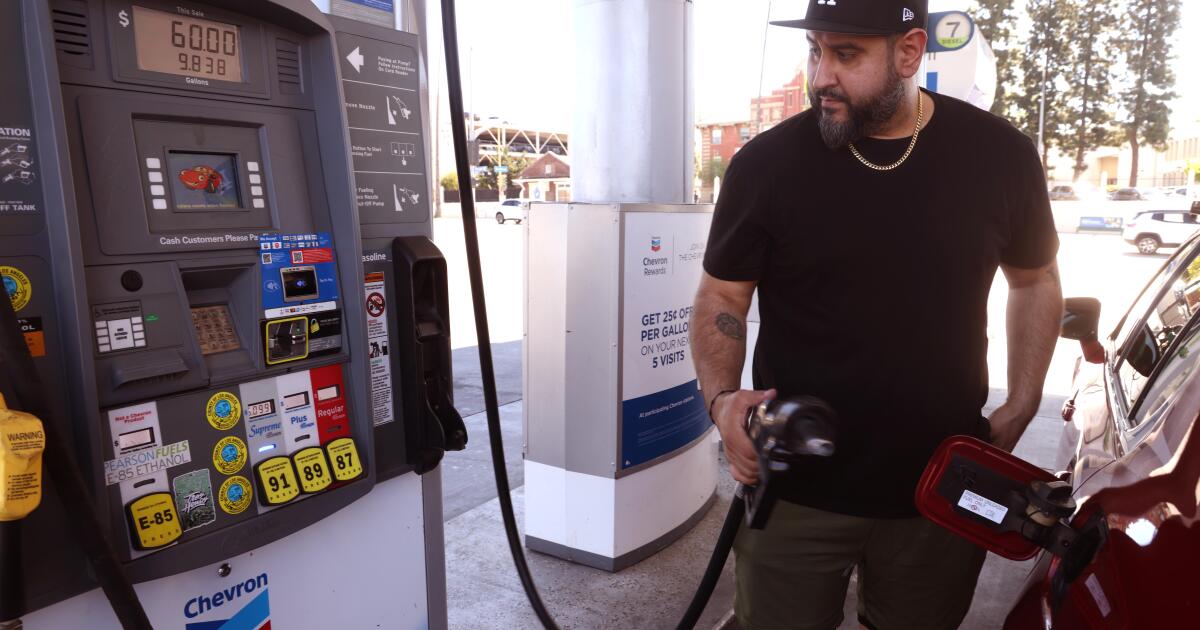
With crude oil topping $100 a barrel, and the average price of gas in the state approaching $5.50 a gallon, every touch of the nozzle is painful for California drivers.
Now, with the Iran war nearing its third week, the soaring costs of energy are rippling through the world’s fourth-largest economy.
While economists say it‘s too early to gauge the long-term impacts on the state, one thing is clear: The higher cost to fill gas tanks is eating into Californians’ disposable incomes — what’s spent to buy food and other necessities, or to go out and have fun — while reducing the income of businesses, also facing higher fuel costs.
“Inflation and affordability have been a big concern for the American public, and the longer this goes on, the greater risk there is of increasing overall inflation,” said Trevor Higgins, senior vice president for energy and the environment at the Center for American Progress. The group released a report this week documenting the inflationary impacts of the war and past conflicts.
The price of a gallon of gas hit $5.37 on Thursday, up 82 cents from a month ago, according to AAA. The state consistently has the highest prices in the nation due to taxes, clean air rules and supply constraints.
Before the start of the war, the California economy seemed poised for strong growth despite a lagging jobs market that has seen multiple employers — including several major tech companies such as Google, Block and Autodesk — slash payrolls by the thousands.
The state’s economy grew at a robust 3.8% annualized rate in the fourth quarter, driven by artificial intelligence investment, the burgeoning aerospace industry and other high-productivity sectors, according to the UCLA Anderson Forecast released early this month.
The report predicted a possible pickup in employment this year, but any prolonged conflict in the Middle East means all bets are off.
The $4.1-trillion state economy is highly diverse, with large logistics, manufacturing and agriculture industries, just to name a few sectors having to absorb higher fuel costs — though defense contractors could well benefit from the war.
Just as the state’s more than 25 million registered drivers are experiencing pain at the pump, the rising cost of diesel fuel is hitting Southern California’s large logistics industry, including truckers reliant on diesel fuel.
The average price of a gallon of diesel was up to $6.21 on Thursday, up $1.17 from a month earlier.
The twin ports of Los Angeles and Long Beach are the epicenter of the region’s logistics industry, supporting more than 200,000 jobs and contributing $28 billion to the regional economy in 2022. Some 9,000 truckers visit the ports at least once weekly.
“Diesel fuels all supply chains, and so it will affect the truckers who are servicing the ports immediately. This is going to upset a lot of business plans,” said economist Jock O’Connell, international trade advisor at L.A.’s Beacon Economics.
“There’s every hope that it will be wrapped up within a few weeks at most and will return to normal. But for the time being, there’s going to be a war tax imposed on the entire transportation system of the United States,” he said.
The war also has doubled the costs of bunker fuel that powers ships calling on the local ports with goods from Asia, said Ronald Widdows, chief executive of FlexiVan, a chassis supplier for the logistics industry, during a Port of Los Angeles media briefing Thursday.
That is adding $2 million to the costs of every round trip, which is passed on to the importers here in the United States, he said. Importers include big U.S. toy, apparel and other retailers that can pass on the costs to consumers.
It’s also expected that the disruption in Middle East shipping lanes could slow goods bound for Southern California as they back up in Southeast Asian ports — though for now it’s expected to be minimal, Widdows said.
“That will have some knock-on effect on cargo volume if this goes on for very much longer,” he said.
The state’s $61-billion agricultural industry, the largest in the nation, is highly sensitive to diesel costs too.
“The agricultural industry here in California, as well as the rest of the country, uses a lot of diesel. There’s lots of big equipment, whether it’s an almond harvester or some big tractor in a rice field,” said Daniel Sumner, a professor of agriculture at UC Davis.
While diesel costs are already affecting farmers, another threat on the horizon is higher fertilizer costs due to the rising costs of natural gas, a key feedstock in making it, he said.
Sumner noted the new challenges arrive as the industry is still grappling with President Trump’s tariffs, which — though a majority have been struck down by the Supreme Court — prompted retaliatory actions by longtime trading partners.
The surge in fuel prices comes as the state is experiencing what the Anderson report called a “bifurcated” state economy, with the tech and aerospace industries making up for the lagging construction, retail and segments of the leisure and hospitality industries.
Also lagging has been the kind of hiring expected from a growing economy, exacerbated by thousands of job cuts in Silicon Valley, which firms say have been prompted by artificial intelligence investment and disruption.
Hollywood studios have also laid off thousands because of a slowdown in filming, with the recent Paramount-Warner Bros. Discovery deal stirring fears of more.
Just last week, Oakland fintech Block, the parent of Cash App and payment services company Square, cut more than 4,000 workers citing AI.
The national jobs picture isn’t much better. Last week, the Labor Department reported that employers cut 92,000 jobs in February, a month economists had expected would see a 60,000 gain. The unemployment rate rose to 4.4%.
California’s unemployment rate was 5.5% in December, the most recent available data. That is the highest in the nation, but down a tenth of a point since November.
Michael Bernick, a former director of California’s Employment Development Department, said that although it has been too soon for the war to affect employment, the inflationary pressures brought by higher fuel costs don’t help.
“California’s job market today is among the most competitive and difficult job markets to find a job in that I’ve seen in over 47 years in the field. So it is not like the California economy is in good position in any case,” he said.
As with any war, though, there’s money to be made, and particularly by the defense industry — a sector of the economy in which California holds an advantage over much of the rest of the nation.
Although multiple legacy defense contractors have moved their headquarters out of the state, it retains significant operations of companies such as Boeing, Lockheed Martin, Northrop Grumman and RTX, formerly Raytheon.
Some defense stocks have surged since the start of the war, while the broader Standard & Poor’s 500 index is down about 3%, including a 1.5% drop on Thursday following threats from Iran’s new leader.
Southern California also has seen a resurgence of the industry in recent years, with dozens of aerospace, defense tech and weapons startups planting their headquarters here.
Among them is Anduril Industries, a Costa Mesa startup that builds drone and other autonomous weapons and last year received a $2.5-billion funding round.
Economist Jim Doti, a professor at Chapman University in Orange, said that despite the negative effects of rising fuel costs and inflation, the state economy should benefit from the war.
“The major reason is that one of the most expensive aspects of the war is the use of missiles that are largely produced in California,” he said. “When you look at the macro impact of a war, generally, wars have positive effects on the economy.”
The university forecast in December that the nation’s real gross domestic product would grow 2% this year — a figure that it is now being revised to 2.2%. That is due to the stimulus effect of an expected $100 billion in additional government spending.
How the war affects the overall state and national economies remains to be seen, with economists not in agreement.
This week, the government reported that inflation rose 0.3% in February, and 2.4% over the last 12 months, higher than the Federal Reserve’s 2% target rate. That lessens the likelihood the central bank will cut interest rates and, coupled with the recent jobs report, raises the prospect of “stagflation” — weak growth and higher inflation.
Oxford Economics this week stayed with its 2.8% growth projection for the U.S. GDP.
The forecast noted that higher energy prices will push up inflation that will weigh on disposable incomes, but that would be offset by larger tax refunds due to Trump’s tax-and-spending bill passed last year.
O’Connell, the trade economist, said California’s defense industry will benefit “to the extent we’ve managed to shoot off a large part of our inventory of our arsenal, and we’ll need to replenish that.”
But, he added, “It’s a narrowly focused benefit.”
First Appeared on
Source link






Leave feedback about this