

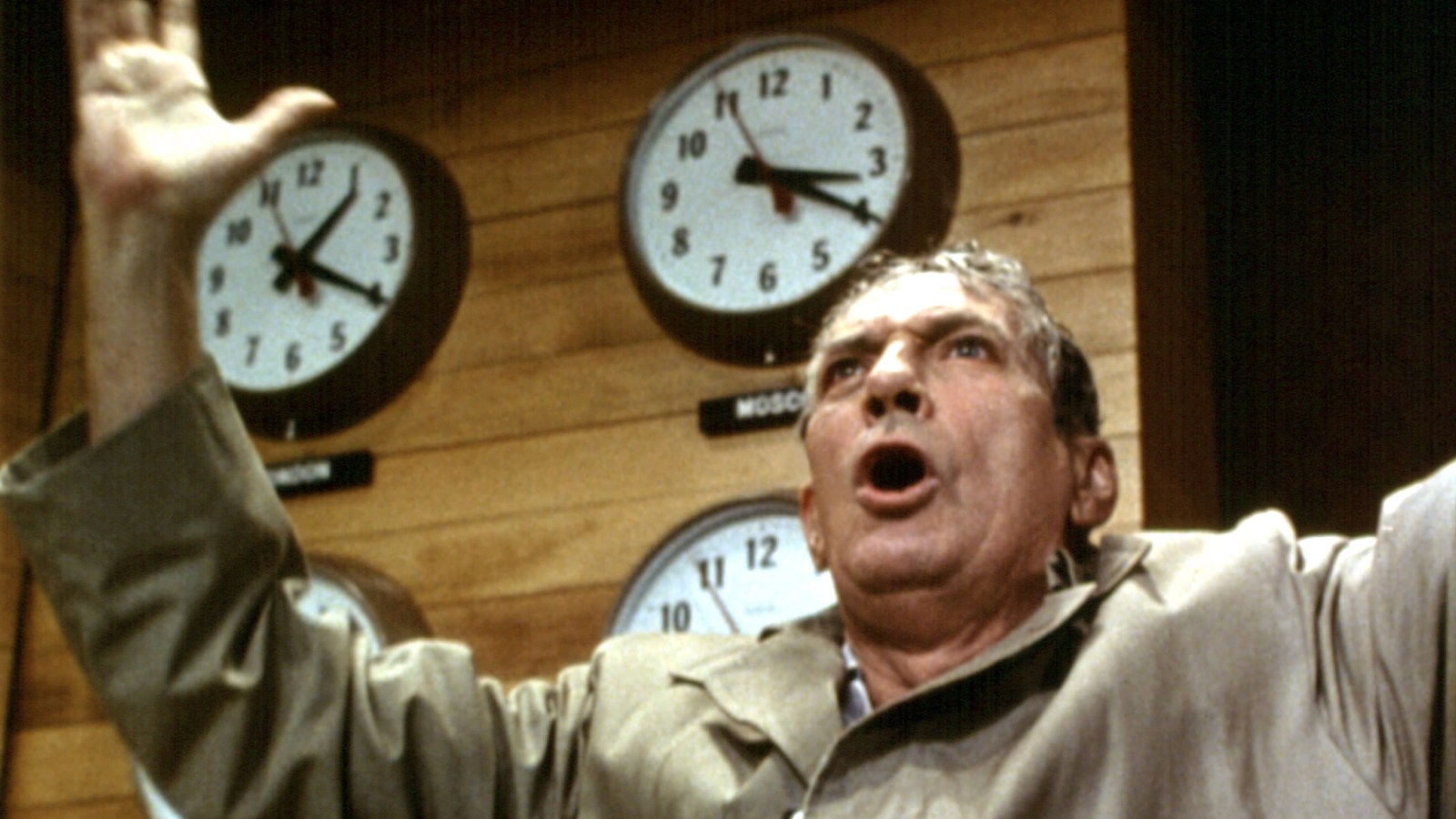
It doesn’t happen until the halfway mark. You may remember the single most famous scene in Network, Paddy Chayefsky and Sidney Lumet‘s take on television news, tabloid culture, corporate takeovers, and the shape of things to come, happening closer to the beginning of the movie. We don’t need to tell you which one we mean: A newscaster named Howard Beale, drunk on prophecy and clarity, rises from his anchor’s desk. Having run down everything that’s wrong with the world outside our windows — unemployment, crime, pollution, a failing economy — the gentleman now has a favor to ask of his viewers. He demands them to temporarily remove themselves from their state of perpetual isolation and become part of the collective chorus, to open their windows and scream into the void. Say it with us. “I’m as mad as hell, and I’m not going to take this any more!”
Watch it again if you haven’t in a while. You’ll be surprised how effective, how positively exhilarating and jolting, all of this still is.
Released during the year of America’s bicentennial, Network turns 50 years old this year. Revisit the complete movie now — which, given that the Criterion Collection has just released a lovely Blu-ray edition of the film, should be near the top of your to-do list (support physical media!) — and it feels as if it’s 50 minutes old. Only the corrupted mediums of mass communication have changed. For decades, it’s been considered a stark, darkly hilarious look at the way that the broadcast news industry could be merged with the Entertainment Industrial Complex, then eventually exploited by the powers that be.
Could is no longer the operative word here. Roughly 10 years after the movie won four Oscars, the Fairness Doctrine requiring networks air balanced coverage of issues in the public interest was repealed, and we had a former movie star in the White House, known to quote pop-culture catchphrases during policy meetings. Twenty years after it was released, Fox News began slouching toward Bethlehem. Fast-forward 30 years after Network hit theaters, and you encounter a fun new app called Twitter. Cut to 40 years later, it’s 2016, and… yeah. Right. See the film today, and it’s like a nation of citizens with a gourmand’s love of human flesh encountering Jonathan Swift’s A Modest Proposal and thinking, “Wait, this was supposed to be satirical?”
Lumet and Chayefsky never thought of Network as a satire; they always referred to it as “reportage.” (“The industry satirizes itself,” Chayefsky was quoted as saying.) Both the director and the screenwriter who helped turn “I’m mad as hell” into a catchall mantra of rage against the machine came from television, albeit not the news departments. Each of them started in the early days of live-TV drama, eventually finding their way into the moving pictures. Lumet turned into a journeyman filmmaker who was particularly actor-friendly, and went from helming socially conscious parables (The Pawnbroker, Fail Safe) and theatrical adaptations (Long Day’s Journey Into Night, The Seagull) to being the go-to guy for New Hollywood’s NYC grit (Serpico, Dog Day Afternoon). Chayefsky was originally dubbed a voice-of-the-common-man scribe with a serious control-freak streak and, after his 1950s character study Marty became a sensation on both small and big screens, enough clout to enforce it. But his script for the 1971 movie The Hospital displayed a righteous sense of indignation at the way the American health-care system failed its practitioners and its patients. It wasn’t long before he turned his eyes, his pen, and his spleen toward a different institution.
These two had firsthand experience with the boob-tube sausage makers who no longer signed their checks, yet still dictated how they — and everyone else in the mid-Seventies — processed the events of the day. When we meet Howard Beale (played by Peter Finch), he’s the fictional peer of Walter Cronkite. His personal life has left him a mess, however, and he’s about to be cut loose. The news division’s president and Beale’s old comrade-in-broadcasting-arms, Max Schumacher (William Holden), takes his friend out for a drink. Howard says he’s going to give the people what they want — sensationalism — and kill himself on air. Max suggests they turn his death into a weekly series, “Suicide of the Week.” During his farewell address the next night, Howard repeats his “joke.” No one knows whether it’s simply the gallows humor of depressed man or something more troubling and serious. (There was, in fact, a real-life precedent.)
Enter Diane Christensen (Faye Dunaway). A programming chief who’s part next-gen power player and part apex predator — she could have played the villain in the previous year’s Jaws — Christensen thinks she’s found the network’s meal ticket in its star anchor’s meltdown. Her idea is to market Beale as a “mad prophet of the airwaves,” someone who can act as a full-throated vox populi. “The American people want somebody to articulate their rage for them,” she declares. Besides, his ascent can help serve as a lead-in to her pet project: a series devoted to a militant leftist organization, complete with a co-opted heiress à la Patty Hearst, that showcases the group’s own grainy, self-lensed footage of robberies.
Faye Dunaway, far right, Network.
ilmPublicityArchive/United Archives/Getty Images
In 1976, the idea that putting “a manifestly irresponsible man on national television,” preaching a no-bullshit gospel of sticking it to the Man, as well as pitching a show that hopes to turn political firebrands into the next sweeps-week superstars, was outrageous. In 2026, both would be considered tame — through, to be fair, the programs would still generate an abundance of memes and have millions of followers on their respective YouTube channels. Regardless, the new corporate owners of the network, embodied by the late, great Robert Duvall‘s C-suite apparatchik, get on board. Beale becomes a mass-media messiah. The evening newscast turned into a variety show, complete with fortune tellers and a game show-style announcer. What starts as an impromptu plea to action — “You’ve got to say, ‘I’m mad as hell, and I’m not going to take this anymore! I’m a human being, goddammit! My life has value!’” — ends as a parroted call-and-response. Rebellion is co-opted into pro-capitalism sloganeering. Ratings dip. Those leftist militants from Christensen’s pet project assassinate Beale during his broadcast. It’s one hell of a crossover episode.
Critics were divided, audiences were entertained, TV executives and Beale’s IRL equivalents were appalled, Oscar voters were enthralled. You can still see the influence of the movie’s equal-opportunity contempt for soulless conglomerates, immoral media types, and opportunistic, attention-seeking activists. (What is Eddington‘s eye-poking of Gen-Z social-media protesters but a kinder, gentler update on the Ecumenical Liberation Army?) Network was nominated for 10 Academy Awards and took home four. Peter Finch died from a heart attack while doing FYC press campaigning; he became the first Best Actor contender to win posthumously. Chayefsky also won for Best Screenplay. He’d be gone less than five years later. Both men had illustrious careers with plenty of ups and downs before this scathing screed, yet the movie is the cornerstone of their respective legacies. “I’m mad as hell” may no longer show up in op-eds or grace T-shirts and coffee mugs like it did in 1976, but the phrase still has currency. Beale’s sermon on the primetime mount remains one of the most famous monologues in movie history.
Slightly less famous, but perhaps even more pertinent to predicting our current fucked-up moment, is a sequence that follows it. To set the scene: Beale has called out his corporate overlords over a deal with the Saudis. The chairman of the board requests an audience with Beale. He has a few things of his own to say.
Television has given way to the internet, news broadcasters have given way to content creators and podcast opinionators, fact-based journalism has given way to “scoops of ideas.” You would not see the 2026 version of The Mao Tse Tung Hour on a TV network, but you would almost assuredly find it on said network’s in-house streamer. In terms of corporate interference and string-pulling regarding the news, talk to the staff of 60 Minutes or Stephen Colbert, an avowed superfan of Network. Americans wanted someone to articulate their rage, and for better or worse, they got one. He was even given a second-season renewal. There is no America. There is no democracy. There is only Meta, and OpenAI, and Amazon, and Skydance, and Google.
The story of our nation is pockmarked and littered with atrocities, oppression, terror, and violence. History is not pretty. Yet the one thing that a divided country can actually agree on right now is that what’s transpiring, in this age of the Great Step Backwards, is not normal, regardless of how those in power are trying to normalize it. Not even low ratings can stop it. Network gazed into its crystal ball and broadcast back a worst-case-scenario diatribe that, if you paid close enough attention, doubled as a warning. We don’t just live in Howard Beale’s world now. We’re stuck in a world dictated by millions of Diane Christensens. Fifty years later, Lumet and Chayefsky’s brilliant work of art is neither a satire nor reportage. It’s a horror movie. It’s reality.
First Appeared on
Source link


Leave feedback about this