

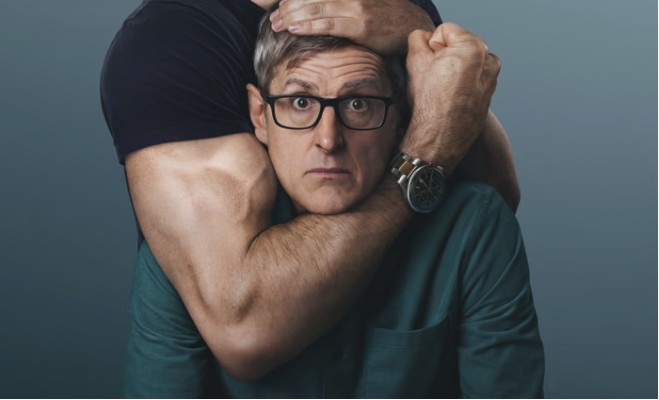
“Maybe that’s his game, to act like he’s your mate then fuck you…” ponders a participant in Louis Theroux’s new Netflix documentary, Inside the Manosphere, during a rare moment of mental acuity. You might think there could be nobody on earth left unaware of the filmmaker’s trademark faux naivety, but you would be wrong. The tiny-minded, tiny-trousered buffoons of the manosphere don’t have a clue who “Therooks” is and don’t really care, as long as the exposure brings them bigger audiences.
In this case, the bloke raising the question is a 24-year old professional Essex wide boy called Harrison Sullivan. Online, he calls himself “HS TikkyTokky”, which sounds a bit like a Gilbert and Sullivan pastiche but probably isn’t. Describing himself as a salesman in the “attention economy”, he seems more like a confused shop-owner, trying to offload printer paper, ski jackets, and dog bowls all at the same time.
Chasing ad revenues from video clips, Harrison wanders the streets of Marbella trailed by a lackey with a camera, shouting lewdly to passing women, luring other men into humiliating “predator stings”, and getting blowjobs in toilets from fellow fame-seekers. Another income stream involves selling dodgy-sounding stock tips on his Telegram channel. Perhaps needless to say, he also comes across as a right plonker, and one who is suppressing quite a lot of self-loathing at that. It must be hard to fight this feeling when you know nearly every waking moment is being dictated by the whims of anonymous teenagers, hooting at you in capslock from their bedrooms.
Harrison’s main friend seems to be another influencer called Ed Matthews, whose personal twist on the lucrative “predator sting” genre involves forcing people to eat dog food, then clipping it up for the socials. The rest of the posse, hovering shyly in his rented apartment, are there because they each won a prize draw; while — other than Harrison’s mother, who makes a late appearance — the only females apparently able to stand his presence are glued to their respective phones, getting maximal “content” out of the situation too. Addicted to livestreaming like it’s breathing, at one point the Brentwood influencer gets confused and starts talking to Netflix’s cameraman directly, bypassing the 50-something Oxford graduate blinking owlishly in the background. It’s a nice metaphor for what social media has done to legacy television. Sometimes, though, you still need a disingenuous old geezer around, to show the kids exactly how humiliating a predator sting can be.
After dispatching his English victims, Theroux flies to the US to meet some older and more established mandible-maxxers and chinfluencers. Ultimately these people don’t come out of the programme looking any better, though at least it is clearer what their appeal is to a younger audience. Figures like Justin Waller and Myron Gaines are leaning hard into their followers’ daddy issues, purporting to offer advice for a successful lifestyle. Their avowed specialty is “women, fitness, and wealth” — the dispiriting 21st-century version of “wine, women, and song” but not half as much fun.
The guiding philosophy seems to be a mash-up of stoicism, misogyny, anti-wokery, conspiracy theories, sex positivity for men, and whatever else has already worked big numbers for Andrew Tate. There’s not much point looking for internal coherence; ideology is entirely dictated by what might draw bored eyeballs. Ironically, for people who talk a lot about overcoming the “slave mindset” and escaping “the matrix” — meaning the 9-to-5 grind, labouring away fruitlessly for the benefit of shadowy elites — these are men almost entirely made up of other people’s projections. They can’t do or say anything that might lose them the commodity of public attention, and they are constantly thinking of ways to get more.
The career of the biggest influencer interviewed by Theroux — a 27-year old streamer known as Sneako — started off with gaming videos, then went through a self-improvement phase, an outrage-seeking trolling phase, and a boxing-other-influencers phase. He is now going through a devout-Muslim phase while pushing mad antisemitic conspiracy theories and feuding with Andrew Tate. In future, Sneako might well be livestreaming from a kibbutz or a gay porn film set; whatever will get him more attention.
“They can’t do or say anything that might lose them the commodity of public attention, and they are constantly thinking of ways to get more.”
As for the fans, they seem to hear what they want. One illuminating segment in the documentary — vaguely reminiscent of a Steinbeck novel — focuses on some touchingly tragic followers of Justin Waller’s, a pair of would-be influencers called Mattie and Chris. They talk reverently about what they have learnt from their idol and his friends the Tate brothers: that, as men, they are born “without value” and that they have to “build that value” through hard work, because “nothing in this world is given to you”. Lest this be mistaken for the boring old Protestant work ethic, Waller chimes in to add that women, in contrast, “are born with their value through beauty” and thus get lots of opportunities, whereas — pointing at the hapless Mattie — “nobody’s going to invite him on a trip to Miami”.
Later Theroux persuades Chris to run along the beach topless, filmed in pitiless slow motion. We also hear from Mattie that he has been homeless, sleeping in his car and “crying every night”; and that his brother took his own life. But it’s OK: he and Chris have reframed these things in a “solutions-based” way, they say. “As men, we are meant to suffer, we are not meant to be happy” is their conclusion, leaving whatever original injustice that put them on life’s scrapheap perfectly intact.
Back at the top of the pyramid, the streamers also seem miserable and haunted. “If I’d just done good things, I’d have never really blown up on social media in the first place,” TikkyTokky plaintively tells Theroux as if this explained it all. Everyone seems trapped in a degrading role, shafted by their own limbic system — the streamers themselves; the half-naked OnlyFans girls straddling them for the camera; the liberal feminists and fat-positive influencers wheeled on to be horribly insulted; the viewers doing the slack-jawed scroll in their bedrooms and cars, dreaming of having big platforms one day too.
There has been criticism of Theroux for giving attention-hungry grifters more of what they want, but I don’t agree. This framing replicates the reductive attitude of the influencer — i.e. all attention is good attention — when obviously this isn’t true. Clever mockery from men with bigger platforms is probably the best bet for puncturing the aura of humourless blowhards, because nothing is more emasculating than other men’s laughter. The alternative — ponderously explaining to the world why these attitudes are Outdated, Bad, and Wrong — only gives them a boost of countercultural glamour, and keeps the whole show on the road.
Another reaction has been the panicky inference that a new wave of virulent misogyny must be hitting young relationships at scale. Once again, I’m dubious, but only because it seems to me that young people stuck on screens all day are unlikely to be in personal relationships at all. The ultimate losers in this respect seem to be the boys, socialised into destructively anti-social paranoia — and also their female schoolteachers, bearing the brunt of misogynistic grandstanding in the classroom. But I’m not sure we need to worry about any imaginary girlfriends.
That’s not to say there isn’t a problem. It’s one we need to understand better before reacting. What does the average commenter writing “LETS GOOO” or “CHIN IT BRO” on a stream really think about the antics of the men he is watching? Is he relating to these people as spiritual gurus or as circus clowns — or perhaps even as whipping boys, suitable objects for his envy and derision? HS TikkyTokky’s comments section would suggest the latter. Mainstream observers tend to approach consumers of the manosphere as if they were passive viewers of television programmes of old, innocently ingesting prejudicial attitudes along with a daily dose of entertainment. In fact, though, many of them think of themselves as creators too. They understand that deliberate provocation and outrage are good means of getting attention. This surely affects the messages they are receiving, and what they do with them afterwards.
This urge to be famous starts young. For every massive streamer account, there are thousands of unknown ones, where pre-pubescent wannabes film themselves gaming or reacting to videos. In my childhood, we made “radio shows” by recording onto audiotapes, though we always knew it was make-believe. These days kids can broadcast to a real audience, so that what used to be pretend is literalised. Even if nobody actually tunes in, the attention-seeking die is cast. The lack feels like a positive deficit, to be remedied as soon as possible.
Indeed, the most affecting part of Inside the Manosphere comes just before the credits, where we are taken back to an angelic looking 15-year-old Sneako, solemnly talking to viewers on his tiny YouTube channel about his Filipino grandparents’ hopes for his career. We also see a very young Ed Matthews — long before the dogfood stunts — lispingly putting marshmallows in his mouth and saying “chubby bunny” as part of a viral challenge. In a parallel universe, these two sweet little boys grew up to have happily ordinary lives, unnoticed by the all-devouring algorithm. In this one, though, they got caught up in a freak show and dutifully became monsters, long before Theroux’s goading cameras ever arrived.
First Appeared on
Source link


Leave feedback about this