

Here on Earth, it seems easy and straightforward to know “where” anything is, or to know “when” an event either occurred or will occur. After all, we’ve mapped out the entire surface of the Earth, and can define our location with three coordinates — latitude, longitude, and altitude/depth — no matter where in the world we are. Additionally, we’ve synchronized all methods of timekeeping here on Earth with atomic clocks, enabling people from all different locations on Earth to know both the “when” and “where” any event occurs, will occur, or has occurred.
But this relies on an underlying assumption that most of us make without ever thinking twice about it: that you, from your location on Earth, are observing the same “here and now” as anyone else in any other location on Earth. Unfortunately, those ideas were proven to be incorrect more than a hundred years ago. We now recognize that even ideas like “when” and “where” are subject to the laws of Einstein’s relativity, and that in relativity, space and time are not absolute quantities, but rather are relative to each and every unique observer.
We can still use our old, Newtonian notions of “where” and “when” for most practical purposes, but when it comes to the incredible precision required by modern science, or with distant objects within the expanding Universe, Einstein’s revolutionary ideas of relativity must be incorporated. Here’s how to do it.
One well-known trick to approximate how far away a lightning/thunder event is involves counting the number of seconds it takes to hear the thunder’s first arrival after seeing the flash of lightning. Every three seconds of delay corresponds to approximately 1 kilometer (~0.6 miles) of distance: a consequence of the extreme differences between the speed of light and the speed of sound.
It might seem obvious in hindsight, but when you’re observing an event here on Earth, you’re not observing what’s actually occurring “right now” in whatever direction you’re looking at. Instead, you’re observing what was occurring when the signal — whatever it may be — that’s arriving in your eyes (or whatever organ or instrument you’re using to measure it) right now was generated.
Consider the above image: of a lightning strike occurring nearby enough that it’s visible to your eyes, but that’s far away enough that your life isn’t in danger from it. If you’ve ever experienced it, you’ll notice that:
- the light from the lightning strike appears to arrive first, with that signal showing up in your eyes,
- while the sound from the thunder, created in the same event, arrives later, with the “time delay” between the light and the sound increasing the farther away the lightning strike actually is.
To be clear, the “lightning strike event” really is a physical event: it occurs in a specific location at a specific moment. But what happens in the aftermath of that strike occurring isn’t something we normally think about; we just observe it. That event generates a multitude of signals, including the light (electromagnetic waves) and sound (pressure waves through the air) that we observe. What we then observe isn’t “where” and “when” the strike occurred, but rather when, and from what direction, those generated light and sound signals arrived in our body’s detectors: our eyes and ears.
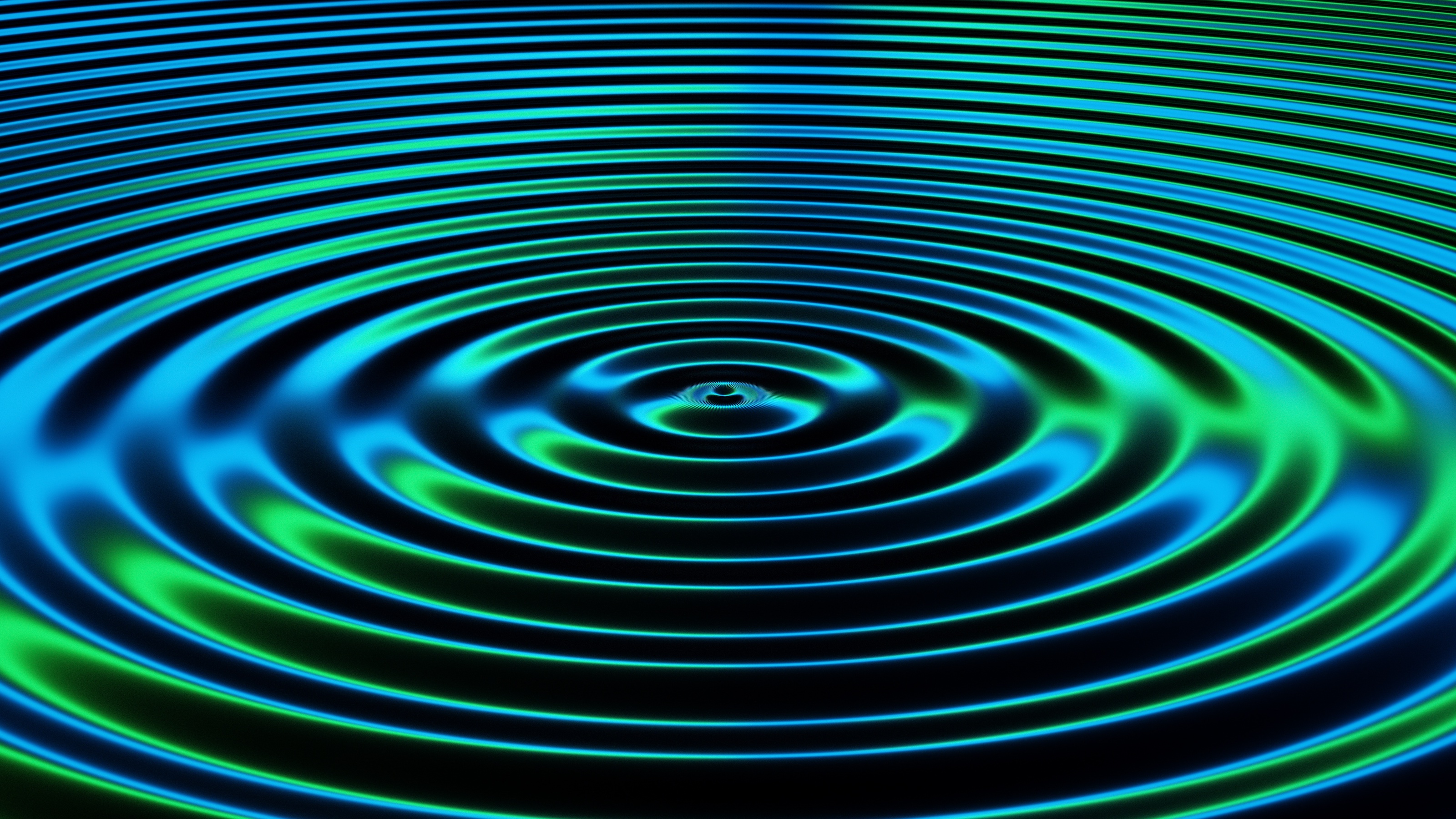
When a disturbance is created in an otherwise still body of water, such as by dropping a stone into it, those signals will then propagate outward, away from the generating source, at a specific speed determined by the properties of the signal and the nature of the medium. Whether water waves, sound waves, light waves, or gravitational waves, all waves propagate at a finite speed.
The reason you see the lightning first and only hear the thunder some time afterward is not because lightning gets created first and thunder gets created second. Instead, it’s because — from a significant but finite distance away from you — those signals both need to propagate across the distance separating you from the event: they must propagate through space. But signals don’t go from the generating source to the observer instantaneously; all physical signals propagate at a finite speed, with the fastest possible speed being the speed of light in a vacuum, c, or 299,792,458 m/s.
That means, even if you’re relatively close to the lightning strike, like just one kilometer (0.62 miles) away, you’re not going to “see” the strike at the moment it occurs. Instead, you’ll only see it once the signal has propagated from its origin point to your current location when you observe it: from the emitter to the observer. The speed of light in air is slightly slower (by about 0.03%) than the speed of light in a vacuum, meaning you won’t observe that signal until about 3.3 microseconds have passed.
For sound, however, its speed through the air is much lower: about 343 meters-per-second, or around 760 mph. That’s because sound is a physical pressure wave, compressing and rarifying the air as it travels through it. Instead of 3.3 microseconds, sound takes nearly 3 full seconds to reach your ear from an event that occurs just 1 kilometer away.
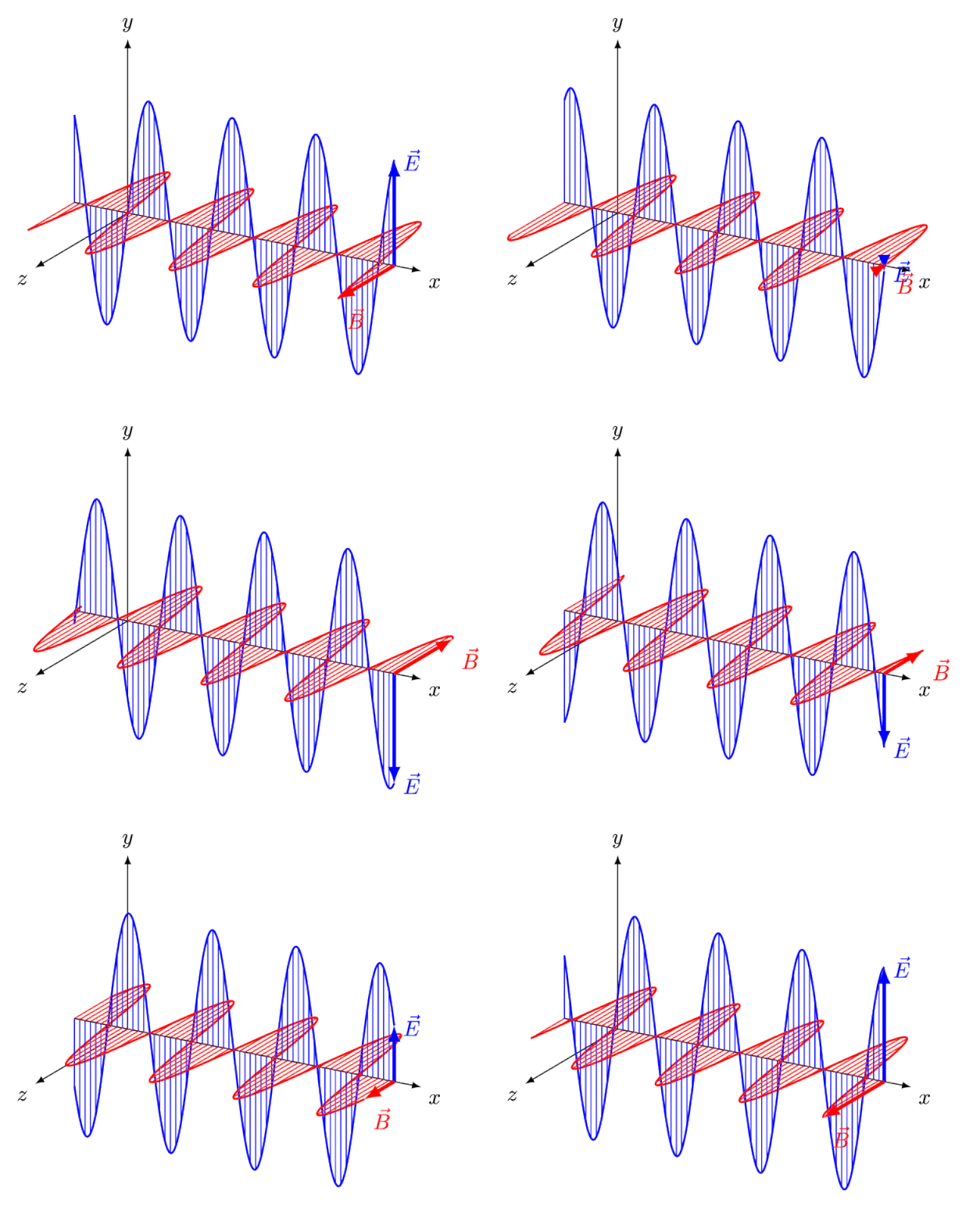
Light is nothing more than an electromagnetic wave, with in-phase oscillating electric and magnetic fields perpendicular to the direction of light’s propagation. The shorter the wavelength, the more energetic the photon, but the more susceptible it is to changes in the speed of light through a medium.
This is important for many reasons, but perhaps the most important is this: a physical signal, any signal, can only propagate at a finite speed, and you can only acquire information about the event that generated the signal once it arrives for you, the observer. That means that, even at the speed of light — the fastest possible signal of all — you can only observe anything in the Universe as it was when the signal was first emitted, not as it is “right now” for you.
- Looking out from a mountaintop at a city that’s 30 kilometers (18.6 miles) away? You’re seeing that city as it was 100 microseconds ago.
- Looking out at the Moon in the night sky? You’re seeing the Moon as it was about 1.3 seconds ago, meaning if an asteroid strike has just occurred on the Moon in the last 1.3 seconds, you haven’t detected it yet, even though it’s already occurred.
- Looking out at the Sun from your perspective here on Earth? You’re seeing the Sun as it was about 8 minutes and 20 seconds ago, meaning that if a solar flare or a space weather event has occurred on the Sun, you won’t be able to detect it until those signals have propagated all the way to your detector.
We can define, using what we know about our planet, our Solar System, and the speed of light, a “when” and a “where” for each of these items, so long as we remember to account for relativity and the notion of signal propagation. That’s why, when it comes to physics, we don’t uniformly say that everything that exists can be seen by us. Instead, we have the idea of a light-cone, where signals within that light cone (both past and future) can be detected, but signals outside of that light-cone cannot: at least, not yet.
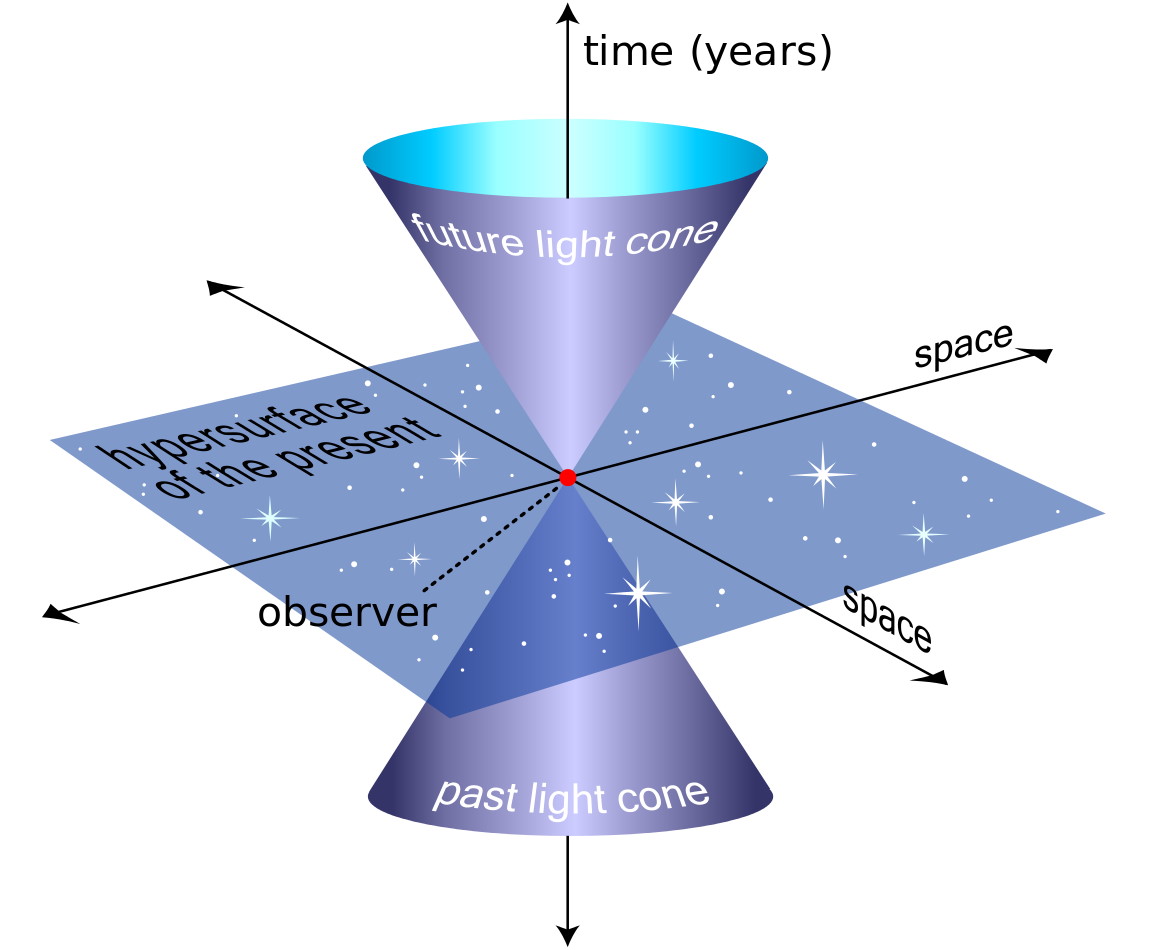
An example of a light cone, the three-dimensional surface of all possible light rays arriving at and departing from a point in spacetime. The more you move through space, the less you move through time, and vice versa. Only things contained within your past light-cone can affect you today; only things contained within your future light-cone can be perceived by you in the future. This illustrates flat Minkowski space, rather than the curved space of general relativity.
Right now, we live in what we might think of as “the present,” which is the “now” of when we are. But the truth of the matter isn’t merely that we can’t see or detect everything that’s happening “right now” around us, but rather that we can only see and detect what’s happening “right now” in the exact location where we are: in the here-and-now. For everything else, we’re seeing it as it was in the past.
- For objects that are 1 km away, we see them as they were 3.3 microseconds in the past.
- For objects that are 100 km away, we see them as they were 100 microseconds in the past.
- For objects that are 300,000 km away, we see them as they were 1 second in the past.
- For objects that are 108 million km away, we see them as they were 1 hour in the past.
- For objects that are 2.6 billion km away, we see them as they were 1 day in the past.
- For objects that are 9.46 trillion km away, we see them as they were 1 year in the past.
That final figure, 9.46 trillion km, corresponds to a distance of 1 light-year: defined that way because it’s the distance that light will traverse after one year of travel at its universal speed: 299,792,458 m/s.
However, what we’ve just covered should make you pause for a moment when you consider a question like “how far away is the nearest star beyond the Sun?” That star isn’t debated: it’s Proxima Centauri, located an approximate distance of 4.24 light-years away.
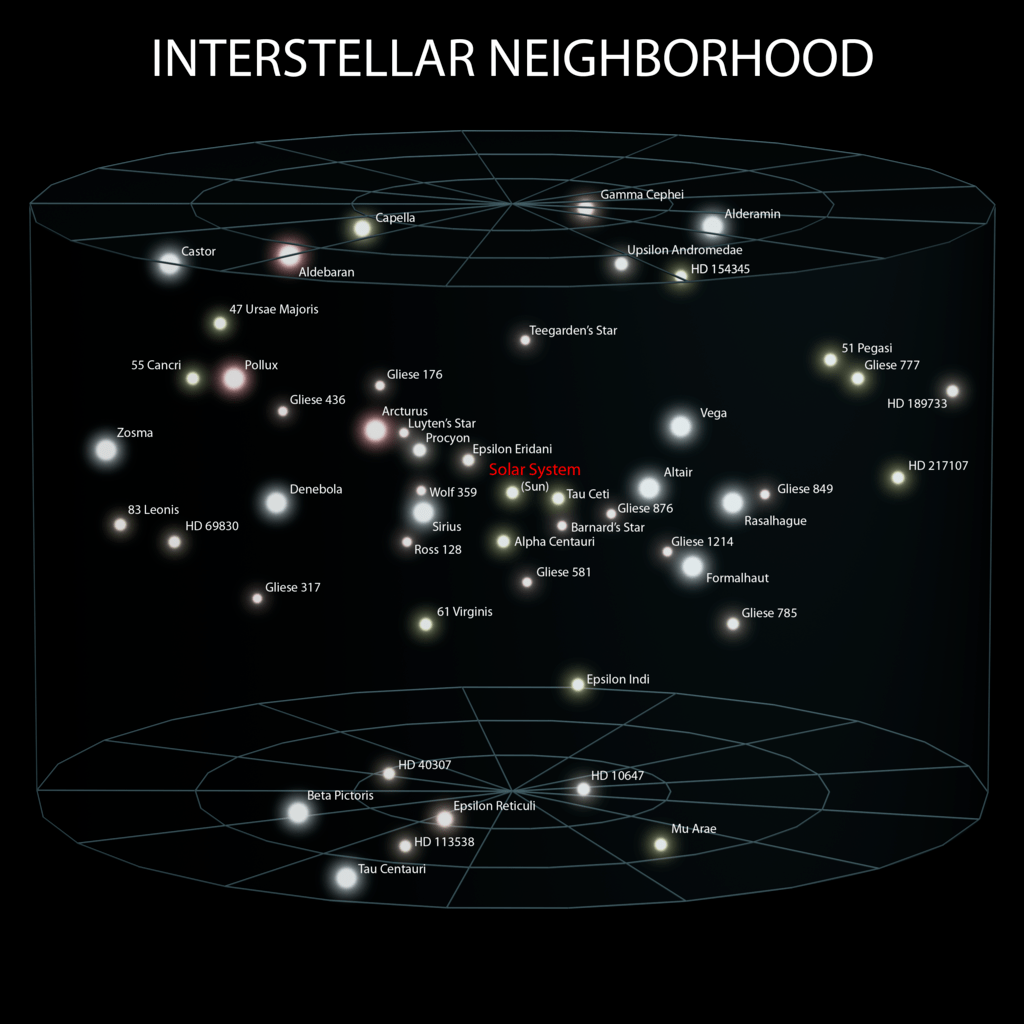
In the early 21st-century, we’ve successfully mapped out practically all the stars in our neighborhood in three-dimensional space. The closest stars to us don’t always align with the stars we can see, as what’s visible is determined by a combination of distance and intrinsic brightness, but all stars beyond the Sun are at a much, much greater distance than anything within our Solar System. The Alpha/Proxima Centauri system is a trinary, and has the three closest stars to our Sun at present; Barnard’s star is the fourth closest, and is the nearest singlet star system to our own.
What is up for debate, however, is the precise question of “how far away” is Proxima Centauri right now, and “when” are we seeing Proxima Centauri as it was? What we know is that the light has arrived from Proxima Centauri after journeying through the interstellar space separating its stellar system from our own. However, because:
- the Sun is in motion around the Milky Way,
- Proxima Centauri is in motion around the Milky Way,
- and those two stars — like any pair of two stars — are in motion relative to one another,
that necessarily means that the distance separating them will change over time. Over the light-travel time of 4.24 years, the amount of time it takes a light signal to traverse that interstellar distance, the distance separating Proxima Centauri and ourselves will have changed.
If Proxima Centaur moves toward us, the distance separating us will decrease, meaning that the “distance” we measure from the light that’s arriving now (that was emitted 4.24 years ago) will only be correct up to a point: up to the amount that Proxima Centauri has drifted closer to us during the light-travel-time from when the light we’re seeing now was emitted. Similarly, a nearby star like Wolf 359 that’s moving away from us will have the distance separating us increase over the 7.86 years that it takes light to travel from there to here. As objects move relative to us through space, we can only see where the object was when that signal was emitted, not where it is at this present moment in time.
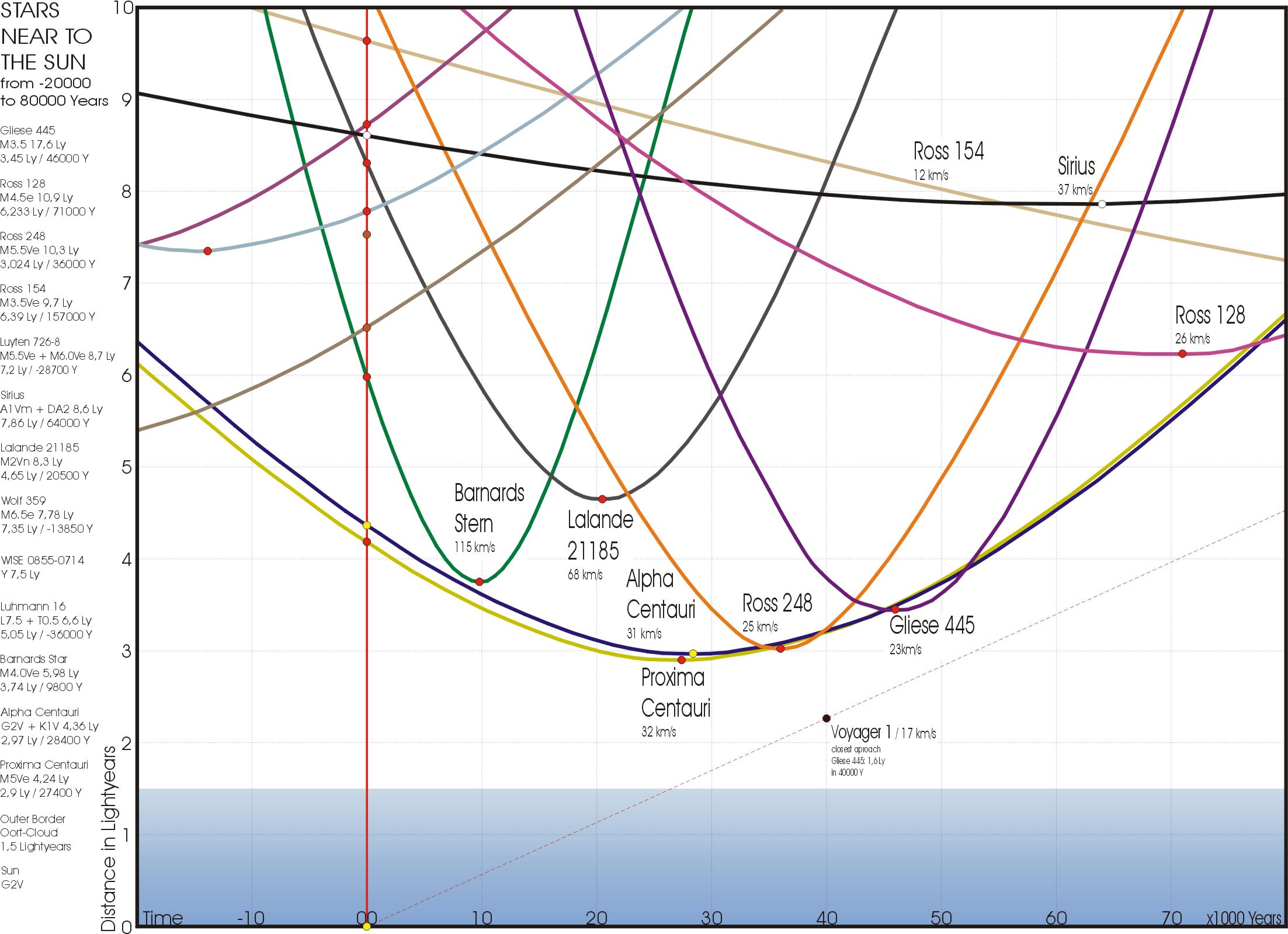
Although the Alpha-and-Proxima Centauri systems are presently the closest star systems to Earth, they weren’t always, and won’t be at various points in the future. In fact, if we’re willing to wait even longer periods of time, stars will pass much closer to Earth than Alpha and Proxima Centauri ever will. This is because all of the stars are in three-dimensional motion with respect to the galactic center and to our Sun, and hence they move farther from us or closer to us over time, dependent on the relative velocities.
Of course, this is something we all have assimilated subconsciously into our minds. If you’re playing a team sport where you need to pass, kick, or throw a ball to a teammate — for example, soccer, basketball, baseball, etc. — you don’t aim the ball for where your teammate is right now. Instead, you aim the ball at where your teammate is going to be when the ball arrives: you anticipate your teammate’s expected motion, and take into account the time it takes the ball to go from here-to-there as well as the time it takes your teammate to cover the distance from where they are now to where they’ll be when the ball arrives.
This happens for all sorts of signals, including two very important ones: light (electromagnetic) signals and gravitational wave signals. Like light, gravitational wave signals also travel at c, or 299,792,458 m/s, because the speed of gravity equals the speed of light, exactly. Because gravitational wave detectors like LIGO Hanford, LIGO Livingston, Virgo, and KAGRA are all at different locations on Earth, there are slight time delays between when the signals arrive in the various detectors. Understanding those waves, and being able to use Einstein’s relativity to account for the arrival time differences at different locations, is key to pinpointing where those gravitational wave signals originate from.
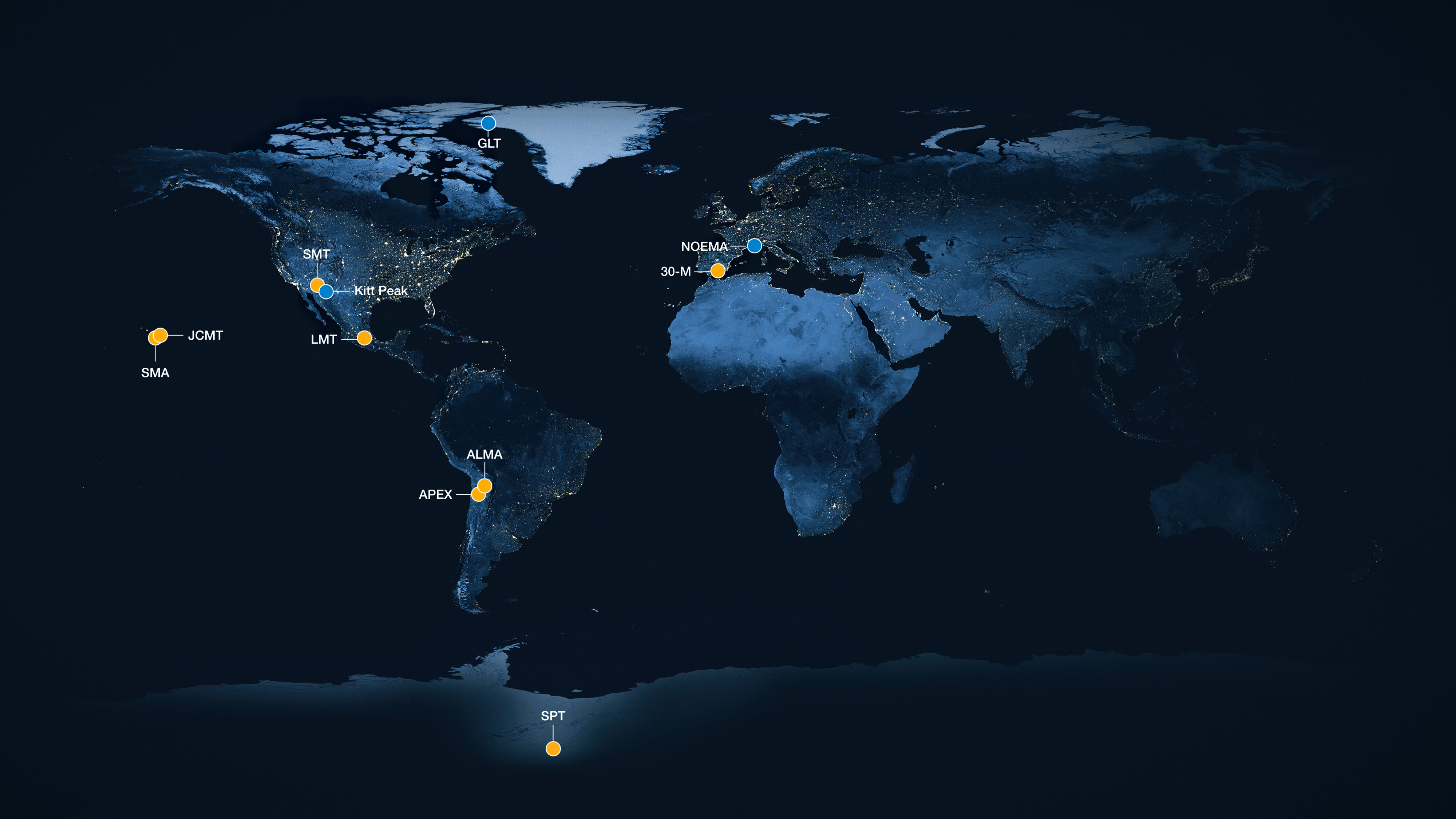
A global map showing the radio observatories that form the Event Horizon Telescope (EHT) network used to image the Milky Way’s central black hole, Sagittarius A*. The telescopes highlighted in yellow were part of the EHT network during the observations of Sagittarius A* in 2017. These include the Atacama Large Millimeter/submillimeter Array (ALMA), the Atacama Pathfinder EXperiment (APEX), IRAM 30-meter telescope, James Clark Maxwell Telescope (JCMT), Large Millimeter Telescope (LMT), Submillimeter Array (SMA), Submillimeter Telescope (SMT) and South Pole Telescope (SPT). They all observed the same black hole simultaneously, with the ability to synchronize those separate measurements key to reconstructing the black hole’s image.
ESO/M. Kornmesser
Similarly, when we observe the same object with multiple different radio telescopes on Earth, it’s only by accounting for the arrival time difference in the signals to those various locations that we can map out what was going on in that signal-emitting object at the time those signals were emitted; this is how we constructed our images of a black hole’s event horizon using the Event Horizon Telescope. Only by using relativity, and accounting for:
- the finite speed of light,
- the time delay of light (or gravitational waves) in traveling from the emitting source to the observer,
- and the changing distances between the source and the observer over the duration of the signal’s travel-time,
can we accurately map out “when” and “where” distant objects are.
There’s one more factor that needs to be taken into account on the largest of cosmic scales, including for the cosmic measurements of the event horizon of the black hole at the center of galaxy Messier 87, and that is the expansion of the Universe. When a soccer player runs downfield in anticipation of the ball being passed to them, the goal is to have the ball arrive where the player will be in the future, but that mental calculation is familiar to us, intuitively, because the soccer field itself is static and unchanging. What if, instead, the field itself was expanding?
Although that might sound absurd for soccer, when it comes to the expanding Universe and our observations of distant galaxies beyond our own Local Group, that’s precisely what’s going on.
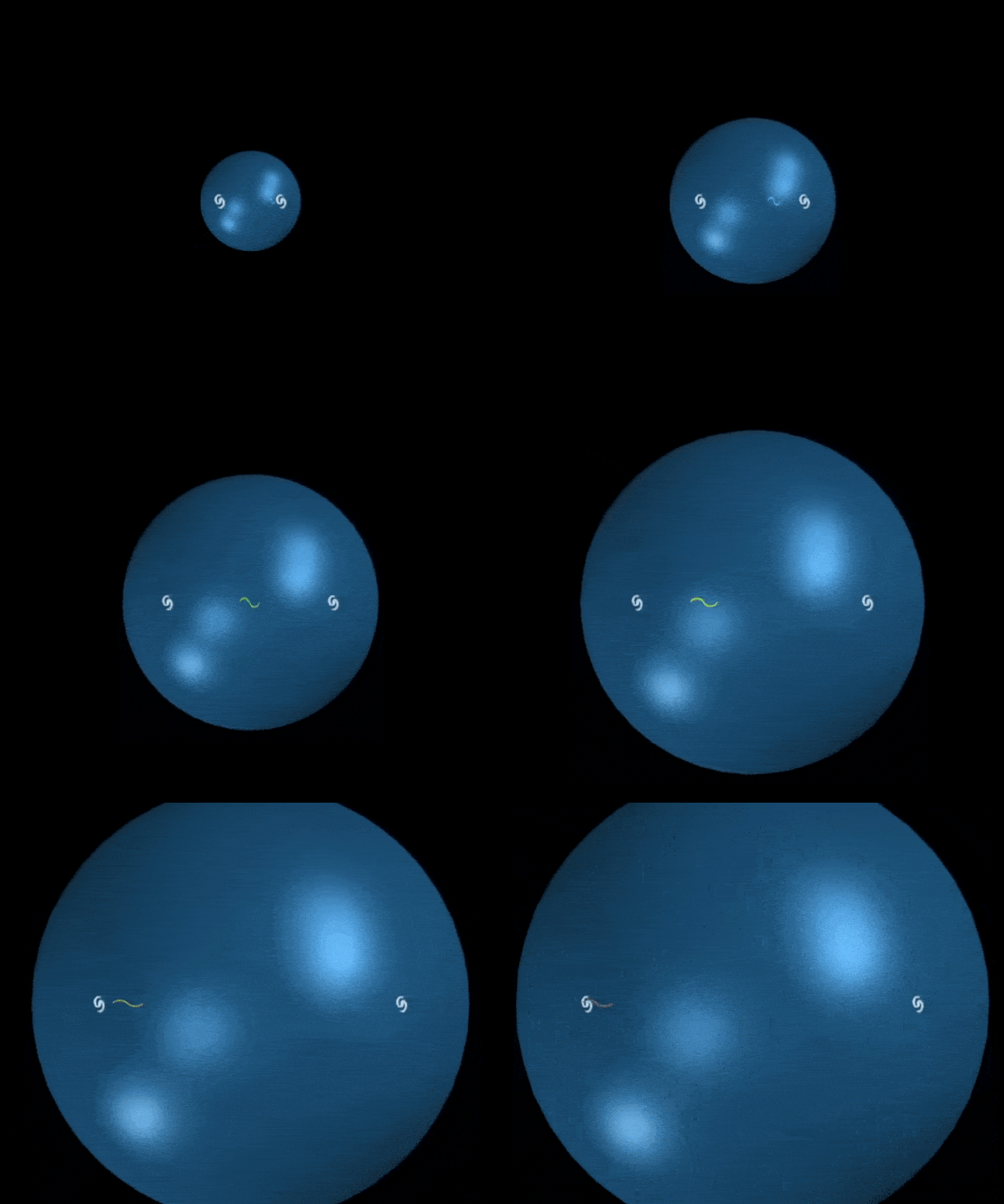
This simplified animation shows how light redshifts and how distances between unbound objects change over time in the expanding Universe. Note that the objects start off closer than the amount of time it takes light to travel between them, the light redshifts due to the expansion of space, and the two galaxies wind up much farther apart than the light-travel path taken by the photon exchanged between them.
Just as objects can move through space relative to one another, and continue to move even as a signal travels in transmission from one to the other, the fabric of space, too, can expand. This extra effect, above and beyond everything else already discussed, winds up being the dominant factor for all but the nearest galaxies in the Universe, leading to a profound difference between:
- the initial distance (in light-years) between the source and the (eventual) observer at the moment of signal emission,
- the light-travel-time (in years) between the source and the observer over the course of the signal being in flight,
- and the final distance (in light-years) between the (original) emitting source and the observer (who’s just now receiving the signal) at the moment of observation.
For example, if we look at an object that we’re seeing as it was 100 million years ago, where the light that’s arriving now has been traveling for 100 million years, we’d find that the distance separating the source and the observer was only 99 million light-years when the light was first emitted, and the separation distance now, when the signal is arriving, is more like 101 million light-years. This effect gets magnified the farther away an object is. Light that arrived after a journey of 1 billion years now corresponds to an object 1.036 billion light-years away; light that arrived after a journey of 10 billion years corresponds to an object 16.03 billion light-years away, and light arriving from the most distant known galaxy at present — MoM-z14 — arrived after a journey of 13.53 billion years, and is now an impressive 33.8 billion light-years away.
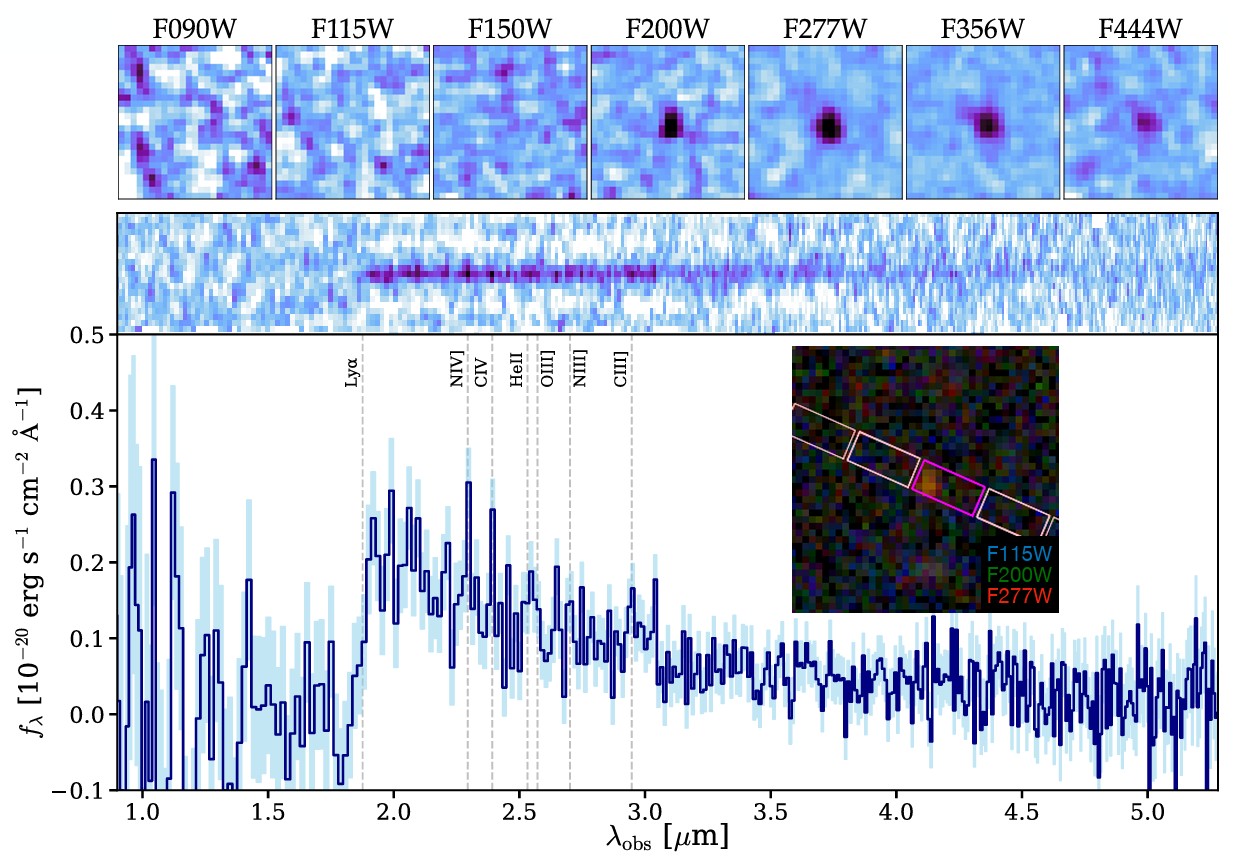
This figure shows the NIRCam (top) and NIRSpec (bottom) data for now-confirmed galaxy MoM-z14: the most distant galaxy known to date as of May 2025. Completely invisible at wavelengths of 1.5 microns and below, its light is stretched by the expansion of the Universe. Emission features of various ionized atoms can be seen in the spectrum, below, as well as the significant and strong Lyman break feature.
All of this is to say that what Einstein taught us more than 100 years ago is just as relevant as ever: space, time, distance, durations, and answers to questions of “where” and “when” are all relative. Specifically, they’re relative to points or events in spacetime that correspond to specific locations (in three-dimensional space) and moments (in time) when you’re moving in a particular reference frame (i.e., with a three-dimensional velocity). They’re relative to how the source and the observer move relative to one another, and whether the spacetime governing the Universe is expanding, contracting, or remaining constant and unchanged between those two all-important points.
Only by understanding all of it and being very clear about what we mean can we hope to answer questions like “when” and “where?” You will often see astronomers announcing things like “this object is 7 billion light-years away” when it, in fact, isn’t; they mean that the light from the object has traveled for 7 billion years from the moment it was emitted before it arrives in our telescopes and their instruments right now. In reality, because the Universe has been expanding, the source and observer were closer than 7 billion light-years when that light was first emitted, the light travels for a duration of 7 billion years, and then today, when the light arrives, those objects are separated by more than 7 billion light-years. We have to account for all of these effects — classically, relativistically, and even in the context of general relativity — if we accurately want to answer what seem like two of the simplest questions one can ask:
- where, exactly, an object is at the present time,
- and how far ago, in the past, we’re seeing it as it was.
First Appeared on
Source link





Leave feedback about this