

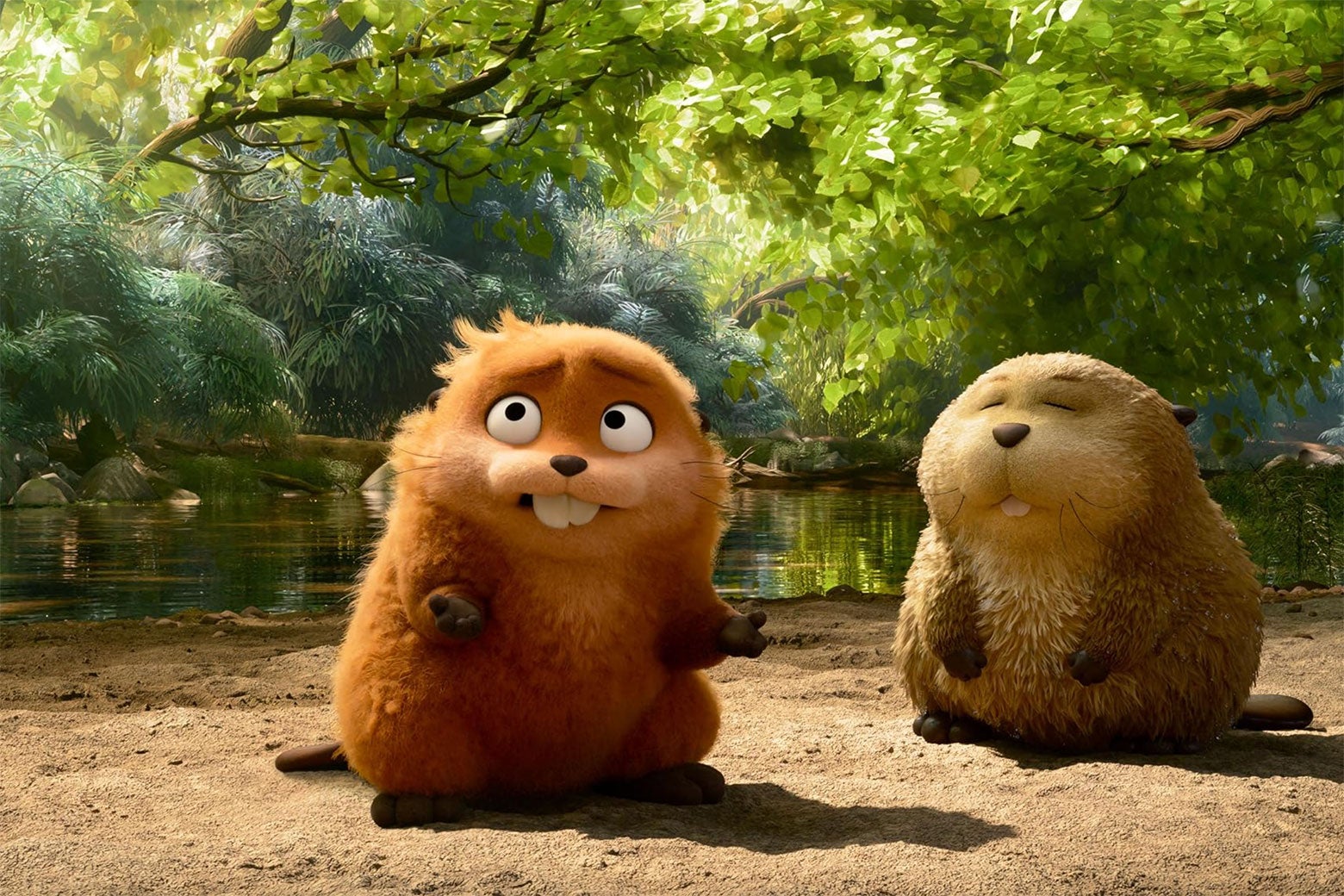
Pixar’s movies usually provoke boisterous laughter and wistful tears, maybe the occasional muffled sob. But Hoppers is the first time I can remember an outright gasp. There weren’t a lot of people in my weekday matinee, but there were enough to generate a collective and audible intake of air.
I won’t give away the moment that generated that reaction, but suffice it to say that it involves a brisk and slightly brutal demonstration of the mercilessness of the natural world. Nineteen-year-old Mabel Tanaka (voiced by Piper Curda) has always used nature as a means of calming her volatile emotions, decompressing in the silence of the placid pond near her house with her beloved grandmother (Karen Huie) by her side. But as Mabel grows from a sullen teen to a young adult, her coping mechanisms fall away one by one. Her parents move away, her grandmother dies, and the pond, the last stable place in her life, is deserted by the wildlife that once gave her so much comfort, and scheduled to be paved over for a new highway.
Through a series of coincidences that the screenplay, by Jesse Andrews, never requires you to take seriously, Mabel discovers that her college biology professor (Kathy Najimy) has developed a technology that allows humans to transfer their consciousness into mechanical animals—animals like the beaver, a keystone species whose dams create the ecosystem that other forms of pond life inhabit. So she jacks into a mechano-beaver and sets out to solve the mystery of where all the pond’s critters have gone and how they might be induced to return.
The world Mabel discovers in her borrowed beaver body is not the peaceful one she’d imagined. True, the animals live in relative peace and harmony. But they’re also resigned to aspects of existence that humans spend most of their conscious hours trying to deny. When she sees a bear trying to swallow a sleepy beaver, she immediately rushes to stop the bloodshed. But both the bear (Melissa Villaseñor) and its intended prey (Eduardo Franco) object to her intervention, because an animal that needs to eat should be allowed to eat, and one that’s caught should submit to being a meal.
As that exchange reveals, the animals all speak the same tongue—call it their lingua fauna—and share the same culture, at least within types. Mammals hang with mammals, insects with insects, and their kingdoms are literal as well as taxonomic. The mammals are ruled by George (Bobby Moynihan), a beaver with a tiny golden crown and a cheery disposition, so cheery that he’s never thought to question why their former home has suddenly become impossible to inhabit. Knowing the depths of human trickery, Mabel is suspicious of the strange new noise that has driven the animals away, and she quickly divines the source: a cell-tower-like metal tree erected by Mayor Jerry (Jon Hamm), who is counting on the Beaverton Beltway to clinch his bid for reelection.
The setup is familiar, especially if you’ve seen Isao Takahata’s Pom Poko, the Studio Ghibli movie in which a band of shape-shifting raccoon dogs take on human form in order to prevent developers from paving over their homes—or even DreamWorks’ 2024 The Wild Robot, which also followed a mechanical outsider who learns the language of the wilderness before uniting it against its invaders. And it certainly lines up with Pixar’s favorite trope, unveiling a world that exists inside or next to our world. But Hoppers feels a little less sanded-down than most of the studio’s recent movies, less content to coast on formula and hew to expectations about what Pixar movies do and don’t do.
Daniel Chong, who worked at Pixar early in his career but left to create the Cartoon Network series We Bare Bears, isn’t the first director to try to nudge the studio in a different direction. But Hoppers might be a sign that the tide is finally starting to turn. Pete Docter, Pixar’s chief creative officer, recently confirmed earlier reports that the studio reworked 2025’s Elio to remove suggestions that its young hero was gay because it might have forced parents into uncomfortable conversations with their children. (“We’re making a movie, not hundreds of millions of dollars of therapy,” said the director of Inside Out.) Like Inside Out 2’s Riley, who nurses a platonic-but-maybe-not fixation on a hockey teammate, Mabel seems to be designed to allow viewers to make their own inferences about her identity—she’s introduced riding her skateboard to the strains of Bikini Kill’s “Rebel Girl,” a queer punk anthem, albeit one that has shed some of its specificity in the past few decades.
The adjustments are small, but they add up. An edgy joke here, like a swan that dares another creature to “flap around and find out.” A plot that passes through absurdity to outright silliness, harking back to the explosive anarchy of Looney Tunes. And then there’s that frankness about death, so often sentimentalized in feature animation, here treated as the unexpected punch line of an especially long joke. It’s not enough to lift Hoppers into the ranks of Pixar’s best movies, or even to leapfrog Turning Red as the best of its post-Coco doldrums, although Hoppers did score the best box-office opening for a Pixar original in nearly a decade. But it suggests that the studio doesn’t have to just keep churning out slightly lesser versions of its past glories if it will only open up the doors and let more fresh blood in.
First Appeared on
Source link


Leave feedback about this